

Scientists are rethinking how to detect alien life by focusing on planets vastly different from Earth.
Instead of searching for familiar biosignatures like oxygen, they’re investigating methyl halides – gases produced by microbes on Earth that could be more easily detected in the thick hydrogen atmospheres of Hycean planets. The James Webb Space Telescope (JWST) could spot these gases in just hours, making the search for extraterrestrial life more efficient than ever.
A New Path to Finding Alien Life
Scientists have discovered a new way to search for life on distant planets, focusing on worlds that are very different from Earth and on gases that have been largely overlooked in the hunt for extraterrestrial life.
In a recent Astrophysical Journal Letters study, researchers from the University of California, Riverside, highlight a group of gases that could serve as potential biosignatures. These gases, known as methyl halides, might be detectable in the atmospheres of exoplanets – planets beyond our solar system – using the James Webb Space Telescope (JWST).
Methyl halides are chemical compounds made up of a methyl group (one carbon and three hydrogen atoms) attached to a halogen atom, such as chlorine or bromine. On Earth, they are primarily produced by bacteria, marine algae, fungi, and certain plants.
Biosignatures are chemical, physical, or biological indicators that suggest the presence of life. These can include specific gases in a planet’s atmosphere, organic molecules, or patterns in light that hint at biological activity. Scientists search for biosignatures on exoplanets to determine whether life might exist beyond Earth.
Hycean Planets: A Better Target for Detection
A major challenge in detecting these gases is that Earth-like exoplanets are too small and dim for JWST to observe in detail.
Instead, JWST would have to aim for larger exoplanets orbiting small red stars, with deep global oceans and thick hydrogen atmospheres called Hycean planets. Humans could not breathe or survive on these worlds, but certain microbes might thrive in such environments.
A Unique Biosignature Advantage
“Unlike an Earth-like planet, where atmospheric noise and telescope limitations make it difficult to detect biosignatures, Hycean planets offer a much clearer signal,” said Eddie Schwieterman, UCR astrobiologist and paper co-author.
The researchers believe that looking for methyl halides on Hycean worlds is an optimal strategy for the present moment in time.
“Oxygen is currently difficult or impossible to detect on an Earth-like planet. However, methyl halides on Hycean worlds offer a unique opportunity for detection with existing technology,” said Michaela Leung, UCR planetary scientist and first author of the paper.
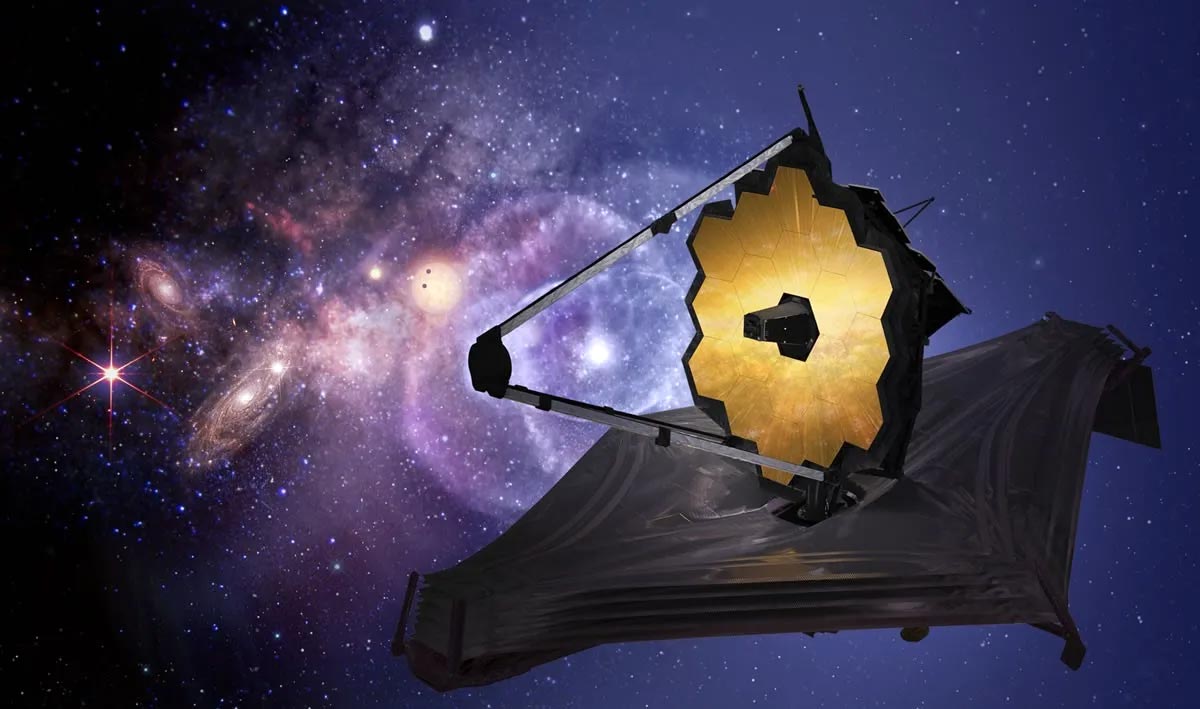
Speed and Efficiency with JWST
Additionally, finding these gases could be easier than looking for other types of biosignature gases indicative of life.
“One of the great benefits of looking for methyl halides is you could potentially find them in as few as 13 hours with James Webb. That is similar or lower, by a lot, to how much telescope time you’d need to find gases like oxygen or methane,” Leung said. “Less time with the telescope means it’s less expensive.”
Could Life Thrive in Extreme Environments?
Though life forms do produce methyl halides on Earth, the gas is found in low concentrations in our atmosphere. Because Hycean planets have such a different atmospheric makeup and are orbiting a different kind of star, the gases could accumulate in their atmospheres and be detectable from light-years away.
“These microbes, if we found them, would be anaerobic. They’d be adapted to a very different type of environment, and we can’t really conceive of what that looks like, except to say that these gases are a plausible output from their metabolism,” Schwieterman said.
Building on Past Research
The study builds on previous research investigating different biosignature gases, including dimethyl sulfide, another potential sign of life. However, methyl halides appear particularly promising because of their strong absorption features in infrared light as well as their potential for high accumulation in a hydrogen-dominated atmosphere.
While James Webb is currently the best tool for this search, future telescopes, like the proposed European LIFE mission, could make detecting these gases even easier. If LIFE launches in the 2040s as proposed, it could confirm the presence of these biosignatures in less than a day.
“If we start finding methyl halides on multiple planets, it would suggest that microbial life is common across the universe,” Leung said. “That would reshape our understanding of life’s distribution and the processes that lead to the origins of life.”
Expanding the Search for Life
Moving forward, the researchers plan to expand this work on other planetary types and other gases. For example, they’ve done measurements of gases emanating from the Salton Sea, which appears to produce halogenated gases, such as chloroform. “We want to get measurements of other things produced in extreme environments on Earth, which could be more common elsewhere,” Schwieterman said.
The Ultimate Question: Are We Alone?
Even as researchers push the boundaries of detection, they acknowledge that direct sampling of exoplanet atmospheres remains beyond current capabilities. However, advances in telescope technology and exoplanet research could one day bring us closer to answering one of humanity’s biggest questions: Are we alone?
“Humans are not going to visit an exoplanet anytime soon,” Schwieterman said. “But knowing where to look, and what to look for, could be the first step in finding life beyond Earth.”
Reference: “Examining the Potential for Methyl Halide Accumulation and Detectability in Possible Hycean-type Atmospheres” by Michaela Leung, Shang-Min Tsai, Edward W. Schwieterman, Daniel Angerhausen and Janina Hansen, 11 March 2025, The Astrophysical Journal Letters.
DOI: 10.3847/2041-8213/adb558
Never miss a breakthrough: Join the SciTechDaily newsletter.
Follow us on Google and Google News.
1 Comment
1.
NASA’s Web Can Detect Alien Life in Hours – Here’s How
On a potential hyoid world where atmospheric methyl halide gases can be detected, scientists are rethinking how to detect extraterrestrial life, focusing on planets that are significantly different from Earth.
Instead of looking for familiar biosignals such as oxygen, we are investigating methyl halide, a gas produced by the [1] microorganisms on Earth.
The James Webb Space Telescope (JWST) can detect these gases in just a few hours, making finding extraterrestrial life more efficient than ever.
_[1]If there is life on the outside world, we need to find a mapping point to a similar environment where life exists on Earth.
1-1.), which has been overlooked so far, has begun to focus on gases that have been largely overlooked in the search for worlds and extraterrestrial life that are very different from Earth.
Recent work highlights groups of gases that could serve as potential biosignals. The gas, known as methyl halide, can be detected in the atmosphere of exoplanets, which are exoplanets, using the James Webb Space Telescope (JWST). Hmm.
Life in the universe is believed to be very widely distributed as long as there is a collision between water droplets and electric charges. Life is very common in space. If I guess from my msbase.qpeoms theory, there could be a myriad of things that are almost like life on Earth. Uh-huh.
According to the latest paper,
Microlighting: In the new theory of the origin of life, life may not have begun with dramatic lightning strikes at the ocean. Instead, tiny “microlightning” sparks generated by crashing waves and water droplets from waterfalls may have played a significant role.
According to a new study by Stanford University, spraying water on a gas mixture similar to Earth’s early atmosphere can create organic molecules that contain carbon-nitrogen bonds. These molecules include uracil, the basic building blocks of DNA and RNA.
Source 1.
https://scitechdaily.com/tiny-sparks-big-discovery-could-water-droplets-have-created-life/
≈≈≈========
1-1.
A New Way to Find Alien Life
Scientists have discovered a new way to find life on distant planets. It focuses on a world that is very different from Earth and gases that have been largely overlooked in the search for extraterrestrial life.
Recent work highlights groups of gases that could serve as potential biosignals. The gas, known as methyl halide, can be detected in the atmosphere of exoplanets, which are exoplanets, using the James Webb Space Telescope (JWST).
Methyl halide is a compound in which a methyl group (one carbon and three hydrogen atoms) is attached to a halogen atom such as chlorine or bromine. On Earth, it is mainly produced by bacteria, marine algae, fungi and certain plants.
Biological signatures are chemical, physical, or biological indicators that suggest the existence of life. They may include patterns of light that suggest specific gas, organic molecules, or biological activity in a planetary atmosphere. Scientists search for biological signatures on exoplanets to see if life could exist beyond Earth.
2.Hysian Planet: A Better Detection Target
A major challenge in detecting these gases is that Earth-like exoplanets are too small and dark to be observed in detail by JWST.
Instead, the JWST had to target larger exoplanets orbiting small red stars with deep oceans and thick hydrogen atmospheres around the world. Humans have not been able to breathe or survive in these worlds, but certain microorganisms can thrive in these environments.
2-1. Advantages of unique biosignature
Unlike Earth-like planets, where it is difficult to detect biosignals due to atmospheric noise and limitations in telescopes, Hyce planets provide much clearer signals.
Researchers believe that finding methyl halides in the high-body world is currently the optimal strategy.
Oxygen is currently difficult or impossible to detect on Earth-like planets.
ㅡㅡㅡㅡㅡㅡㅡㅡㅡㅡ
Source 1.
https://scitechdaily.com/nasas-webb-could-detect-alien-life-in-hours-heres-how/