
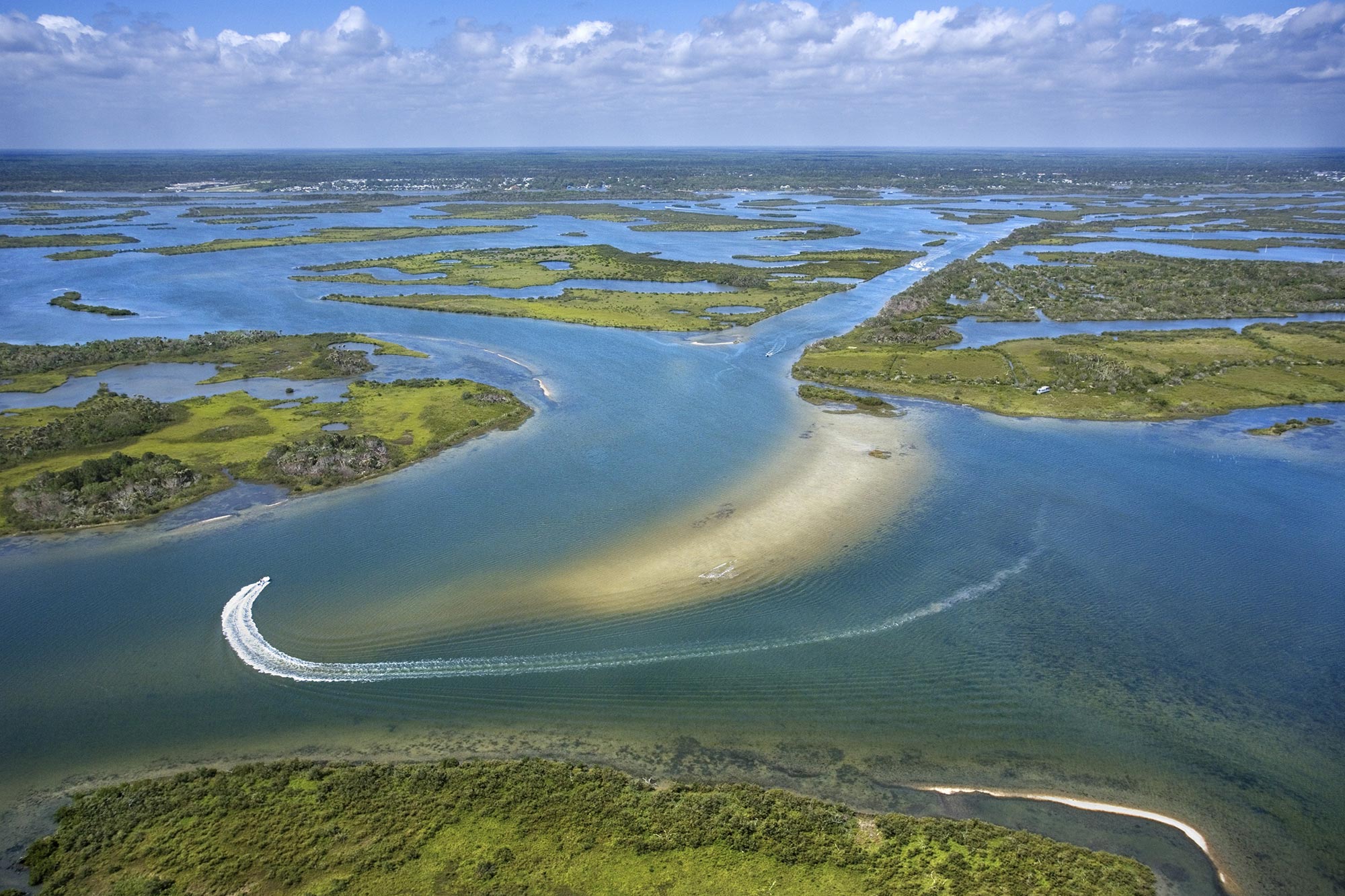
New research reveals that enhancing salt marshes in front of seawalls not only protects coastlines effectively but also reduces costs significantly, making it an economically viable option.
Even small marshes can offer substantial protection, challenging prior assumptions about their value in urban settings. Further validation through real-world applications, like those in Salem, Massachusetts, demonstrates potential for widespread adoption.
Rising Seas and Coastal Defense
An MIT study reveals that enhancing salt marshes in front of seawalls not only protects coastlines effectively but also reduces costs significantly, making it an economically viable option. Even small marshes can offer substantial protection, challenging prior assumptions about their value in urban settings. Further validation through real-world applications, like those in Salem, Massachusetts, demonstrates potential for widespread adoption.
Coastal houses being swept into the sea due to erosion and powerful storm surges are becoming a more frequent sight as climate change drives rising sea levels and stronger storms. In the U.S. alone, coastal storms caused $165 billion in damage in 2022.
A new MIT study suggests that restoring and enhancing salt marshes in front of seawalls can provide significant protection for coastlines, and at a cost that makes this approach feasible.
Economically Justifiable Marsh Restoration
Published today (October 23) in the journal Communications Earth and Environment, the study was conducted by MIT graduate student Ernie I. H. Lee and Heidi Nepf, a professor of civil and environmental engineering. Nepf says that the findings show that restoring coastal marshes “is not just something that would be nice to do, but it’s actually economically justifiable.” The researchers found that, among other things, the wave-dampening ability of salt marshes allows seawalls behind them to be built lower, reducing construction costs while still offering strong protection against storms.
“One of the other exciting things that the study really brings to light,” Nepf says, “is that you don’t need a huge marsh to get a good effect. It could be a relatively short marsh, just tens of meters wide, that can give you benefit.” That makes her hopeful, Nepf says, that this information might be applied in places where planners may have thought saving a smaller marsh was not worth the expense. “We show that it can make enough of a difference to be financially viable,” she says.
Urban Settings and Marsh Efficiency
While other studies have previously shown the benefits of natural marshes in attenuating damaging storms, Lee says that such studies “mainly focus on landscapes that have a wide marsh on the order of hundreds of meters. But we want to show that it also applies in urban settings where not as much marsh land is available, especially since in these places existing gray infrastructure (seawalls) tends to already be in place.”
The study was based on computer modeling of waves propagating over different shore profiles, using the morphology of various salt marsh plants — the height and stiffness of the plants, and their spatial density — rather than an empirical drag coefficient. “It’s a physically based model of plant-wave interaction, which allowed us to look at the influence of plant species and changes in morphology across seasons,” without having to go out and calibrate the vegetation drag coefficient with field measurements for each different condition, Nepf says.
The researchers based their benefit-cost analysis on a simple metric: To protect a certain length of shoreline, how much could the height of a given seawall be reduced if it were accompanied by a given amount of marsh? Other ways of assessing the value, such as including the value of real estate that might be damaged by a given amount of flooding, “vary a lot depending on how you value the assets if a flood happens,” Lee says. “We use a more concrete value to quantify the benefits of salt marshes, which is the equivalent height of seawall you would need to deliver the same protection value.”
Real-World Applications and Future Prospects
They used models of a variety of plants, reflecting differences in height and the stiffness across different seasons. They found a twofold variation in the various plants’ effectiveness in attenuating waves, but all provided a useful benefit.
To demonstrate the details in a real-world example and help to validate the simulations, Nepf and Lee studied local salt marshes in Salem, Massachusetts, where projects are already underway to try to restore marshes that had been degraded. Including the specific example provided a template for others, Nepf says. In Salem, their model showed that a healthy salt marsh could offset the need for an additional seawall height of 1.7 meters (about 5.5 feet), based on satisfying a rate of wave overtopping that was set for the safety of pedestrians.
However, the real-world data needed to model a marsh, including maps of salt marsh species, plant height, and shoots per bed area, are “very labor-intensive” to put together, Nepf says. Lee is now developing a method to use drone imaging and machine learning to facilitate this mapmaking. Nepf says this will enable researchers or planners to evaluate a given area of marshland and say, “How much is this marsh worth in terms of its ability to reduce flooding?”
Integrating Technology and Policy
The White House Office of Information and Regulatory Affairs recently released guidance for assessing the value of ecosystem services in planning of federal projects, Nepf explains. “But in many scenarios, it lacks specific methods for quantifying value, and this study is meeting that need,” she says.
The Federal Emergency Management Agency also has a benefit-cost analysis (BCA) toolkit, Lee notes. “They have guidelines on how to quantify each of the environmental services, and one of the novelties of this paper is quantifying the cost and the protection value of marshes. This is one of the applications that policymakers can consider on how to quantify the environmental service values of marshes,” he says.
The software that environmental engineers can apply to specific sites has been made available online for free on GitHub. “It’s a one-dimensional model accessible by a standard consulting firm,” Nepf says.
“This paper presents a practical tool for translating the wave attenuation capabilities of marshes into economic values, which could assist decision-makers in the adaptation of marshes for nature-based coastal defense,” says Xioaxia Zhang, a professor at Shenzen University in China who was not involved in this work. “The results indicate that salt marshes are not only environmentally beneficial but also cost-effective.”
Reference: “Marsh restoration in front of seawalls is an economically justified nature-based solution for coastal protection” by Ernie I. H. Lee, and Heidi Nepf, 23 October 2024, Communications Earth & Environment.
DOI: 10.1038/s43247-024-01753-5
Lee received support for this work from the Schoettler Scholarship Fund, administered by the MIT Department of Civil and Environmental Engineering.
Never miss a breakthrough: Join the SciTechDaily newsletter.
Follow us on Google and Google News.