
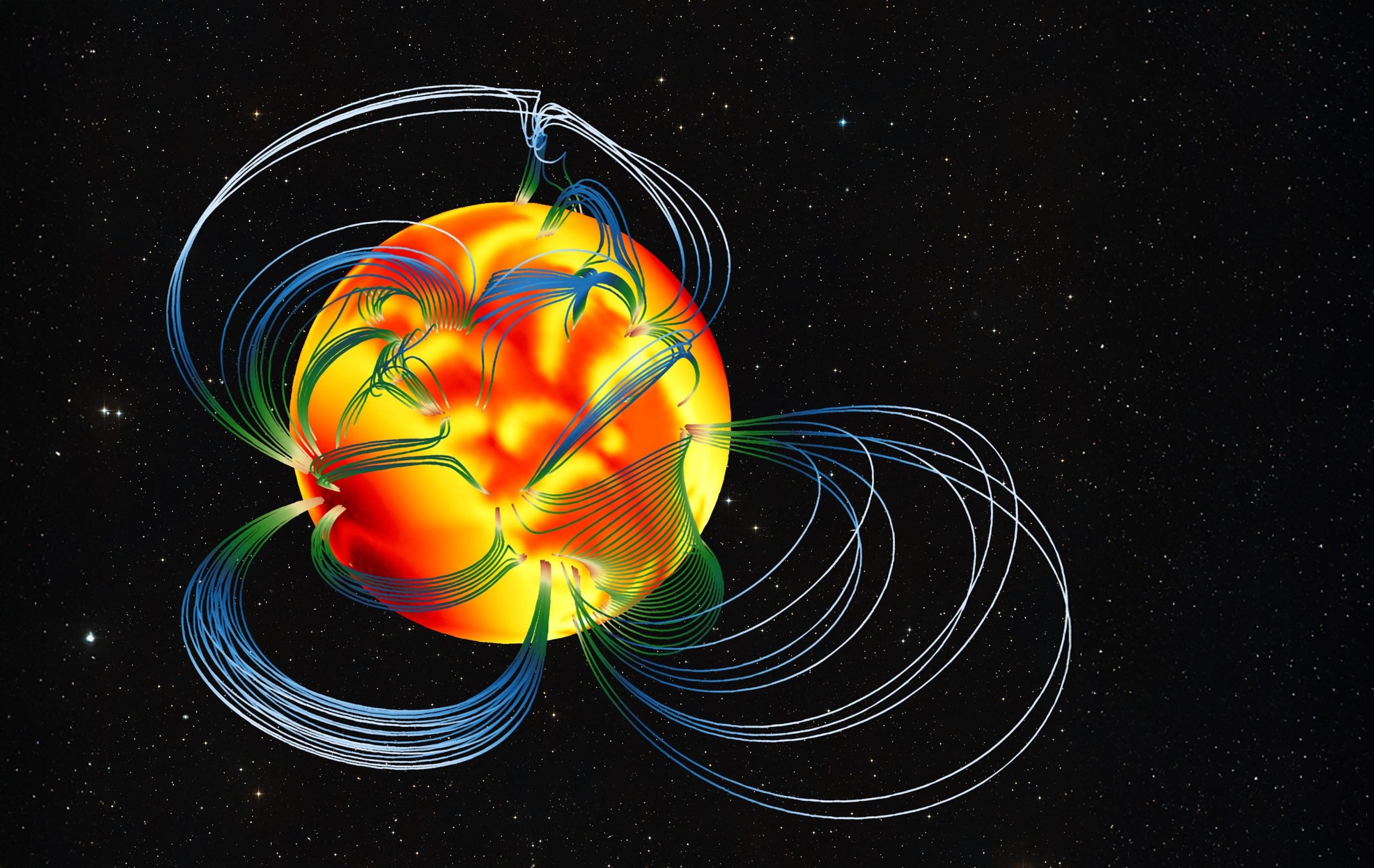
A breakthrough simulation reveals how magnetars form and evolve, solving a key mystery about their magnetic origins.
Magnetars are a rare type of neutron star with the strongest magnetic fields in the Universe. These incredibly dense objects play a key role in some of the most extreme cosmic events, including hypernovae, fast radio bursts, and gamma-ray bursts. Despite their significance, their origins have remained a mystery. By using advanced numerical simulations, researchers have now recreated the process that forms and shapes these magnetic giants. This breakthrough, offering new insights into magnetars, has been published in Nature Astronomy.
Magnetars: The Universe’s Magnetic Titans
At the end of their lives, stars at least eight times the mass of the Sun undergo a dramatic collapse due to gravity. This collapse triggers a supernova explosion, ejecting the outer layers of the star while the core contracts violently. What remains is a neutron star — the densest known object in the Universe. Just a teaspoon of its material would weigh a staggering billion tons, equivalent to 100,000 Eiffel Towers.
The neutron star simulated in this study reproduces the observational characteristics of the so-called weak-field magnetars.
While most neutron stars are detected through radio waves, some produce intense bursts of X-rays and gamma rays. These highly magnetic neutron stars, known as magnetars, generate emissions believed to result from the release of their immense magnetic energy — fields a million billion times stronger than Earth’s.
The Mystery of Magnetar Origin
Since the magnetic fields of magnetars play a crucial role in the luminous phenomena they are associated with, scientists are working to understand their origin. Several theories have been proposed, but the most promising suggests magnetic field generation through dynamo action in the proto-neutron star, just seconds after the explosion begins.
‘‘Dynamo action enables a conducting fluid, such as a plasma, with sufficiently complex motions, to amplify and maintain its own magnetic fields against the diffusive effects, which weaken them. This amplification effect is undoubtedly at the origin of the majority of astrophysical magnetic fields, such as those of the Sun or Earth,’’ explains Paul Barrère, a postdoctoral researcher in the Department of Astronomy at the UNIGE Faculty of Science, and second author of this study. ‘‘Unlike the others, this theory is supported by a large number of numerical simulations.’’
A New Magnetar Formation Scenario
Many of these dynamos require rapid rotation of the progenitor star’s core to be effective. However, these rotational velocities are poorly understood due to a lack of observations. Paul Barrère and researchers Jérôme Guilet and Raphaël Raynaud from the Department of Astrophysics at CEA Saclay have therefore studied an alternative scenario. It suggests that the proto-neutron star is spun up by some of the matter initially ejected during the supernova, which later falls back onto the star’s surface. ‘‘This renders our new formation scenario independent of the progenitor star rotation,’’ says Paul Barrère.
The favored mechanism to amplify the magnetic field in this proto-neutron star is a specific type of dynamo, known as the Tayler-Spruit dynamo. ‘‘This mechanism feeds off the difference of rotation inside the star and an instability of the magnetic field. This dynamo is well known to researchers working on stars, as it could explain core rotation in stars,’’ explains the researcher.
Simulating Magnetar Evolution
Despite its relevance, this new scenario focuses only on the first few seconds after the supernova, which is very brief compared to the age of the observed magnetars. Collaboration with scientists from the Universities of Newcastle and Leeds, who specialize in neutron star evolution, was therefore crucial to produce the first numerical simulation of the evolution, on a million-year timescale, of a neutron star harboring an initial complex magnetic field produced by the Tayler-Spruit dynamo. ‘‘The combination of our expertise has, for the first time, bridged the gap between our studies of formation in proto-neutron stars and research on the evolution of evolved neutron stars,’’ states Paul Barrère.
The neutron star simulated in this study reproduces the observational characteristics of the so-called weak-field magnetars discovered in 2010. These magnetars have magnetic dipoles that are ten to one hundred times weaker than those of classical magnetars. This study therefore demonstrates that these magnetars are probably formed in neutron protostars accelerated by the accretion of supernova matter in which the Tayler-Spruit dynamo operates.
A Breakthrough in Understanding Magnetars
‘‘Our work represents a major breakthrough in our understanding of magnetars and opens very interesting new perspectives in the study of other dynamo effects. Our results suggest that each dynamo leaves its imprint on the complex magnetic field configuration and therefore on the observed emission from magnetars. While the Tayler-Spruit dynamo is associated with low-field magnetars, we hope to identify in the future the mechanisms associated with the other magnetars,’’ concludes Paul Barrère.
Reference: “A connection between proto-neutron-star Tayler–Spruit dynamos and low-field magnetars” by Andrei Igoshev, Paul Barrère, Raphaël Raynaud, Jérome Guilet, Toby Wood and Rainer Hollerbach, 4 February 2025, Nature Astronomy.
DOI: 10.1038/s41550-025-02477-y
Never miss a breakthrough: Join the SciTechDaily newsletter.
Follow us on Google and Google News.
1 Comment
Thanks your reply was much appreciated and simpler for me to understand than the original article which contained far too much science for a Neanderthal like me unfortunately much depends upon the audience you are trying to attract one thing to consider is that if you are taking to physicists they have probably read the original articles leaving lesser intellects like me searching Google for information that will allow me or people like me to play science
I will however point out that even though I got lost with this and other similar stories I still enjoyed attempting to understand all