
Researchers from the universities of Geneva, Paris, and Barcelona have uncovered strong evidence that the peculiarities seen in sizable star clusters can be explained by supermassive stars.
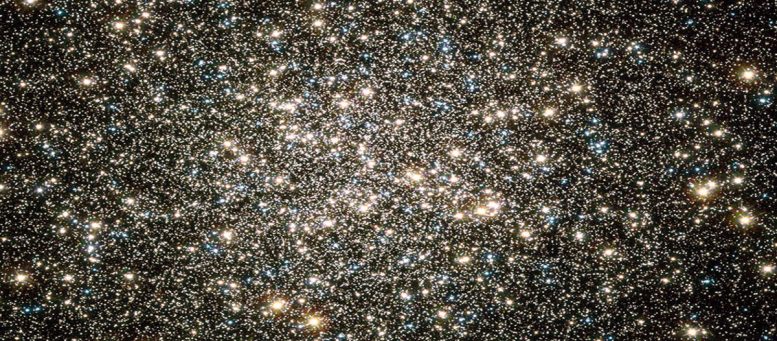
Globular clusters are the universe’s most massive and ancient star groupings, housing up to a million individual stars. These stars, which were born at the same time, possess a distinct chemical makeup, exhibiting anomalies that are not found in any other population of stars.
Understanding this unique characteristic represents a major conundrum in the field of astronomy. Previously conjecturing that supermassive stars might be responsible, researchers from the Universities of Geneva and Barcelona along with the Paris Institute of Astrophysics (affiliated with CNRS and Sorbonne University), believe that they have detected the initial chemical evidence of these stars in globular proto-clusters. These proto-clusters came into existence approximately 440 million years following the Big Bang.
These results, obtained thanks to observations by the James-Webb space telescope, were published in the journal Astronomy and Astrophysics.
Globular clusters are very dense groupings of stars distributed in a sphere, with a radius varying from a dozen to a hundred light years. They can contain up to 1 million stars and are found in all types of galaxies. Ours is home to about 180 of them. One of their great mysteries is the composition of their stars: why is it so varied? For instance, the proportion of oxygen, nitrogen, sodium, and aluminum varies from one star to another. However, they were all born at the same time, within the same cloud of gas. Astrophysicists speak of ‘‘abundance anomalies’.’
Monsters With Very Short Lives
A team from the universities of Geneva (UNIGE) and Barcelona, and the Institut d’Astrophysique de Paris (CNRS and Sorbonne University) has made a new advance in the explanation of this phenomenon. In 2018, it had developed a theoretical model according to which supermassive stars would have «polluted» the original gas cloud during the formation of these clusters, enriching their stars with chemical elements in a heterogeneous manner.
‘‘Today, thanks to the data collected by the James-Webb Space Telescope, we believe we have found a first clue of the presence of these extraordinary stars,’’ explains Corinne Charbonnel, a full professor in the Department of Astronomy at the UNIGE Faculty of Science, and first author of the study.
These celestial monsters are 5 000 to 10 000 times more massive and five times hotter at their center (75 million °C) than the Sun. But proving their existence is complex.
‘‘Globular clusters are between 10 and 13 billion years old, whereas the maximum lifespan of superstars is two million years. They, therefore, disappeared very early from the clusters that are currently observable. Only indirect traces remain,’’ explains Mark Gieles, ICREA professor at the University of Barcelona and co-author of the study.
Revealed by Light
Thanks to the very powerful infrared vision of the James-Webb telescope, the co-authors were able to support their hypothesis. The satellite captured the light emitted by one of the most distant and youngest galaxies known to date in our Universe. Located at about 13.3 billion light-years, GN-z11 is only a few tens of millions of years old. In astronomy, the analysis of the light spectrum of cosmic objects is a key element in determining their characteristics. Here, the light emitted by this galaxy has provided two valuable pieces of information.
‘‘It has been established that it contains very high proportions of nitrogen and a very high density of stars,’’ says Daniel Schaerer, associate professor in the Department of Astronomy at the UNIGE Faculty of Science, and co-author of the study.
This suggests that several globular clusters are forming in this galaxy and that they still harbor an active supermassive star. ‘‘The strong presence of nitrogen can only be explained by the combustion of hydrogen at extremely high temperatures, which only the core of supermassive stars can reach, as shown by the models of Laura Ramirez-Galeano, a Master’s student in our team,’’ explains Corinne Charbonnel.
These new results strengthen the international team’s model. This model is the only one currently capable of explaining the abundance anomalies in globular clusters. The next step for the scientists will be to test the validity of this model on other globular clusters forming in distant galaxies, using the James-Webb data.
Reference: “N-enhancement in GN-z11: First evidence for supermassive stars nucleosynthesis in proto-globular clusters-like conditions at high redshift?” by C. Charbonnel, D. Schaerer, N. Prantzos, L. Ramírez-Galeano, T. Fragos, A. Kuruvanthodi, R. Marques-Chaves and M. Gieles, 5 May 2023, Astronomy & Astrophysics.
DOI: 10.1051/0004-6361/202346410
Never miss a breakthrough: Join the SciTechDaily newsletter.
Follow us on Google and Google News.