

A surprisingly well-formed spiral galaxy has been spotted just a billion years after the Big Bang, challenging long-held beliefs about how quickly galaxies evolve.
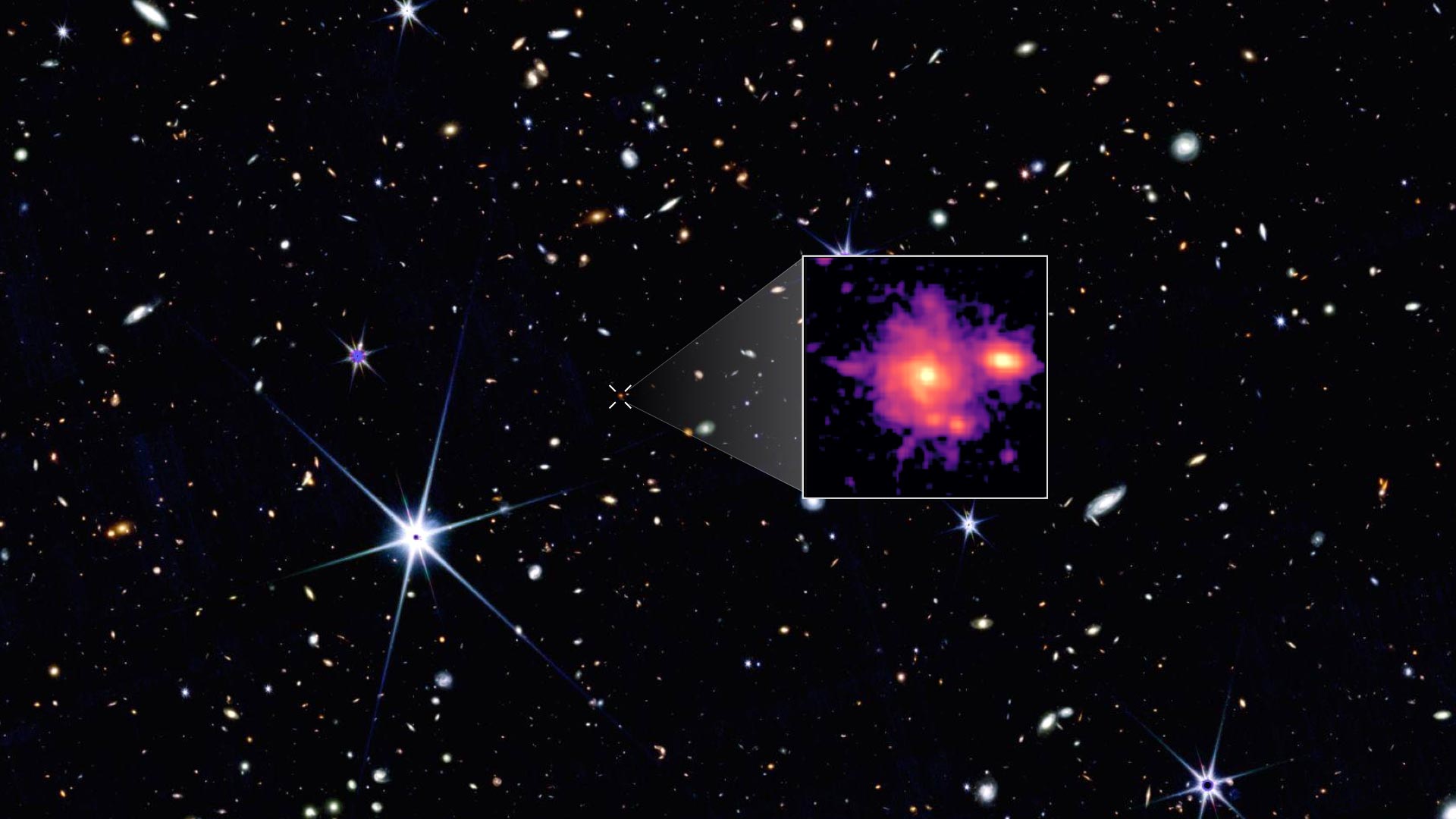
Named Zhúlóng, after a Chinese solar dragon, it looks remarkably like our Milky Way, with spiral arms, a central bulge, and a sprawling disk of stars. Detected by the James Webb Space Telescope during a serendipitous deep-sky survey, this discovery is pushing scientists to rethink the timeline of galactic evolution. More finds like Zhúlóng could completely rewrite our cosmic origin story.
Defying Expectations: Massive Galaxies in a Young Universe
Traditionally, astronomers believed that large spiral galaxies, like our Milky Way, took billions of years to form, gradually assembling from smaller, irregular galaxies. In the early universe, galaxies were expected to be small, chaotic, and misshapen. But the James Webb Space Telescope (JWST) is painting a different picture. Its deep-field imaging has revealed unexpectedly massive and well-structured galaxies forming much earlier than anticipated, forcing scientists to rethink the timeline of galaxy formation.
“We named this galaxy Zhúlóng, meaning ‘Torch Dragon’ in Chinese mythology.”
Dr. Mengyuan Xiao
A Milky Way Twin in the Early Universe
Among the most striking of these discoveries is Zhúlóng, the most distant spiral galaxy candidate identified to date, observed at a redshift of 5.2, placing it just one billion years after the universe began. Despite its early age, it mirrors many characteristics of mature galaxies in our nearby universe.
“We named this galaxy Zhúlóng, meaning ‘Torch Dragon’ in Chinese mythology. In the myth, Zhúlóng is a powerful red solar dragon that creates day and night by opening and closing its eyes, symbolizing light and cosmic time,” says Dr. Mengyuan Xiao, postdoctoral researcher at the Department of Astronomy of the Faculty of Science of UNIGE and lead author of the study.
“What makes Zhúlóng stand out is just how much it resembles the Milky Way in shape, size and stellar mass,” she adds. Its disk spans over 60,000 light-years, comparable to our own galaxy, and contains more than 100 billion solar masses in stars. This makes it one of the most compelling Milky Way analogues ever found at such an early time, raising new questions about how massive, well-ordered spiral galaxies could form so soon after the Big Bang.
Cosmic Serendipity: How the Discovery Happened
Zhúlóng was discovered in deep imaging from JWST’s PANORAMIC survey (GO-2514), a wide-area extragalactic program led by Christina Williams (NOIRLab) and Pascal Oesch (UNIGE). PANORAMIC exploits JWST’s unique “pure parallel” mode – an efficient strategy to collect high-quality images while JWST’s main instrument is taking data on another target. “This allows JWST to map large areas of the sky, which is essential for discovering massive galaxies, as they are incredibly rare,” says Dr. Christina Williams, assistant astronomer at NOIRLab and principal investigator of the PANORAMIC program. “This discovery highlights the potential of pure parallel programs for uncovering rare, distant objects that stress-test galaxy formation models.”
Challenging Old Theories of Galaxy Evolution
Spiral structures were previously thought to take billions of years to develop, and massive galaxies were not expected to exist until much later in the universe, because they typically form after smaller galaxies merged together over time. “This discovery shows how JWST is fundamentally changing our view of the early Universe,” says Prof. Pascal Oesch, associate professor in the Department of Astronomy at the Faculty of Science of UNIGE and co-principal investigator of the PANORAMIC program.
Future JWST and Atacama Large Millimeter Array (ALMA) observations will help confirm its properties and reveal more about its formation history. As new wide-area JWST surveys continue, astronomers expect to find more such galaxies – offering fresh insights into the complex processes shaping galaxies in the early Universe.
Reference: “PANORAMIC: Discovery of an ultra-massive grand-design spiral galaxy at z ∼ 5.2” by Mengyuan Xiao, Christina C. Williams, Pascal A. Oesch, David Elbaz, Miroslava Dessauges-Zavadsky, Rui Marques-Chaves, Longji Bing, Zhiyuan Ji, Andrea Weibel, Rachel Bezanson, Gabriel Brammer, Caitlin Casey, Aidan P. Cloonan, Emanuele Daddi, Pratika Dayal, Andreas L. Faisst, Marijn Franx, Karl Glazebrook, Anne Hutter, Jeyhan S. Kartaltepe, Ivo Labbe, Guilaine Lagache, Seunghwan Lim, Benjamin Magnelli, Felix Martinez, Michael V. Maseda, Themiya Nanayakkara, Daniel Schaerer and Katherine E. Whitaker, 16 April 2025, Astronomy & Astrophysics.
DOI: 10.1051/0004-6361/202453487
Never miss a breakthrough: Join the SciTechDaily newsletter.
Follow us on Google and Google News.
9 Comments
The ‘Standard Model’ is a blind alley. Let’s drop it and move on.
Give it a rest, and discuss something tangible instead.
The standard model of cosmology – which this wasn’t about – is ever more successful as new surveys support it. And even if galaxy evolution would have been an essential part of the standard model a single outlier is not sufficient reason to drop a model.
“This isn’t the first galaxy Milky Way analog, but it is the best so far”.
Your words, from a following comment, contradicting your assertion that this is a single outlier. Also, the DESI results are an excellent reason to drop the ‘Standard Model’… along with many other reasons.
T. Larson – Why don’t you and other BBT absolutists stop trying to fit square pegs in round holes, this galaxy is not an outlier. See the related article above – “Red Monster’s”.
Correction – should read Monsters, not Monster’s.
I can’t believe you lot.
Before I say this, rings in galaxy formations, gravitational wave across the whole universe and magnets building planets are all my ideas that were stolen by scientists. Even multiple big bang (200 trillion explosions 1 singular singularity is how the other inverse works but the singularity cannot be in our universe).
So, next idea to be stolen. They are not explosions they are galaxies from the universe above ripping into our universe and dumping all the stuff that goes into a galaxy into our universe. Which is everything in the universe
There is a universe above you, you can’t see it but it’s there and that universe had galaxies too. All matter fell from the universe above us untill it ran out and only space was left and then space came through the holes and drove the voids in the gas cloud
https://youtu.be/uDjymaeLRTw?si=uebXQ_Dh6H0697aP
That is what has been mistaken for an explosion, but there are trillions of our galaxies so there would have been trillions of theirs
This is the only way to make the Hubble constant work.
Give it a rest, and discuss something tangible instead.
No one have heard of a Jonathan Welburn publishing in peer reviewed physics or any of the purported galaxy evolution or cosmological notions you mention. A Jonathan Welburn in Google Scholar is an economist.
This isn’t the first early galaxy Milky Way analog, but it is the best so far.
This was the most important reason to build JWST – our galaxy formation models were likely erroneous. The situation remind of star formation models in 2015ish. Models had given natural formation rates two order of magnitude larger than what Hubble saw, and astronomers had to improve observations (they had looked in the wrong places) and models (they had not included star feedback).
So we have ‘a supply’ of star formation rates to throw at JWST observations of early galaxy formation at rates much higher than the down-adjusted star formation rate models would naturally suggest. Again, we are probably looking at the wrong spots (as dust occlusion and “red dots” imply) and we have to improve models with feedback mechanisms.
The only model that works is that our Universe is a singularity – or in one. People are always like “if only we could see inside a black hole, we’d have a unified theory” – not understanding they’re in one and still don’t know how to even start the math. To me, superposition is evidence that all matter and energy is connected. It’s a staggeringly infinite and inescapable prison of exquisite design. When nature uses this stuff, it’s like magic dust from a unicorns horn. When we touch it, it becomes a handful of worthless dust.