
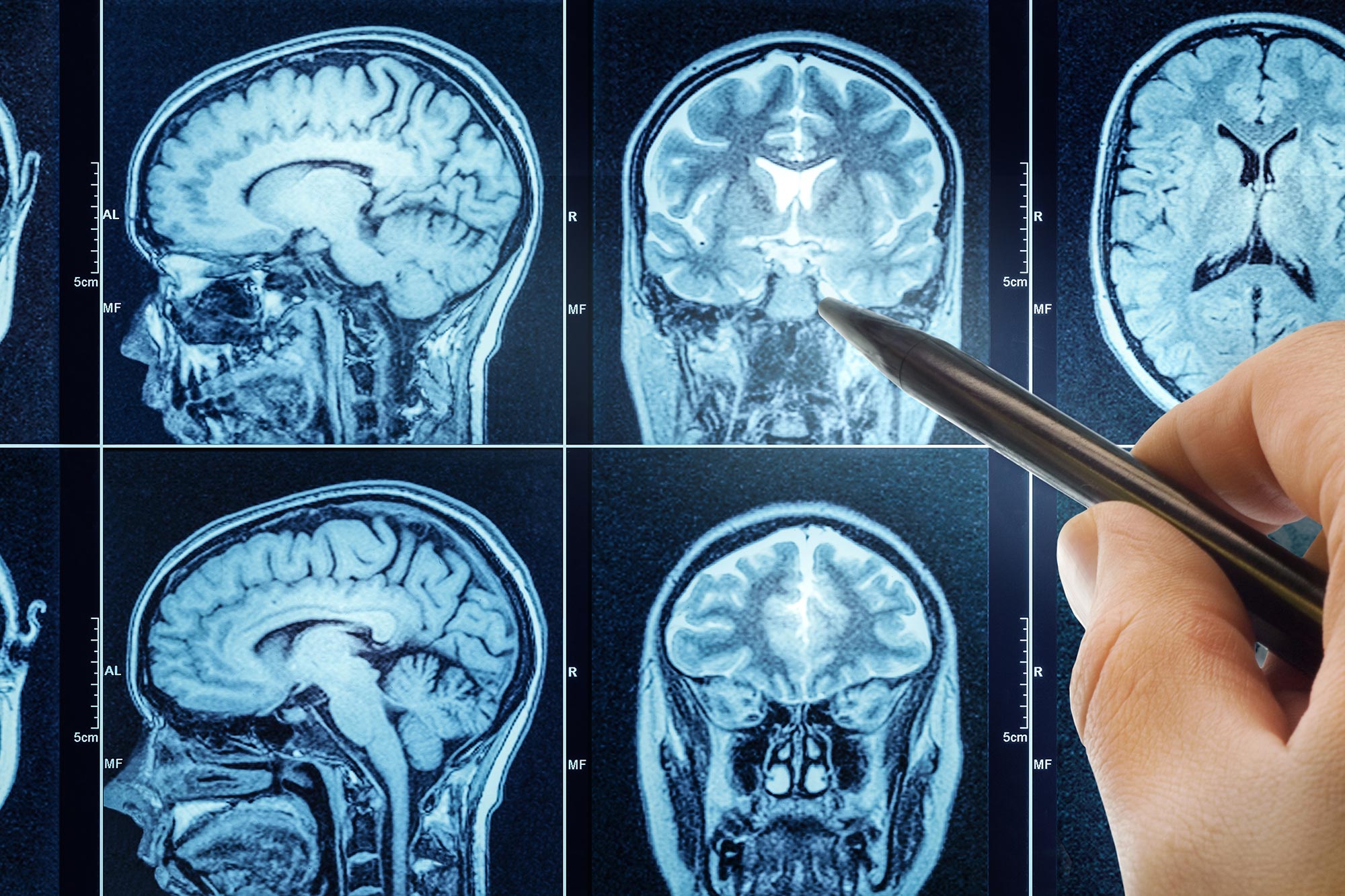
Scientists at the Carney Institute for Brain Science have discovered specific patterns of electrical signals in the brain that may help forecast whether a person will go on to develop Alzheimer’s disease.
Using a specialized tool designed to examine the electrical signals produced by neurons, scientists at Brown University have identified a brain-based marker that may help determine whether mild cognitive impairment is likely to progress into Alzheimer’s disease.
“We’ve detected a pattern in electrical signals of brain activity that predicts which patients are most likely to develop the disease within two and a half years,” said Stephanie Jones, a professor of neuroscience affiliated with Brown’s Carney Institute for Brain Science who co-led the research. “Being able to noninvasively observe a new early marker of Alzheimer’s disease progression in the brain for the first time is a very exciting step.”
The findings were published in Imaging Neuroscience.
In collaboration with researchers at the Complutense University of Madrid in Spain, the team examined brain activity data from 85 individuals diagnosed with mild cognitive impairment. The participants were followed for several years to track how their condition evolved.
Brain activity was recorded using magnetoencephalography, or MEG — a noninvasive technique to record electrical activity in the brain — while participants rested quietly with their eyes closed.
A New Way to Analyze Neural Signals
Traditional approaches to analyzing MEG data typically combine and smooth neural signals, which can obscure activity at the level of individual neurons. To address this limitation, Jones and her colleagues at Brown developed a computational method known as the Spectral Events Toolbox.
This approach breaks brain activity into distinct events, allowing researchers to determine precisely when neural signals occur, how frequently they appear, how long they persist, and how strong they are. The toolbox has since gained broad adoption and has been cited in more than 300 scientific publications.
Applying the Spectral Events Toolbox, the researchers examined patterns of brain activity in patients with mild cognitive impairment within the beta frequency band, a range of neural activity linked to memory processes and therefore relevant to Alzheimer’s disease, according to Jones. The analysis revealed clear differences in beta activity between patients who went on to develop Alzheimer’s disease within two and a half years and those whose condition did not progress.
“Two and a half years prior to their Alzheimer’s disease diagnosis, patients were producing beta events at a lower rate, shorter in duration, and at a weaker power,” said Danylyna Shpakivska, the Madrid-based first author of the study. “To our knowledge, this is the first time scientists have looked at beta events in relation to Alzheimer’s disease.”
Toward More Direct Biomarkers
Spinal fluid and blood biomarkers can identify the presence of toxic beta amyloid plaques and tau tangles –proteins that build up in the brain and are thought to contribute to Alzheimer’s disease symptoms. A biomarker from brain activity itself represents a more direct method of assessing how neurons respond to this toxicity, said David Zhou, a postdoctoral researcher in Jones’ lab at Brown who will lead the next phase of the project.
Jones envisions that the Spectral Events Toolbox could be used by clinicians to diagnose Alzheimer’s disease before it progresses.
“The signal we’ve discovered can aid early detection,” Jones said. “Once our finding is replicated, clinicians could use our toolkit for early diagnosis and also to check whether their interventions are working.”
Meanwhile, Jones and her team will move into a new phase of research, funded by a Zimmerman Innovation Award in Brain Science from the Carney Institute.
“Now that we’ve uncovered beta event features that predict Alzheimer’s disease progression, our next step is to study the mechanisms of generation using computational neural modeling tools,” Jones said. “If we can recreate what’s going wrong in the brain to generate that signal, then we can work with our collaborators to test therapeutics that might be able to correct the problem.”
Reference: “High-power transient 12–30 Hz beta event features as early biomarkers of Alzheimer’s disease conversion: An MEG study ” by Danylyna Shpakivska-Bilan, Gianluca Susi, David W. Zhou, Jesus Cabrera, Blanca P. Carvajal, Ernesto Pereda, Maria Eugenia Lopez, Ricardo Bruña, Fernando Maestu and Stephanie R. Jones, 14 July 2025, Imaging Neuroscience.
DOI: 10.1162/IMAG.a.69
The research was supported by the National Institutes of Health, including the Brain Research through Advancing Innovative Neurotechnologies (BRAIN) Initiative, in addition to funding from agencies in Spain.
Never miss a breakthrough: Join the SciTechDaily newsletter.
Follow us on Google and Google News.
2 Comments
There is no Alzheimer’s,Alzheimer is the name of the German Physician century ago who discovered this disease it’s Dementia. Dementia treatment “Saffron” walnuts stave off Dementia.
Google non-Alzheimer’s dementia to find out that Alzheimer’s is indeed a specific type of dementia and then wonder if you should be taking any sort of advice from someone who doesn’t seem to know that