

Close Menu
    Facebook X (Twitter) Instagram
    SciTechDaily
    • Biology
    • Chemistry
    • Earth
    • Health
    • Physics
    • Science
    • Space
    • Technology
    Facebook X (Twitter) Pinterest YouTube RSS
    SciTechDaily
    Home»Chemistry»New Catalyst Destroys “Forever Chemicals” in Seconds
    Chemistry

    New Catalyst Destroys “Forever Chemicals” in Seconds

    By Goethe University FrankfurtJune 20, 20254 Comments3 Mins Read
    Facebook Twitter Pinterest Telegram LinkedIn WhatsApp Email Reddit
    Share
    Facebook Twitter LinkedIn Pinterest Telegram Email Reddit
    Chemistry Catalyst Concept
    PFAS, known for their extraordinary resistance and widespread utility, have become an environmental and health concern due to their extreme persistence and bioaccumulation. A new boron-based catalyst may offer a groundbreaking solution by rapidly breaking the ultra-stable C–F bonds that make PFAS so durable. Credit: Stock

    New catalyst developed at Goethe University Frankfurt can break strong carbon-fluorine bonds, with potential applications in pharmaceutical production.

    PFAS are remarkable molecules in many respects. Even a thin coating can repel water, oil, and dirt. They are also highly resistant to heat and UV light, making them ideal for products like breathable outdoor clothing, stain-resistant carpets, disposable tableware, irons, and non-stick cookware.

    In industrial settings, PFAS are used as lubricants, surfactants, wetting agents, in chrome plating, and in fire-fighting foams. Their applications are widespread, and PFAS are found in countless everyday items.

    However, these advantages come with serious drawbacks. Because PFAS are so stable, they remain in the environment long after their use. Although they can be nearly completely destroyed in waste incineration plants, they may still build up during recycling processes—such as in textiles or sewage sludge—and eventually make their way into the environment.

    Non Stick Frying Pan With Egg Illustrates PFAS
    Coatings containing PFAS ensure that the egg does not stick in the pan. PFAS hardly degrade in the environment and are therefore considered “eternal chemicals”. Credit: Markus Bernards for Goethe University Frankfurt

    PFAS have been detected in water, soil, plants, and even inside the human body. This is especially concerning because some of the roughly 4,700 known PFAS compounds are suspected to be carcinogenic or linked to other health risks.

    How the catalyst works at the molecular level

    The key to both the effectiveness and environmental persistence of PFAS lies in their extremely stable molecular structure, particularly the carbon–fluorine (C–F) bonds. A team of chemists led by Professor Matthias Wagner at Goethe University’s Institute of Inorganic and Analytical Chemistry has now developed a catalyst that can break these C–F bonds within seconds at room temperature.

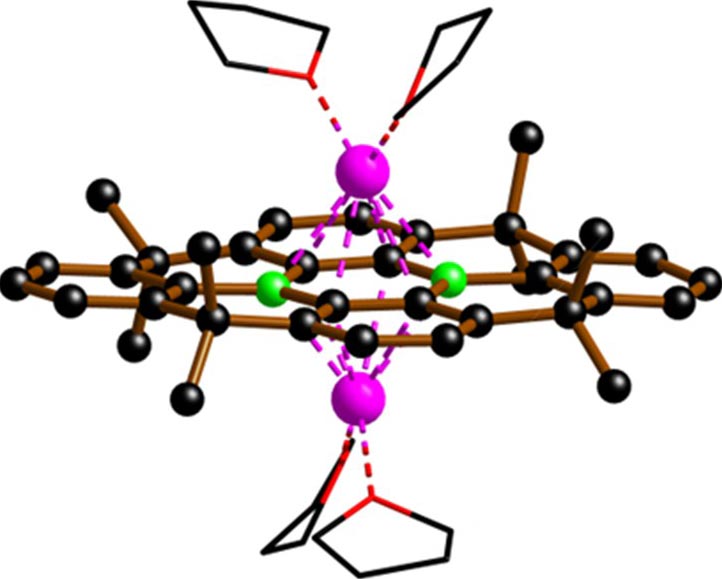
    At the core of the catalyst are two boron atoms embedded in a carbon framework, which makes the structure resistant to air and moisture—a rare and highly useful feature for boron-based compounds.
    New Catalyst Splits C F Bonds
    Two boron atoms (green spheres) are embedded in a framework of carbon atoms (black). The electrons required for C-F cleaving currently still come from lithium (pink), in future from electric current. Credit: Group of Matthias Wagner, Goethe University Frankfurt

    Christoph Buch, a doctoral researcher in Wagner’s group and first author of the study, explains: “To break C–F bonds, we need electrons, which our catalyst transfers with exceptional efficiency. So far, we’ve been using alkali metals like lithium as the electron source, but we’re already working on switching to electrical current instead. That would make the process both much simpler and more efficient.”

    Future applications in pharmaceuticals

    Beyond PFAS degradation, Wagner sees broader applications for the catalyst: “Many pharmacologically important substances contain fluorine atoms to increase their physiological stability and enhance their effect. Fluorine atoms can also improve drug uptake. With this catalyst, we now have a tool that allows us to precisely control the degree of fluorination in such compounds.”

    Reference: “Planarity Is Not Plain: Closed- vs Open-Shell Reactivity of a Structurally Constrained, Doubly Reduced Arylborane toward Fluorobenzenes” by Christoph D. Buch, Alexander Virovets, Eugenia Peresypkina, Burkhard Endeward, Hans-Wolfram Lerner, Felipe Fantuzzi, Shigehiro Yamaguchi and Matthias Wagner, 29 May 2025, Journal of the American Chemical Society.
    DOI: 10.1021/jacs.5c05588

    Never miss a breakthrough: Join the SciTechDaily newsletter.
    Follow us on Google and Google News.

    Catalysts Goethe University Frankfurt PFAS Popular Public Health
    Share. Facebook Twitter Pinterest LinkedIn Email Reddit

    Related Articles

    Scientists Discover That Toxic Compounds in Everyday Products Are Disrupting Vital Human Proteins

    Startling Research Shows That Toxic “Forever Chemicals” Can Penetrate Human Skin

    Does Soap Actually ‘Kill’ the Coronavirus? Here’s the Chemistry [Video]

    MIT Chemists Have Developed a Peptide That Could Block COVID-19

    Researchers Unearth a ‘Ticking Time Bomb’ – Synthetic Chemicals in Soils

    Gasification Goes Green: Low-Temp Photocatalyst Slashes Carbon Footprint for Syngas

    Scientists Turn Plastic Waste Into Valuable Chemicals With Sunlight

    Solving a Riddle That Would Provide the World With Entirely Clean, Renewable Energy

    Working to Recycle Greenhouse Gases

    4 Comments

    1. SYED FARRUKH RASHEED on June 25, 2025 3:12 am

      Could there be a similar catalyst that can break Hydrogen Fluorine Bonds?
      Please elaborate.

      Reply
    2. Kopcho on June 25, 2025 3:20 am

      Really?
      And what about your liver?!

      Reply
      • Captain Username on June 25, 2025 9:32 am

        Your liver will not break down “forever chemicals”

        Reply
    3. K-Check on July 20, 2025 7:59 pm

      Down with PFAS

      Reply
    Leave A Reply Cancel Reply

    • Facebook
    • Twitter
    • Pinterest
    • YouTube

    Don't Miss a Discovery

    Subscribe for the Latest in Science & Tech!

    Trending News

    AI Could Detect Early Signs of Alzheimer’s in Under a Minute – Far Before Traditional Tests

    What if Dark Matter Has Two Forms? Bold New Hypothesis Could Explain a Cosmic Mystery

    This Metal Melts in Your Hand – and Scientists Just Discovered Something Strange

    Beef vs. Chicken: Surprising Results From New Prediabetes Study

    Alzheimer’s Breakthrough: Scientists Discover Key Protein May Prevent Toxic Protein Clumps in the Brain

    Quantum Reality Gets Stranger: Physicists Put a Lump of Metal in Two Places at Once

    Scientists May Have Found the Key to Jupiter and Saturn’s Moon Mystery

    Scientists Uncover Brain Changes That Link Pain to Depression

    Follow SciTechDaily
    • Facebook
    • Twitter
    • YouTube
    • Pinterest
    • Newsletter
    • RSS
    SciTech News
    • Biology News
    • Chemistry News
    • Earth News
    • Health News
    • Physics News
    • Science News
    • Space News
    • Technology News
    Recent Posts
    • What if Your Memories Never Happened? Physicists Take a New Look at the Boltzmann Brain Paradox
    • Students Found an Ancient Star That Shouldn’t Be in the Milky Way
    • Astronomers Solve 50-Year Mystery and Reveal Hidden Culprit Behind Strange X-Ray Emissions
    • One of the Universe’s Largest Stars May Be Getting Ready To Explode
    • Scientists Discover Enzyme That Could Supercharge Ozempic-Like Weight Loss Drugs
    Copyright © 1998 - 2026 SciTechDaily. All Rights Reserved.
    • Science News
    • About
    • Contact
    • Editorial Board
    • Privacy Policy
    • Terms of Use

    Type above and press Enter to search. Press Esc to cancel.