
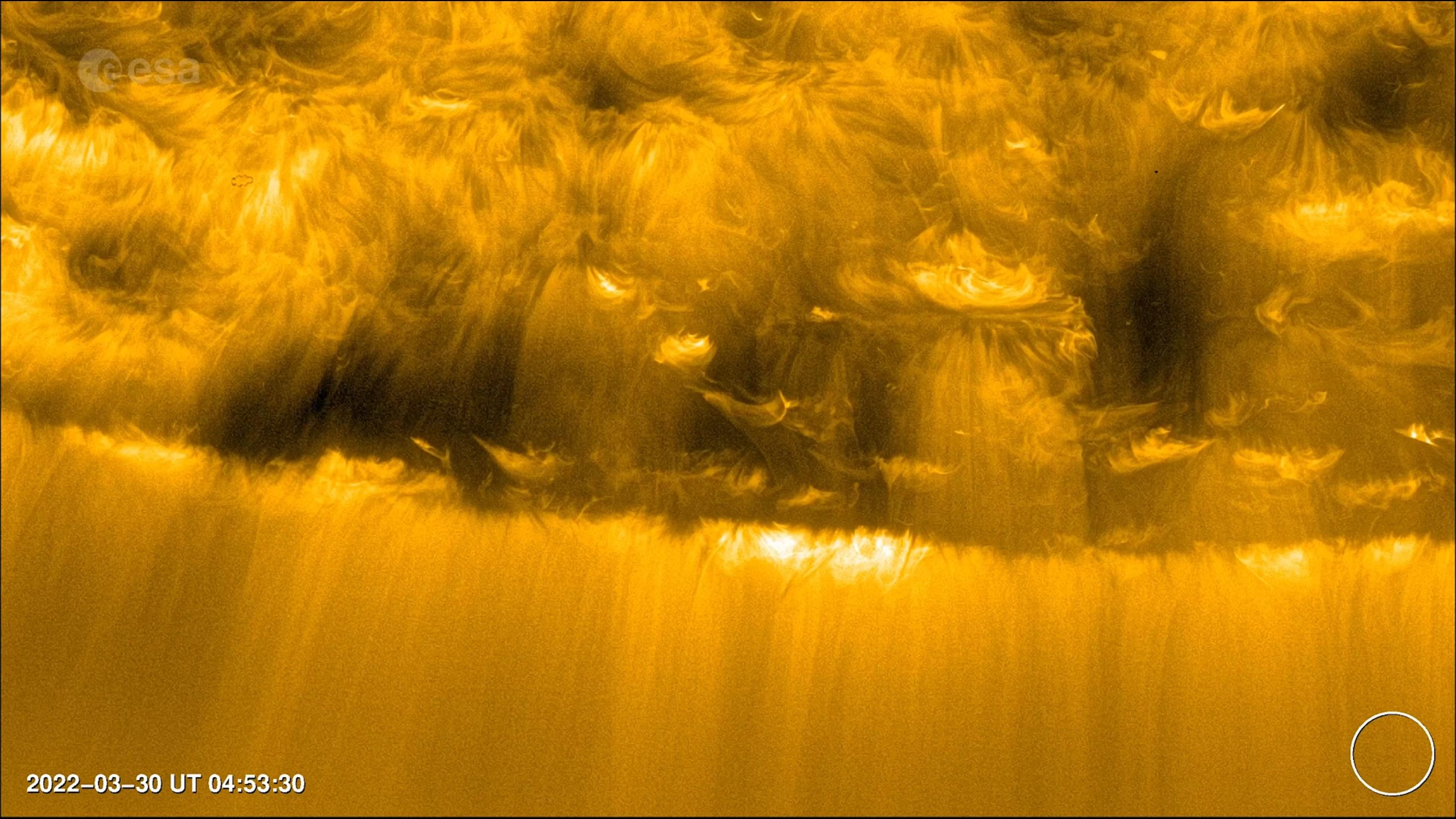
Researchers at the Princeton Plasma Physics Laboratory have made a significant discovery regarding the solar corona’s extreme heat, pinpointing reflected plasma waves as the likely cause.
This breakthrough, involving both experimental and simulation methods, provides crucial insight into the long-standing mystery of why the solar corona is substantially hotter than the sun’s surface.
Sun’s Mysterious Heat: A Decades-Old Puzzle
There is a profound mystery in our sun. Although the sun’s surface temperature is around 10,000 degrees Fahrenheit, its outer atmosphere, the solar corona, soars to about 2 million degrees Fahrenheit—roughly 200 times hotter. This dramatic increase in temperature away from the sun’s surface has puzzled scientists since 1939 when the high temperature of the corona was first documented. Over the decades, researchers have endeavored to uncover the mechanism behind this unexpected heating, yet the mystery has remained unsolved.
Breakthrough in Solar Research
Recently, however, a breakthrough has been achieved by a team led by Sayak Bose, a researcher at the U.S. Department of Energy’s (DOE) Princeton Plasma Physics Laboratory (PPPL). Their findings indicate that reflected plasma waves are likely responsible for heating coronal holes—low-density regions in the solar corona with open magnetic field lines that stretch into interplanetary space. This discovery marks significant progress in unraveling one of the most enduring mysteries about our closest star.
“Scientists knew that coronal holes have high temperatures, but the underlying mechanism responsible for the heating is not well understood,” said Bose, the lead author of the paper reporting the results in The Astrophysical Journal. “Our findings reveal that plasma wave reflection can do the job. This is the first laboratory experiment demonstrating that Alfvén waves reflect under conditions relevant to coronal holes.”

Unraveling the Alfvén Waves Mystery
First predicted by a Swedish physicist and Nobel Prize winner, Hannes Alfvén, the waves that bear his name resemble the vibrations of plucked guitar strings, except that in this case, the plasma waves are caused by wiggling magnetic fields.
Bose and other members of the team used the 20-meter-long plasma column of the Large Plasma Device (LAPD) at the University of California-Los Angeles (UCLA) to excite Alfvén waves under conditions that mimic those occurring around coronal holes. The experiment demonstrated that when Alfvén waves encounter regions of varying plasma density and magnetic field intensity, as they do in the solar atmosphere around coronal holes, they can be reflected and travel backward toward their source. The collision of the outward-moving and reflected waves causes turbulence that, in turn, causes heating.
Experimental Advances and Simulation Insights
“Physicists have long hypothesized that Alfvén wave reflection could help explain the heating of coronal holes, but it has been impossible to either verify in the laboratory or directly measure,” said Jason TenBarge, a visiting research scholar at PPPL, who also contributed to the research. “This work provides the first experimental verification that Alfvén wave reflection is not only possible but also that the amount of reflected energy is sufficient to heat coronal holes.”
Along with conducting the laboratory experiments, the team performed computer simulations of the experiments, which corroborated the reflection of Alfvén waves under conditions similar to coronal holes. “We routinely conduct multiple verifications to ensure the accuracy of our observed results,” said Bose, “and conducting simulations was one of those steps. The physics of Alfvén wave reflection is very fascinating and complicated! It is amazing how profoundly basic physics laboratory experiments and simulations can significantly improve our understanding of natural systems like our sun.”
Reference: “Experimental Study of Alfvén Wave Reflection from an Alfvén-speed Gradient Relevant to the Solar Coronal Holes” by Sayak Bose, Jason M. TenBarge, Troy Carter, Michael Hahn, Hantao Ji, James Juno, Daniel Wolf Savin, Shreekrishna Tripathi and Stephen Vincena, 7 August 2024, The Astrophysical Journal.
DOI: 10.3847/1538-4357/ad528f
Collaborators included scientists from Princeton University, the University of California-Los Angeles and Columbia University. The research was funded by the DOE under contracts DE-AC0209CH11466 and DE-SC0021261, as well as the National Science Foundation (NSF) under grant number 2209471. The experiment was performed at the Basic Plasma Science Facility, which is a collaborative user facility part of the DOE Office of Science’s Fusion Energy Sciences program and is funded by DOE contract DE-FC02-07ER54918 and the NSF under contract NSF-PHY 1036140.
Never miss a breakthrough: Join the SciTechDaily newsletter.
Follow us on Google and Google News.