
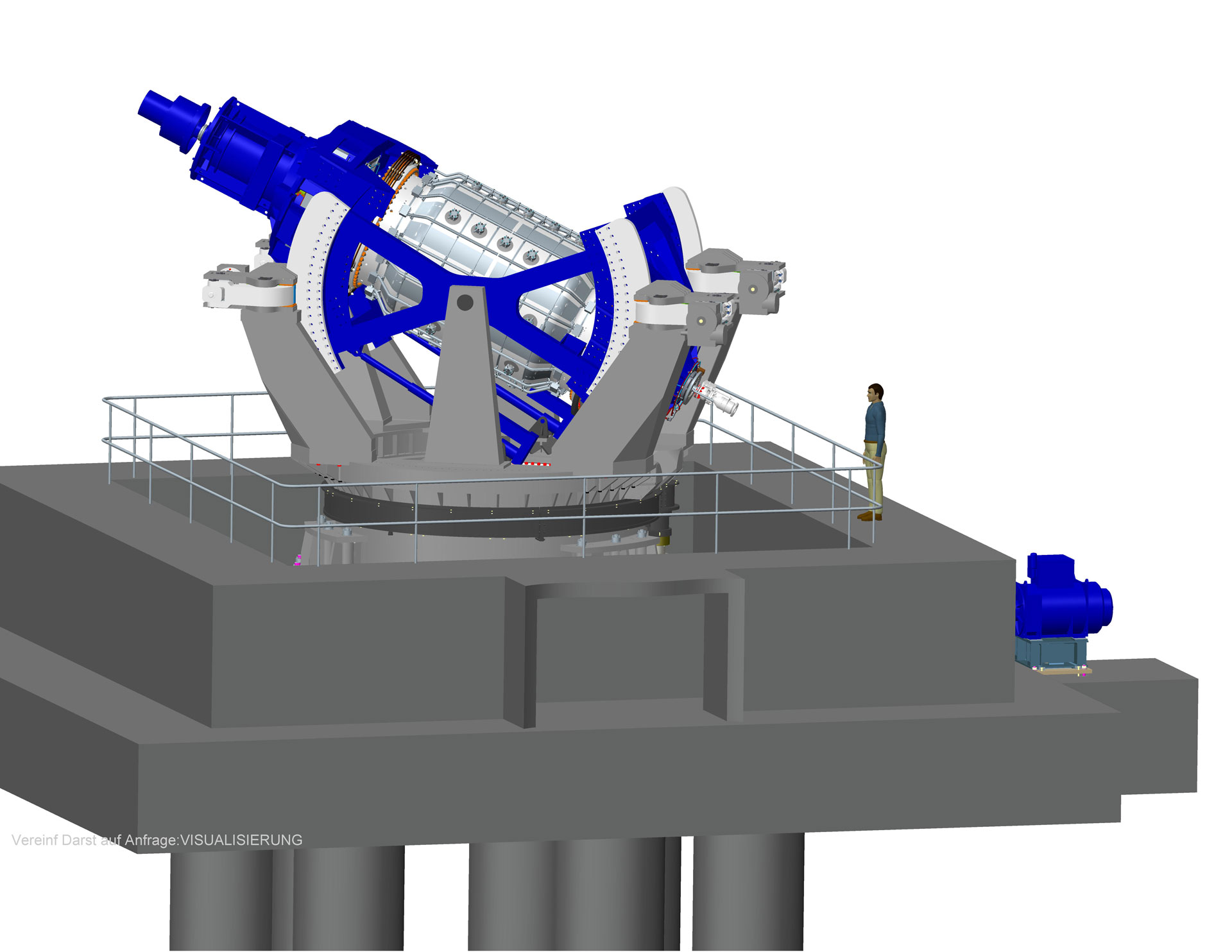
Flows of molten metal can generate magnetic fields. This so-called dynamo effect creates cosmic magnetic fields, like those found on planets, moons, and even asteroids. Over the coming years, a globally unique experiment, in which a steel drum containing several tons of liquid sodium rotates around two axes, is intended to demonstrate this effect. It will be carried out in the new DRESDYN facility at the Helmholtz-Zentrum Dresden-Rossendorf (HZDR). A recently published study in the scientific journal “Physical Review Letters” confirms the experiment’s chances of success.
Similarly to how a bicycle dynamo converts motion into electricity, moving conductive fluids can generate magnetic fields. The so-called magnetic Reynolds number (the product of the fluid’s flow velocity, expansion, and conductivity) primarily determines whether a magnetic field is actually generated. During a spectacular experiment, scientists in Frank Stefani’s team at the HZDR’s Institute of Fluid Dynamics aim to achieve the critical value required for the occurrence of the dynamo effect. For this purpose, a two-meter diameter steel cylinder containing eight tons of liquid sodium will rotate around one axis up to ten times per second and once per second around another, which is tilted with respect to the first. The technical term for this movement, which is often compared to a tilted spinning top, is precession.
“Our experiment at the new DRESDYN facility is intended to demonstrate that precession, as a natural driver of flow, is sufficient to create a magnetic field,” says André Giesecke, lead author of the study. In his simulations and during accompanying water experiments – the mock-up was six times smaller than the large dynamo – scientists examined the structure of precession-driven flow. “To our surprise, we observed a symmetrical double roll structure in a specific range of the precession rate, which should provide a dynamo effect at a magnetic Reynolds number of 430,” says the physicist.

Unresolved: the role of precession in the geodynamo
The center of the Earth consists of a solid core surrounded by a layer of molten iron. “The molten metal induces an electric current, which in turn generates a magnetic field,” explains Giesecke. The common belief is that buoyancy-driven convection, together with Earth’s rotation, is responsible for this geodynamo. However, the role played by precession in the formation of Earth’s magnetic field is still completely unclear. The Earth’s rotational axis is tilted by 23.5 degrees from its orbital plane. The rotational axis changes position over a period of approximately 26,000 years. This precessing motion through space is thought to be one of the possible sources of energy for the geodynamo. Millions of years ago, the Moon also had a powerful magnetic field, as indicated by rock samples from the Apollo missions. According to experts, precession could have been the main cause of this.
The liquid sodium experiments at HZDR are expected to start in 2020. Unlike earlier geodynamo laboratory experiments, there will be no propeller inside the steel drum, as was used in the first successful dynamo experiment in Riga, Latvia in 1999, in which HZDR scientists were heavily involved. This and other experiments in Karlsruhe, Germany, and Cadarache, France provided ground-breaking research for a better understanding of the geodynamo.
“In principle, we can define three different parameters for the experiments at DRESDYN: rotation, precession, and the angle between the two axes,” says Giesecke. On the one hand, he and his colleagues expect to get answers to the fundamental question of whether precession actually produces a magnetic field in a conductive fluid. On the other hand, they are interested in finding out which flow components are responsible for the creation of the magnetic field, and the point at which saturation occurs.
Double roll in the container
“In simulations, we discovered that stationary inertia waves occur in a wide parameter range. Within a certain range, however, we have now noticed a characteristic double roll structure that proves to be extremely efficient for the dynamo effect. In principle, we are already aware of such a velocity structure thanks to the French dynamo experiment, in which it was artificially produced by two propellers, while in our precession experiment it should emerge naturally.”
The HZDR researchers used special ultrasound technology to measure the flow structure. “We were very surprised at how well the data from the experiment matches the results of the simulation. We therefore have an extremely robust prediction for the major DRESDYN experiment. For example, we know at which rotational rates the dynamo effect occurs and which magnetic field structures we can expect,” says Giesecke.
The scientific community involved with dynamos is eagerly awaiting the results of the planned experiment, which will operate at the limits of technical feasibility in many respects. “We also expect detailed insights into the general dynamics of liquid metal flows under the influence of magnetic fields. This will allow us to draw conclusions about flows in the industrial sector,” according to Giesecke. And last but not least, the magnetic flow tomography developed at the HZDR as part of its dynamo research is of interest to many areas of steel casting and crystal growing. The work has been partially funded by the Helmholtz Alliance “Liquid Metal Technologies” (LIMTECH).
Reference: “Nonlinear Large Scale Flow in a Precessing Cylinder and Its Ability To Drive Dynamo Action” by André Giesecke, Tobias Vogt, Thomas Gundrum and Frank Stefani, 12 January 2018, Physical Review Letters.
DOI: 10.1103/PhysRevLett.120.024502
Never miss a breakthrough: Join the SciTechDaily newsletter.
Follow us on Google and Google News.
1 Comment
This experiment on geodynamos is missing a few key factors: the thermoelectric drive of the sun on the earth extreme heat to extreme cold, along with the fact that most solar partials are directed to the poles. also the center of the earth is only solid cause of the gravitation weight( look at a gas filled outer space its only until the weight increases does it start to form a sun) all of this drives the earth. Also why sodium mixture and not a lava and gas based since your saying that lave is magnetic..