
Close Menu
    Facebook X (Twitter) Instagram
    SciTechDaily
    • Biology
    • Chemistry
    • Earth
    • Health
    • Physics
    • Science
    • Space
    • Technology
    Facebook X (Twitter) Pinterest YouTube RSS
    SciTechDaily
    Home»Space»New Horizons Image Shows Pluto’s ‘Halo’ Craters
    Space

    New Horizons Image Shows Pluto’s ‘Halo’ Craters

    By SciTechDailyApril 21, 20161 Comment2 Mins Read
    Facebook Twitter Pinterest Telegram LinkedIn WhatsApp Email Reddit
    Share
    Facebook Twitter LinkedIn Pinterest Telegram Email Reddit
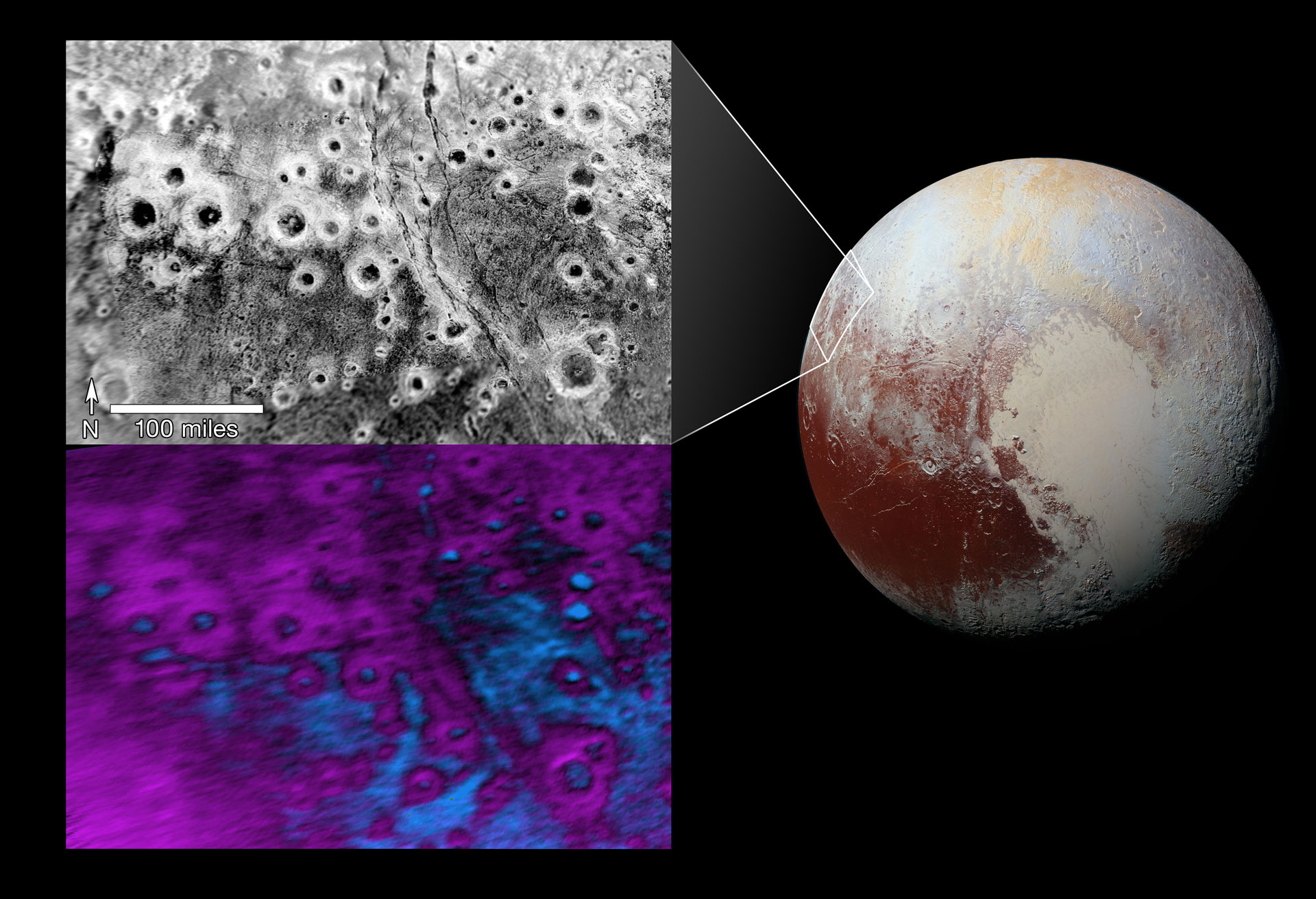
    New Horizons Image of Pluto’s ‘Halo’ Craters
    Pluto’s ‘Halo’ Craters.  Credit: NASA/JHUAPL/SwRI

    This newly released image from the New Horizons Spacecraft looks within Pluto’s informally named Vega Terra region, showing a field of eye-catching craters that looks like a cluster of bright halos scattered across a dark landscape.

    The region is far west of the hemisphere NASA’s New Horizons spacecraft viewed during close approach last summer. The upper image – in black and white – sports several dozen “haloed” craters. The largest crater, at the bottom-right, measures about 30 miles (50 kilometers) across. The craters’ bright walls and rims stand out from their dark floors and surrounding terrain, creating the halo effect.

    In the lower image, composition data from New Horizons’ Ralph/Linear Etalon Imaging Spectral Array (LEISA) indicate a connection between the bright halos and the distribution of methane ice, shown in false color as purple. The floors and terrain between craters show signs of water ice, colored in blue. Exactly why the bright methane ice settles on these crater rims and walls is a mystery; also puzzling is why this same effect doesn’t occur broadly across Pluto.

    The upper view is a mosaic made from two separate images obtained by New Horizons’ Long Range Reconnaissance Imager (LORRI). A high-resolution strip taken at approximately 760 feet (232 meters) per pixel is overlain on a broader, low-resolution image taken at 2,910 feet (889 meters) per pixel. The images were obtained at ranges of 28,800 miles (46,400 kilometers) and 106,700 miles (171,700 kilometers) from Pluto, respectively, on July 14, 2015. The LEISA data came the same day, during the instrument’s highest-resolution scan of Pluto, with New Horizons 28,000 miles (45,500 kilometers) from Pluto, with a resolution of 1.7 miles (2.7 kilometers) per pixel.

    Never miss a breakthrough: Join the SciTechDaily newsletter.
    Follow us on Google and Google News.

    Astronomy NASA New Horizons Planetary Science Pluto
    Share. Facebook Twitter Pinterest LinkedIn Email Reddit

    Related Articles

    New Horizons Reveals Signs of Pluto’s Geology

    NASA’s New Horizons Pluto Flyby Begins

    New Horizons Reflectance and Color Map of Pluto

    The Latest New Horizons Images of Dwarf Planet Pluto

    Dwarf Planet Pluto: The ‘Other’ Red Planet

    New Horizons Spacecraft Reveals Series of Spots on Pluto That Fascinate

    New Horizons Spacecraft Awakens for Encounter with Pluto System

    New ScienceCast Video Previews What New Horizons May See on Pluto

    New ScienceCast Video – Countdown to Pluto

    1 Comment

    1. Jbspear on April 21, 2016 1:19 pm

      Looks like space barnacles!

      Reply
    Leave A Reply Cancel Reply

    • Facebook
    • Twitter
    • Pinterest
    • YouTube

    Don't Miss a Discovery

    Subscribe for the Latest in Science & Tech!

    Trending News

    The Universe Is Expanding Too Fast and Scientists Can’t Explain Why

    “Like Liquid Metal”: Scientists Create Strange Shape-Shifting Material

    Early Warning Signals of Esophageal Cancer May Be Hiding in Plain Sight

    Common Blood Pressure Drug Shows Surprising Power Against Deadly Antibiotic-Resistant Superbug

    Scientists Uncover Dangerous Connection Between Serotonin and Heart Valve Disease

    Scientists Discover a “Protector” Protein That Could Help Reverse Hair Loss

    Bone-Strengthening Discovery Could Reverse Osteoporosis

    Scientists Uncover Hidden Trigger Behind Stem Cell Aging

    Follow SciTechDaily
    • Facebook
    • Twitter
    • YouTube
    • Pinterest
    • Newsletter
    • RSS
    SciTech News
    • Biology News
    • Chemistry News
    • Earth News
    • Health News
    • Physics News
    • Science News
    • Space News
    • Technology News
    Recent Posts
    • 5 Common Myths About Learning a New Language, Debunked
    • The Neanderthal “Love Story” Isn’t What It Seems
    • Scientists Unlock Hidden Secrets of 2,300-Year-Old Mummies Using Cutting-Edge CT Scanner
    • Men vs. Women: Scientists Uncover Dramatic Differences in How the Immune System Ages
    • Eating Chili Peppers Linked to Longer Life
    Copyright © 1998 - 2026 SciTechDaily. All Rights Reserved.
    • Science News
    • About
    • Contact
    • Editorial Board
    • Privacy Policy
    • Terms of Use

    Type above and press Enter to search. Press Esc to cancel.