
Close Menu
    Facebook X (Twitter) Instagram
    SciTechDaily
    • Biology
    • Chemistry
    • Earth
    • Health
    • Physics
    • Science
    • Space
    • Technology
    Facebook X (Twitter) Pinterest YouTube RSS
    SciTechDaily
    Home»Space»New Horizons Spacecraft Discovers Second Mountain Range on Pluto
    Space

    New Horizons Spacecraft Discovers Second Mountain Range on Pluto

    By SciTechDailyJuly 22, 20151 Comment3 Mins Read
    Facebook Twitter Pinterest Telegram LinkedIn WhatsApp Email Reddit
    Share
    Facebook Twitter LinkedIn Pinterest Telegram Email Reddit
    New Horizons Discovers Second Mountain Range on Pluto
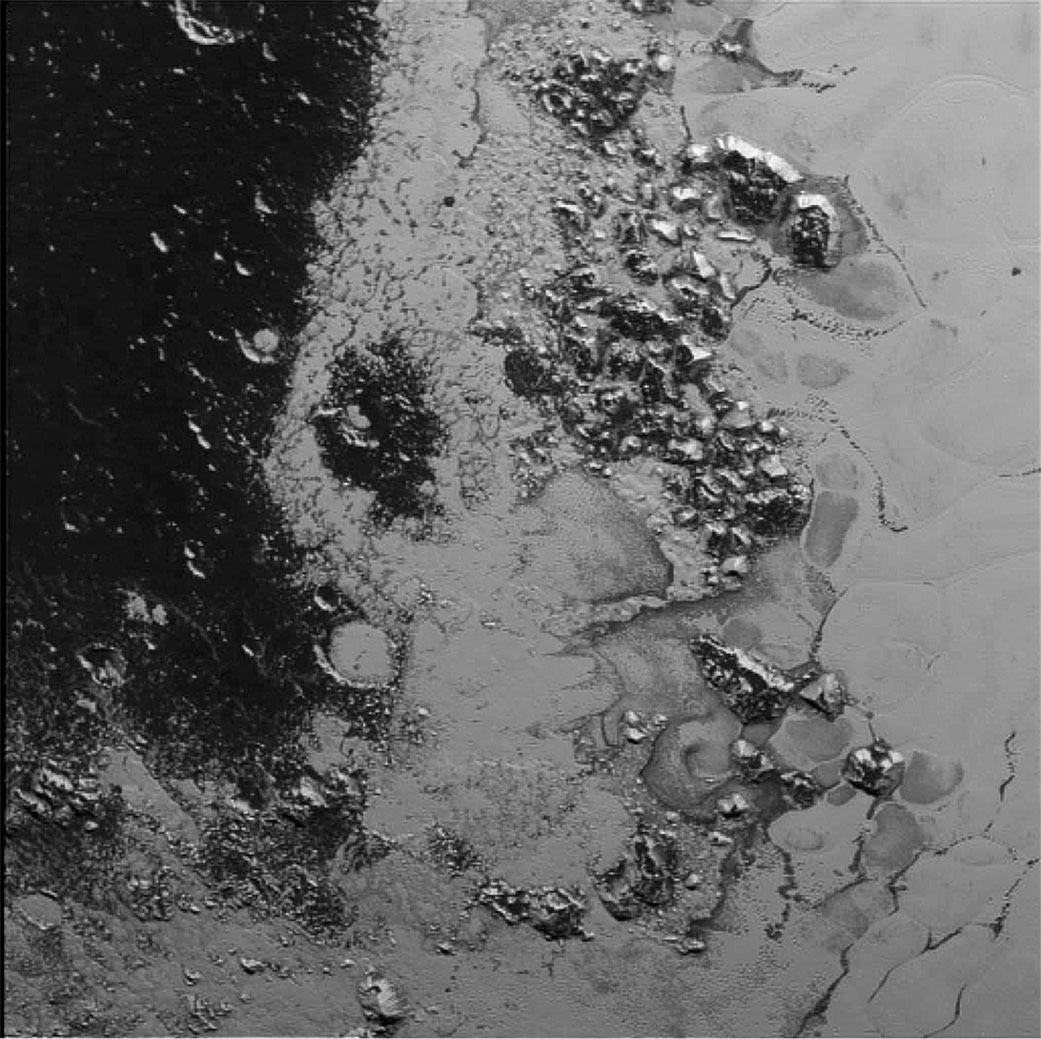
    NASA’s New Horizons mission has discovered a new, apparently less lofty mountain range on the lower-left edge of Pluto’s best known feature, the bright, heart-shaped region named Tombaugh Regio (Tombaugh Region). Credit: NASA/JHUAPL/SWRI

    NASA’s New Horizons Spacecraft has discovered a second mountain range near the southwestern margin of Pluto’s Tombaugh Regio (Tombaugh Region), situated between bright, icy plains and dark, heavily-cratered terrain.

    This image was acquired by New Horizons’ Long Range Reconnaissance Imager (LORRI) on July 14, 2015, from a distance of 48,000 miles (77,000 kilometers) and sent back to Earth on July 20. Features as small as a half-mile (1 kilometer) across are visible.

    Pluto’s icy mountains have company. NASA’s New Horizons mission has discovered a new, apparently less lofty mountain range on the lower-left edge of Pluto’s best known feature, the bright, heart-shaped region named Tombaugh Regio (Tombaugh Region).

    These newly discovered frozen peaks are estimated to be one-half mile to one mile (1-1.5 kilometers) high, about the same height as the United States’ Appalachian Mountains. The Norgay Montes (Norgay Mountains) discovered by New Horizons on July 15 more closely approximates the height of the taller Rocky Mountains.

    The new range is just west of the region within Pluto’s heart called Sputnik Planum (Sputnik Plain). The peaks lie some 68 miles (110 kilometers) northwest of Norgay Montes.

    This newest image further illustrates the remarkably well-defined topography along the western edge of Tombaugh Regio.

    “There is a pronounced difference in texture between the younger, frozen plains to the east and the dark, heavily-cratered terrain to the west,” said Jeff Moore, leader of the New Horizons Geology, Geophysics and Imaging Team (GGI) at NASA’s Ames Research Center in Moffett Field, California. “There’s a complex interaction going on between the bright and the dark materials that we’re still trying to understand.”

    While Sputnik Planum is believed to be relatively young in geological terms – perhaps less than 100 million years old – the darker region probably dates back billions of years. Moore notes that the bright, sediment-like material appears to be filling in old craters (for example, the bright circular feature to the lower left of the center).

    This image was acquired by the Long Range Reconnaissance Imager (LORRI) on July 14 from a distance of 48,000 miles (77,000 kilometers) and sent back to Earth on July 20. Features as small as a half-mile (1 kilometer) across are visible. The names of features on Pluto have all been given on an informal basis by the New Horizons team.

    Never miss a breakthrough: Join the SciTechDaily newsletter.
    Follow us on Google and Google News.

    Astronomy NASA New Horizons Planetary Science Pluto
    Share. Facebook Twitter Pinterest LinkedIn Email Reddit

    Related Articles

    New Horizons Reveals Signs of Pluto’s Geology

    NASA’s New Horizons Pluto Flyby Begins

    New Horizons Reflectance and Color Map of Pluto

    The Latest New Horizons Images of Dwarf Planet Pluto

    Dwarf Planet Pluto: The ‘Other’ Red Planet

    New Horizons Spacecraft Reveals Series of Spots on Pluto That Fascinate

    New Horizons Spacecraft Awakens for Encounter with Pluto System

    New ScienceCast Video Previews What New Horizons May See on Pluto

    New ScienceCast Video – Countdown to Pluto

    1 Comment

    1. john on July 22, 2015 7:17 pm

      Really that’s a close up of my counter top where I spilled coffee close by See the sugar crystal mountains and dried milk ?

      Reply
    Leave A Reply Cancel Reply

    • Facebook
    • Twitter
    • Pinterest
    • YouTube

    Don't Miss a Discovery

    Subscribe for the Latest in Science & Tech!

    Trending News

    Enormous Prehistoric Insects Puzzle Scientists

    Scientists Develop Bioengineered Chewing Gum That Could Help Fight Oral Cancer

    After 37 Years, the World’s Longest-Running Soil Warming Experiment Uncovers a Startling Climate Secret

    NASA Satellite Captures First-Ever High-Res View of Massive Pacific Tsunami

    ADHD Isn’t Just a Deficit: Study Reveals Powerful Hidden Strengths

    Scientists Discover Stem Cells That Could Regrow Teeth and Bone

    Early Cannabis Use May Stall Key Brain Skills in Teens

    Popular Vitamin D Supplement Has “Previously Unknown” Negative Effect, Study Finds

    Follow SciTechDaily
    • Facebook
    • Twitter
    • YouTube
    • Pinterest
    • Newsletter
    • RSS
    SciTech News
    • Biology News
    • Chemistry News
    • Earth News
    • Health News
    • Physics News
    • Science News
    • Space News
    • Technology News
    Recent Posts
    • Darwin’s Islands Still Evolving: Giant Daisies Rewrite the Rules of Evolution
    • Ancient Document Confirms “Legendary” African King Actually Existed
    • First-of-Its-Kind Discovery: Homer’s Iliad Found Embedded in a 1,600-Year-Old Egyptian Mummy
    • Beyond Inflammation: Scientists Uncover New Cause of Persistent Rheumatoid Arthritis
    • Cancer-Like Mutations Found in the Brain May Be Driving Alzheimer’s Disease
    Copyright © 1998 - 2026 SciTechDaily. All Rights Reserved.
    • Science News
    • About
    • Contact
    • Editorial Board
    • Privacy Policy
    • Terms of Use

    Type above and press Enter to search. Press Esc to cancel.