
Close Menu
    Facebook X (Twitter) Instagram
    SciTechDaily
    • Biology
    • Chemistry
    • Earth
    • Health
    • Physics
    • Science
    • Space
    • Technology
    Facebook X (Twitter) Pinterest YouTube RSS
    SciTechDaily
    Home»Space»New Hubble Image of the Large Magellanic Cloud
    Space

    New Hubble Image of the Large Magellanic Cloud

    By Hubble Space TelescopeFebruary 24, 20141 Comment2 Mins Read
    Facebook Twitter Pinterest Telegram LinkedIn WhatsApp Email Reddit
    Share
    Facebook Twitter LinkedIn Pinterest Telegram Email Reddit


    New Hubble Image Shows Part of the Large Magellanic Cloud
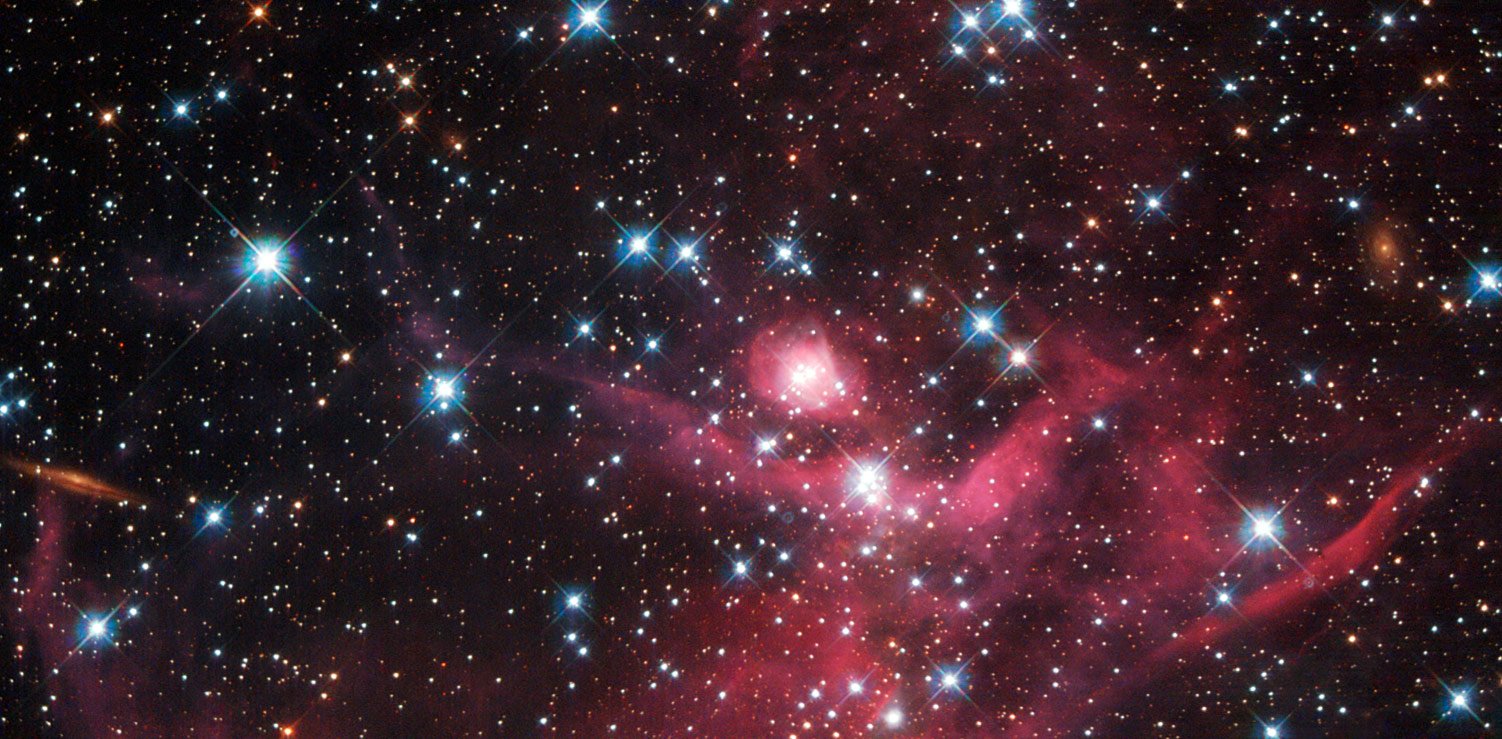
    New Hubble image shows a small part of the Large Magellanic Cloud. A group of small baby stars, most lighter than the Sun, forms a young stellar cluster called LH63. This cluster remains partially embedded in its birth cloud within the bright star-forming region known as the emission nebula LHA 120-N 51 or N51. It’s just one of many such regions teeming with young stars across the Large Magellanic Cloud. The red glow at the bottom of the image illuminates gas and dark dust, spanning light-years. As you move up and across, bright stars appear as sparse specks, resembling pinpricks in the cosmic tapestry. Credit: NASA, ESA, and D. Gouliermis (University of Heidelberg) Acknowledgement: Luca Limatola

    This newly released Hubble image shows a small part of the Large Magellanic Cloud.

    This stunning new Hubble image shows a small part of the Large Magellanic Cloud, one of the closest galaxies to our own. This collection of small baby stars, most weighing less than the Sun, form a young stellar cluster known as LH63. This cluster is still half-embedded in the cloud from which it was born, in a bright star-forming region known as the emission nebula LHA 120-N 51, or N51. This is just one of the hundreds of star-forming regions filled with young stars spread throughout the Large Magellanic Cloud.

    The burning red intensity of the nebulae at the bottom of the picture illuminates wisps of gas and dark dust, each spanning many light-years. Moving up and across, bright stars become visible as sparse specks of light, giving the impression of pin-pricks in a cosmic cloak.

    This patch of sky was the subject of observation by Hubble’s WFPC2 camera. Looking for and at low-mass stars can help us to understand how stars behave when they are in the early stages of formation, and can give us an idea of how the Sun might have looked billions of years ago.

    A version of this image was submitted to the Hubble’s Hidden Treasures image processing competition by contestant Luca Limatola.


    Never miss a breakthrough: Join the SciTechDaily newsletter.
    Follow us on Google and Google News.

    Astronomy Hubble Space Telescope Large Magellanic Cloud
    Share. Facebook Twitter Pinterest LinkedIn Email Reddit

    Related Articles

    Cotton Candy Clouds: Hubble Captures a Dwarf Galaxy in Stunning Detail

    Hubble Unveils the Brilliant Chaos of Star Birth in the Tarantula Nebula

    Hubble Spots a Dazzling Cluster in the Cloud

    Hubble Image of the Week – LMC and the Honeycomb Nebula

    Hubble Image of the Week – Glowing Gas and Dark Dust in the LMC

    Hubble Image of the Week – The Stars of the Large Magellanic Cloud

    Distance to the Large Magellanic Cloud Recalculated, Improves Hubble Constant

    Hubble Views the Large Magellanic Cloud and Its Star Forming Regions

    Hubble’s Close-Up View of the Tarantula Nebula

    1 Comment

    1. kamir bouchareb st on June 20, 2020 6:30 am

      good article thank you

      Reply
    Leave A Reply Cancel Reply

    • Facebook
    • Twitter
    • Pinterest
    • YouTube

    Don't Miss a Discovery

    Subscribe for the Latest in Science & Tech!

    Trending News

    Monster Storms on Jupiter Unleash Lightning Beyond Anything on Earth

    Scientists Create “Liquid Gears” That Spin Without Touching

    The Simple Habit That Could Help Prevent Cancer

    Millions Take These IBS Drugs, But a New Study Finds Serious Risks

    Scientists Unlock Hidden Secrets of 2,300-Year-Old Mummies Using Cutting-Edge CT Scanner

    Bread Might Be Making You Gain Weight Even Without Eating More Calories

    Scientists Discover Massive Magma Reservoir Beneath Tuscany

    Europe’s Most Active Volcano Just Got Stranger – Here’s Why Scientists Are Rethinking It

    Follow SciTechDaily
    • Facebook
    • Twitter
    • YouTube
    • Pinterest
    • Newsletter
    • RSS
    SciTech News
    • Biology News
    • Chemistry News
    • Earth News
    • Health News
    • Physics News
    • Science News
    • Space News
    • Technology News
    Recent Posts
    • Scientists Were Wrong About This Strange “Rule-Breaking” Particle
    • Webb Space Telescope Uncovers Unexpected Ice Clouds on a Jupiter-Like World
    • 289-Million-Year-Old Reptile Mummy Reveals Origin of Human Breathing System
    • New Brain Discovery Challenges Long-Held Theory of Teenage Brain Development
    • Sharks Are Overheating as Warming Oceans Push Them to the Edge
    Copyright © 1998 - 2026 SciTechDaily. All Rights Reserved.
    • Science News
    • About
    • Contact
    • Editorial Board
    • Privacy Policy
    • Terms of Use

    Type above and press Enter to search. Press Esc to cancel.