
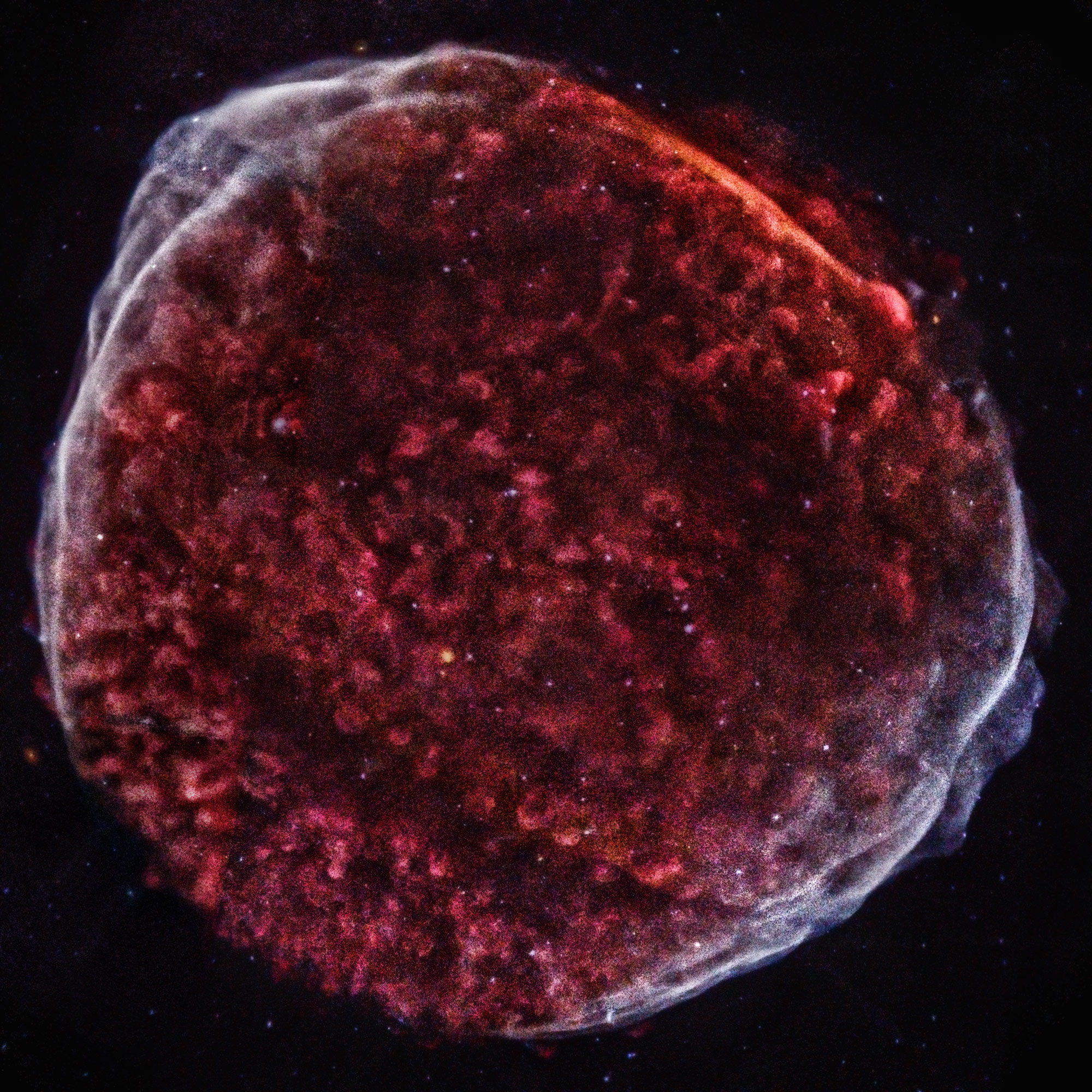
A newly released image of SN 1006 provides new details about the remains of an exploded star that was witnessed from Earth over a millennium ago.
This year, astronomers around the world have been celebrating the 50th anniversary of X-ray astronomy. Few objects better illustrate the progress of the field in the past half-century than the supernova remnant known as SN 1006.
When the object we now call SN 1006 first appeared on May 1, 1006 A.D., it was far brighter than Venus and visible during the daytime for weeks. Astronomers in China, Japan, Europe, and the Arab world all documented this spectacular sight. With the advent of the Space Age in the 1960s, scientists were able to launch instruments and detectors above Earth’s atmosphere to observe the Universe in wavelengths that are blocked from the ground, including X-rays. SN 1006 was one of the faintest X-ray sources detected by the first generation of X-ray satellites.
A new image of SN 1006 from NASA’s Chandra X-ray Observatory reveals this supernova remnant in exquisite detail. By overlapping ten different pointings of Chandra’s field-of-view, astronomers have stitched together a cosmic tapestry of the debris field that was created when a white dwarf star exploded, sending its material hurtling into space. In this new Chandra image, low, medium, and higher-energy X-rays are colored red, green, and blue respectively.
The Chandra image provides new insight into the nature of SN1006, which is the remnant of a so-called Type Ia supernova. This class of supernova is caused when a white dwarf pulls too much mass from a companion star and explodes, or when two white dwarfs merge and explode. Understanding Type Ia supernovas is especially important because astronomers use observations of these explosions in distant galaxies as mileposts to mark the expansion of the Universe.
The new SN 1006 image represents the most spatially detailed map yet of the material ejected during a Type Ia supernova. By examining the different elements in the debris field — such as silicon, oxygen, and magnesium — the researchers may be able to piece together how the star looked before it exploded and the order that the layers of the star were ejected, and constrain theoretical models for the explosion.
Scientists are also able to study just how fast specific knots of material are moving away from the original explosion. The fastest knots are moving outward at almost eleven million miles (18 million kilometers) per hour, while those in other areas are moving at a more leisurely seven million miles (11 million kilometers) per hour. SN 1006 is located about 7,000 light-years from Earth. The new Chandra image of SN 1006 contains over 8 days’ worth of observing time by the telescope. These results were presented at a meeting of High Energy Astrophysics Division of the American Astronomical Society in Monterey, California.
Reference: “X-ray Proper Motions and Shock Speeds along the Northwest Rim of SN 1006” by Satoru Katsuda, Knox S. Long, Robert Petre, Stephen P. Reynolds, Brian J. Williams and P. Frank Winkler, 11 January 2013, The Astrophysical Journal.
DOI: 10.1088/0004-637X/763/2/85
This work involved Frank Winkler, from Middlebury College in Middlebury, VT; Satoru Katsuda from The Institute of Physical and Chemical Research (RIKEN) in Saitama, Japan; Knox Long from Space Telescope Science Institute in Baltimore, MD; Robert Petre from NASA -Goddard Space Flight Center (GSFC) in Greenbelt, MD; Stephen Reynolds from North Carolina State University in Raleigh, NC; and Brian Williams from NASA -GSFC in Greenbelt, MD.
NASA’s Marshall Space Flight Center in Huntsville, Alabama, manages the Chandra program for NASA’s Science Mission Directorate in Washington. The Smithsonian Astrophysical Observatory controls Chandra’s science and flight operations from Cambridge, Massachusetts.
Never miss a breakthrough: Join the SciTechDaily newsletter.
Follow us on Google and Google News.