
Close Menu
    Facebook X (Twitter) Instagram
    SciTechDaily
    • Biology
    • Chemistry
    • Earth
    • Health
    • Physics
    • Science
    • Space
    • Technology
    Facebook X (Twitter) Pinterest YouTube RSS
    SciTechDaily
    Home»Space»New Juno Spacecraft Image of Jupiter’s Clouds
    Space

    New Juno Spacecraft Image of Jupiter’s Clouds

    By SciTechDailyJanuary 5, 2018No Comments1 Min Read
    Facebook Twitter Pinterest Telegram LinkedIn WhatsApp Email Reddit
    Share
    Facebook Twitter LinkedIn Pinterest Telegram Email Reddit
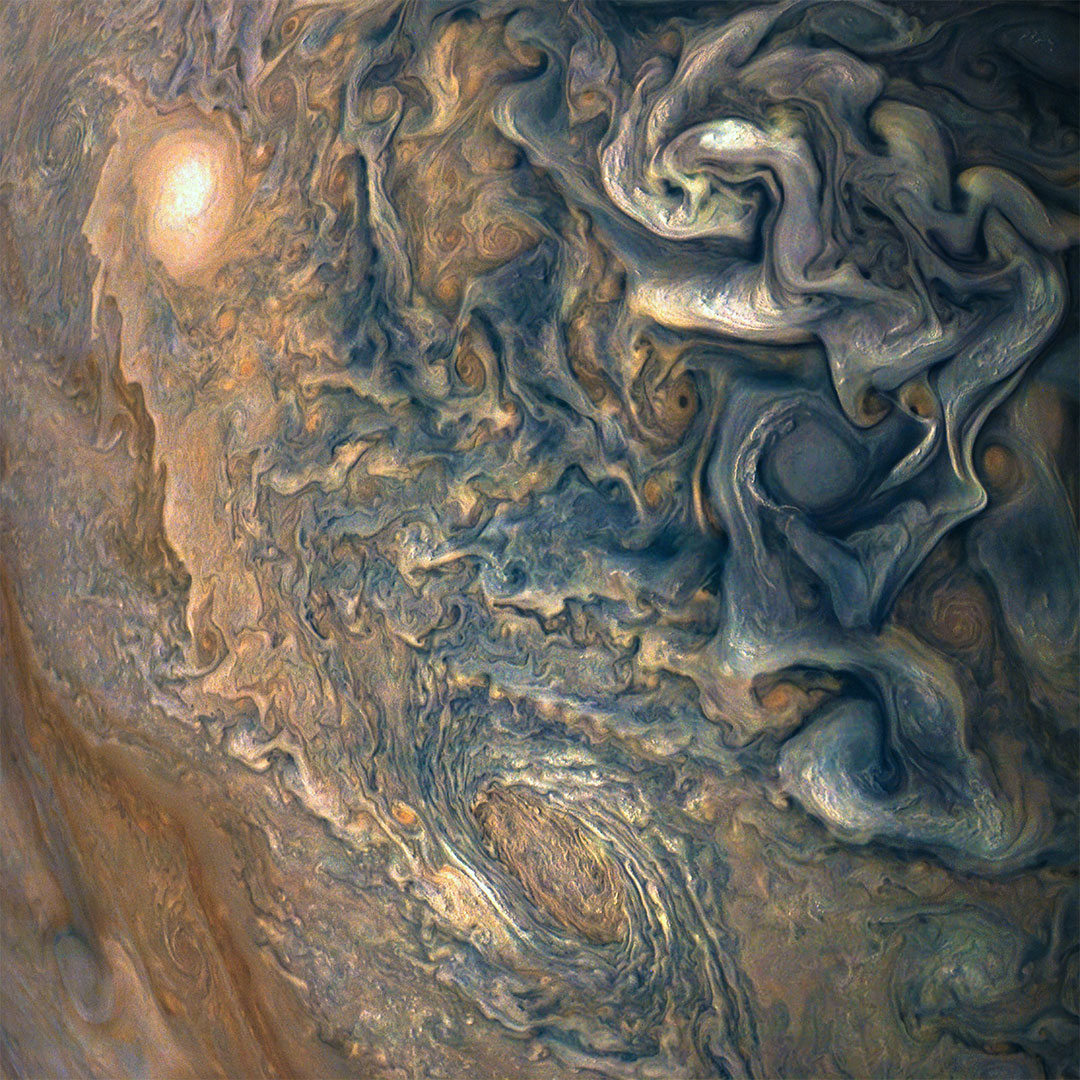
    New Juno Image From High Above Jupiter's Clouds
    Colorful, turbulent clouds in Jupiter’s northern hemisphere. Credit: NASA/JPL-Caltech/SwRI/MSSS/Gerald Eichstädt/Seán Doran

    NASA’s Juno spacecraft was a little more than one Earth diameter from Jupiter when it captured this mind-bending, color-enhanced view of the planet’s tumultuous atmosphere.

    Jupiter completely fills the image, with only a hint of the terminator (where daylight fades to night) in the upper right corner, and no visible limb (the curved edge of the planet).

    Juno took this image of colorful, turbulent clouds in Jupiter’s northern hemisphere on December 16, 2017 at 9:43 a.m. PST (12:43 p.m. EST) from 8,292 miles (13,345 kilometers) above the tops of Jupiter’s clouds, at a latitude of 48.9 degrees.

    The spatial scale in this image is 5.8 miles/pixel (9.3 kilometers/pixel).

    Citizen scientists Gerald Eichstädt and Seán Doran processed this image using data from the JunoCam imager.

    JunoCam’s raw images are available for the public to peruse and process into image products at: www.missionjuno.swri.edu/junocam

    Never miss a breakthrough: Join the SciTechDaily newsletter.
    Follow us on Google and Google News.

    Astronomy Juno Spacecraft Jupiter Planetary Science
    Share. Facebook Twitter Pinterest LinkedIn Email Reddit

    Related Articles

    Juno Mission Prepares for Jupiter Flyby

    Juno Images Provide an Unprecedented View of Jupiter

    A Billion or More Jupiter-Like Worlds Could Be Orbiting Stars in the Milky Way

    First In-orbit View from NASA’s Juno Spacecraft

    Juno Spacecraft in Orbit Around Jupiter

    Hubble Telescope Views Vivid Auroras in Jupiter’s Atmosphere

    NASA Juno Mission Trailer – Jupiter: Into the Unknown

    ScienceCasts Video: Close Encounters with Jupiter

    NASA’s Juno Spacecraft Adjusts Flight Path for Jupiter

    Leave A Reply Cancel Reply

    • Facebook
    • Twitter
    • Pinterest
    • YouTube

    Don't Miss a Discovery

    Subscribe for the Latest in Science & Tech!

    Trending News

    Giant Plasma Waves May Be Stripping Away Mars’ Atmosphere

    Scientists Thought SuperAgers Had Lucky Genes. They Were Wrong

    Astronomers Find Ancient Black Holes Shining With the Power of a Trillion Suns

    Researchers Solve Mystery Behind Contradictory Weight-Loss Drug Paradox

    Long-Lost Megalodon Fossils Found Hiding on a Museum Shelf

    Experimental Eye Drops Restore Sight in Blind Mice

    Scientists Discover the Brain May Enter a New Biological Phase Between 50 and 75

    New Research Reveals Autistic Brains Process Faces Differently

    Follow SciTechDaily
    • Facebook
    • Twitter
    • YouTube
    • Pinterest
    • Newsletter
    • RSS
    SciTech News
    • Biology News
    • Chemistry News
    • Earth News
    • Health News
    • Physics News
    • Science News
    • Space News
    • Technology News
    Recent Posts
    • Researchers Map the Hidden 3D Geometry of a Quantum Wavefunction
    • Lost in Space: Rare Cosmic Flare Exposes a Wandering Black Hole Far From Its Galaxy’s Center
    • Dark Matter May Be Leaving a Signal in Earth’s Atmosphere
    • Scientists Find Remarkable New Snail Species in Montenegro’s Mountains
    • Scientists Discover a 300-Million-Year-Old Geological Time Capsule Inside Fossilized Wood
    Copyright © 1998 - 2026 SciTechDaily. All Rights Reserved.
    • Science News
    • About
    • Contact
    • Editorial Board
    • Privacy Policy
    • Terms of Use

    Type above and press Enter to search. Press Esc to cancel.