
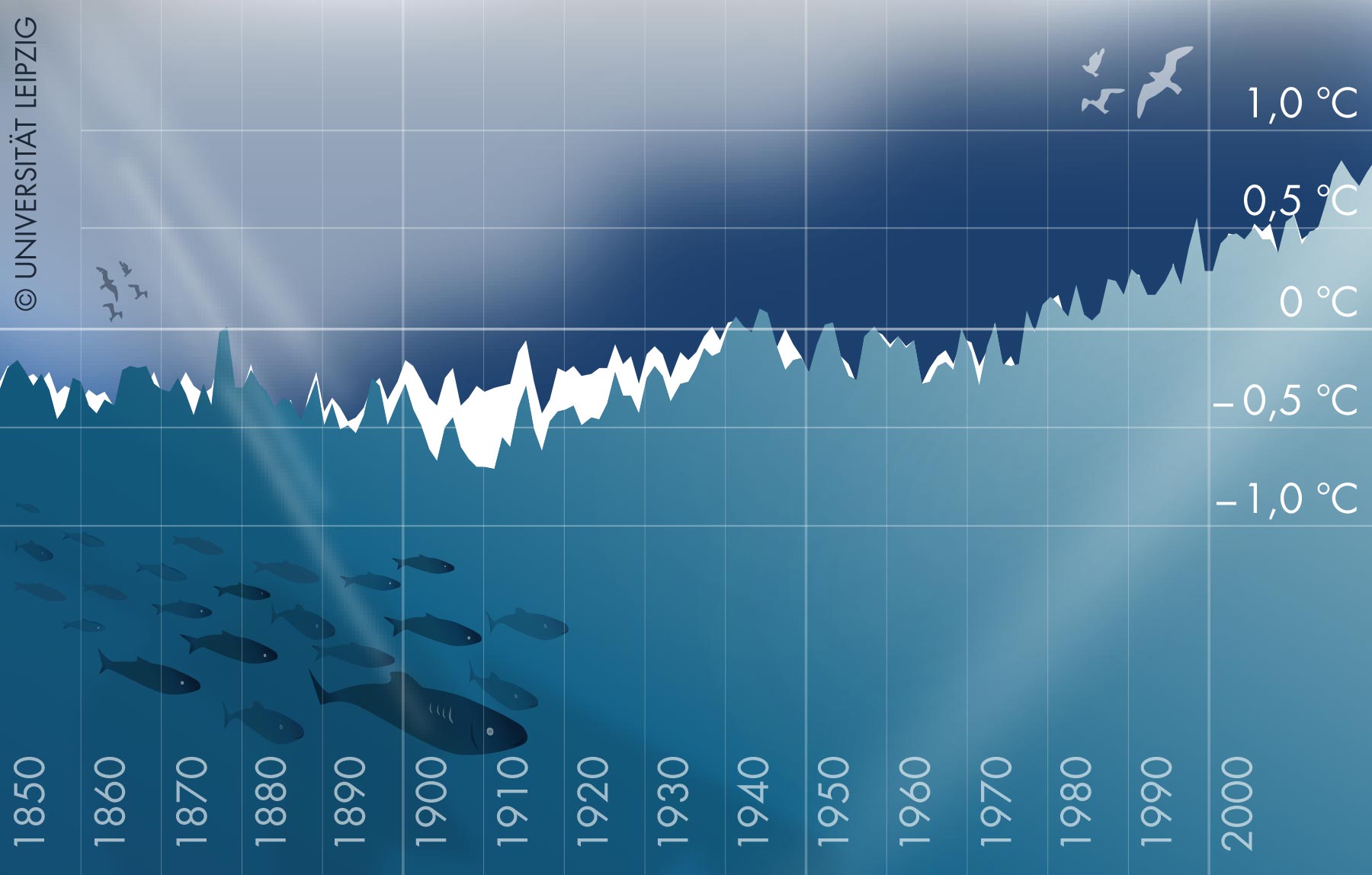
Researchers have uncovered inaccuracies in historical ocean temperature data, revealing that early 20th-century ocean temperatures were significantly colder than land measurements, contrary to previous models.
This discovery offers significant insights into past climate variability and future climate change. According to Dr. Sebastian Sippel, Junior Professor at Leipzig University, the findings do not alter our understanding of global warming relative to 1850–1900 or the role of human activity in driving that warming.
The 19th-century land and ocean temperatures (1850–1900), before the onset of the cold period, present a reliable and consistent picture of temperature changes up to today. However, addressing the inaccuracies in the cold period data could enhance confidence in the observed warming trends, refine our understanding of historical climate variability, and improve future climate models.
Insights From Historical Data Analysis
Accurately interpreting global temperature trends is vital for climate research. Dr. Sippel collaborated with international scientists to piece together global mean temperature trends using historical land and ocean measurements, along with palaeoclimatic data. During this reconstruction, Sippel identified a systematic discrepancy: in the early 20th century, ocean temperatures appeared cooler than in preceding decades, while land-based air temperatures remained steady. This mismatch contradicts both physical theories and established climate models.
Reevaluating Early 20th Century Climate Anomalies
Using many different lines of evidence, the new study shows that reconstructions of the global mean temperature from ocean surface data for this period are too cold: on average about 0.26 degrees Celsius colder than seen in land-based reconstructions. This discrepancy is greater than what would be possible under natural climate variability.
“Our latest findings do not change the long-term warming since 1850. However, we can now better understand historical climate change and climate variability,” says junior professor Dr. Sebastian Sippel.
For example, the reasons for the early 20th century warming period between 1900 and 1950 have never been fully understood. If the ocean temperatures are corrected, the warming trend of the early 20th century is weaker.
“The discrepancies between the climate models and the observed temperature trend at the beginning of the 20th century are mainly due to an incomplete understanding of the observations, rather than incomplete climate models or natural climate variability. There are well-established approaches to account for the effects of changing measurement methods on ocean surface temperature measurements. The new research shows that in the early 20th century these methods don’t properly account for very rapidly changing differences in the way the observations were made. Our new understanding confirms the climate models and shows even more clearly the human impact since pre-industrial times,” says co-author Professor Reto Knutti, Professor for Climate Physics at ETH Zurich.
Addressing Historical Measurement Challenges
The study itself offers indications that the cause of the ocean cold anomaly could lie in insufficiently documented information about the measurement techniques used at that time. Before the Second World War, ocean temperatures were mainly measured with buckets on ships, but the method of measurement and the composition of ship fleets changed from decade to decade, making it much more difficult to correct for systematic measurement errors.
The authors of the study therefore recommend a variety of approaches to data processing and analysis: “Our methodological approach emphasizes the need to continuously rescue and digitize historical climate data and compare it with independent data. At the same time, very different assumptions regarding systematic adjustments of early climate data should be tested, as the observational data are of central importance as a basis for climate understanding and modeling,” says Sippel.
Reference: “Early-twentieth-century cold bias in ocean surface temperature observations” by Sebastian Sippel, Elizabeth C. Kent, Nicolai Meinshausen, Duo Chan, Christopher Kadow, Raphael Neukom, Erich M. Fischer, Vincent Humphrey, Robert Rohde, Iris de Vries and Reto Knutti, 20 November 2024, Nature.
DOI: 10.1038/s41586-024-08230-1
Never miss a breakthrough: Join the SciTechDaily newsletter.
Follow us on Google and Google News.
11 Comments
if you cant prove climate change with current data then go back and change historical data to prove your false narative
The climate has changed in the past and will change in the future. No planet has the same climate all the time. In space, everything changes with time.
It is difficult to know who to believe when different researchers come to different conclusions. Results have to be replicable to be believable.
“This mismatch contradicts both PHYSICAL THEORIES and established climate models.
Notably missing from this press release, and the full article, is any mention of the significant difference in the specific heat capacity of water versus terrestrial materials and air. One would expect that the multidecadal variability of SST would be smaller than LSAT, and SST temperatures would lag changes in LSAT temperatures, based on physical theories. That does not seem to be reflected in the lede graph. Also, it appears to display ‘anomalies’ (or more properly called residuals) rather than “temperatures,” as labeled.
My understanding of climate change is that the so called “consensus” about it is a lie. And that’s enough for me to conclude it’s just a hoax. Not entirely deliberate, not entirely with a malicious purpose, but a hoax nevertheless.
Where do you get your “understanding” from? Just because someone writes something on the internet doesn’t make it true. It needs to be based on facts that are verifiable. Anything less and it is in the category of gossip.
What evidence do you have that it isn’t malicious. This is a science website. There should at least be a good reason for believing or denying a claim. Just because one likes the sound of something says more about their political leaning than it does about the scientific validity of a hypothesis.
Oh, but he has an “understanding”. Trump would call this a gut feeling, while others may see it as a bodily function for eliminating waste.
Ignoring a ‘gut feeling,’ or general discomfort with a situation, is done at one’s peril. That is, society should not go BLINDLY where Man has not gone before. However, before society is turned on its head, or large amounts of money are spent, a prudent society would thoroughly investigate the situation to see if there is evidence for or against what is a tenuous hypothesis. It is surprising how many people stumble through life, oblivious to what is happening around them, and never questioning what is being done and why.
My point was that opinions should be based on articulated and verified facts, not just political leanings — or politically-motivated insults. Again, this is a science website, not an outlet for political Op-Eds.
It’s funny, weren’t they the whole F you feelings party ?? Yet now that’s all they seem to go on
So why are sweeden france spain and china all spending money on this hoax? Your saying that an american enemy (china) and possibly the smartest country (sweeden) are so rapped up in american democratic propaganda that they are spending tons of money on a hoax?
The battle of sensationalism pro con opinions of positive and negative effects . so familiar of a historical value of change in our understanding of life on earth , ya it’s to bad we all are not carved from the same building blocks but that would not fit our need for difference in how we look . we moved from walking to riding animals then we moved from that to traveling on machines and we are moving to another new age that wants more out of our sole single earth environment , can we make a world that doesn’t compete with our environment or not is the question . we aren’t going anywhere else soon so our environment needs even more attention because at this point in time there has not ever been as many people on the earth .