
Close Menu
    Facebook X (Twitter) Instagram
    SciTechDaily
    • Biology
    • Chemistry
    • Earth
    • Health
    • Physics
    • Science
    • Space
    • Technology
    Facebook X (Twitter) Pinterest YouTube RSS
    SciTechDaily
    Home»Science»New Species of “Living Fossil” Fish Found Hiding in Plain Sight After 150 Years
    Science

    New Species of “Living Fossil” Fish Found Hiding in Plain Sight After 150 Years

    By University of BristolSeptember 16, 20251 Comment3 Mins Read
    Facebook Twitter Pinterest Telegram LinkedIn WhatsApp Email Reddit
    Share
    Facebook Twitter LinkedIn Pinterest Telegram Email Reddit
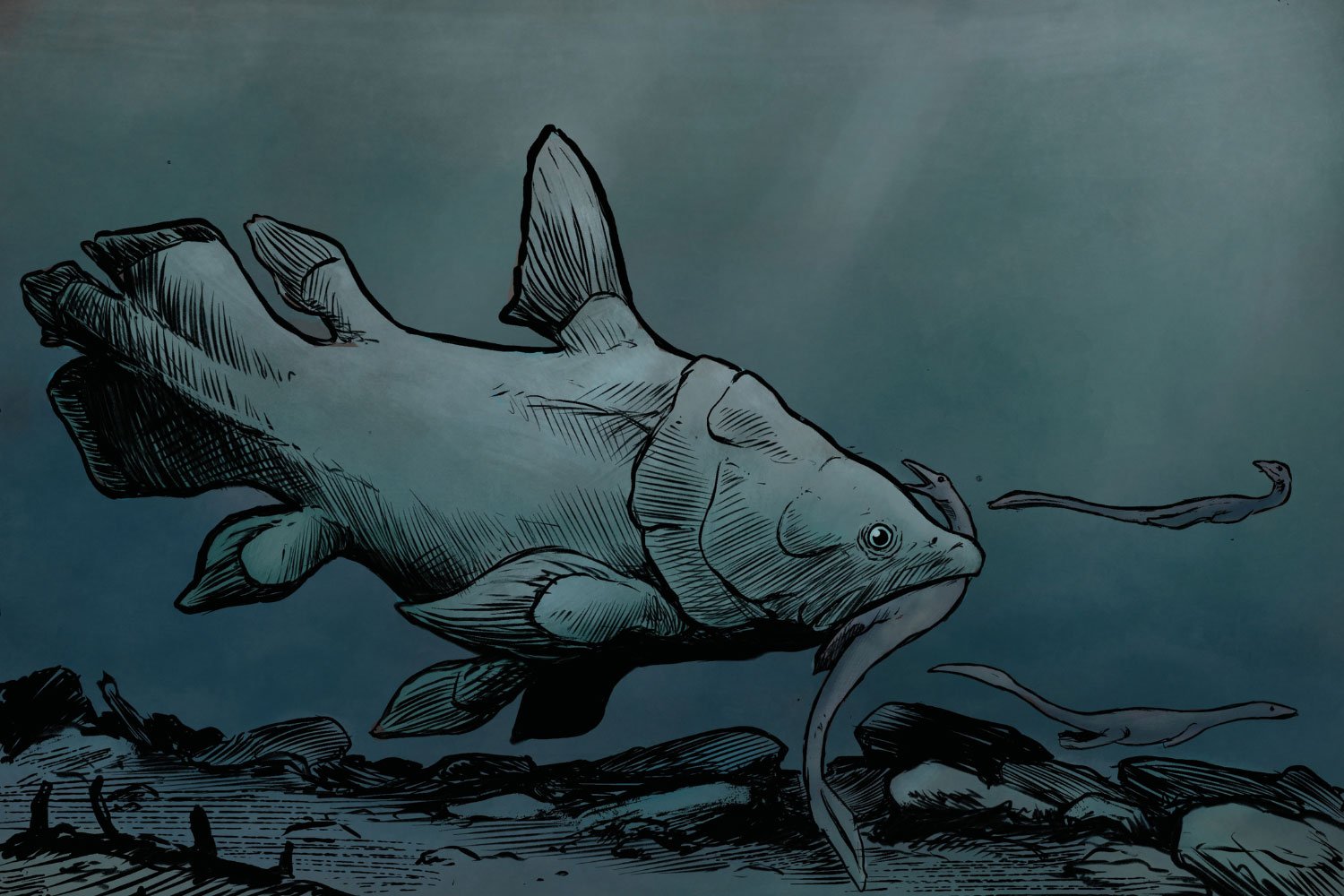
    Reconstruction of a Large Mawsoniid Coelacanth
    Reconstruction of a large mawsoniid coelacanth from the British Rhaetian. Credit: Daniel Phillips

    Researchers found dozens of Triassic coelacanth fossils in UK museums. The fish were once mistaken for reptile bones.

    The coelacanth is often called a “living fossil.” Once believed to have vanished millions of years ago, it was unexpectedly rediscovered in 1938 when one was caught in the Indian Ocean.

    Since then, several more specimens have been documented, yet their fossil record has remained incomplete. In a recent study, Jacob Quinn and his collaborators from the University of Bristol and the University of Uruguay uncovered coelacanth fossils in museum collections that had gone unnoticed for over 150 years.

    Fossils from the Triassic seas

    The newly identified specimens date to the closing stages of the Triassic Period, around 200 million years ago, when the region that is now the UK was positioned in more tropical latitudes.

    “During his Master’s in Palaeobiology at Bristol, Jacob realised that many fossils previously assigned to the small marine reptile Pachystropheus actually came from coelacanth fishes,” said Professor Mike Benton, one of Jacob’s supervisors. “Many of the Pachystropheus and coelacanth fossils have uncanny similarities, but importantly, Jacob then went off to look at collections around the country, and he found the same mistake had been made many times.”
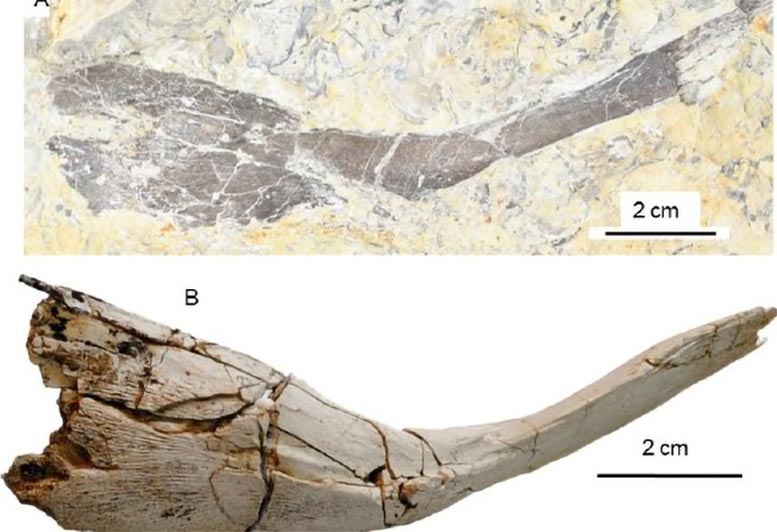
    Comparison Between the Clavicles of the British Triassic and Mawsonia Gigas
    Comparison between clavicles (collar bones) from (A) the British Triassic and (B) the largest known coelacanth, Mawsonia gigas, from the Cretaceous of Brazil. Credit: University of Bristol

    “It is remarkable that some of these specimens had been sat in museum storage facilities, and even on public display, since the late 1800s, and have seemingly been disregarded or identified as bones of lizards, mammals, and everything in-between,” said Jacob. He continued “from just four previous reports of coelacanths from the British Triassic, we now have over fifty.”

    Jacob made X-ray scans of many specimens to confirm the identifications. The specimens mostly belong to an extinct group of coelacanths, the Mawsoniidae, but are closely related to the living fish.

    Insights into ancient ecosystems

    Co-author Pablo Toriño, a world expert on coelacanths, located in Uruguay, added, “Although the material we identify occurs as isolated specimens, we can see that they come from individuals of varying ages, sizes, and species, some of them up to one metre long, and suggesting a complex community at the time.”

    “The coelacanth fossils all come from the area of Bristol and Mendip Hills, which in the Triassic was an archipelago of small islands in a shallow tropical sea,” said co-supervisor Dr David Whiteside. “Like modern-day coelacanths, these large fishes were likely opportunistic predators, lurking around the seafloor and eating anything they encountered, probably including these small Pachystropheus marine reptiles, which is ironic given their fossils have been confused with those of coelacanths for decades.”

    Reference: “Coelacanthiform fishes of the British Rhaetian” by Jacob G. Quinn, David I. Whiteside, Pablo Toriño, Evangelos R. Matheau-Raven and Michael J. Benton, 7 September 2025, Journal of Vertebrate Paleontology.
    DOI:10.1080/02724634.2025.2520921

    Never miss a breakthrough: Join the SciTechDaily newsletter.
    Follow us on Google and Google News.

    Evolutionary Biology Fossils Paleontology University of Bristol
    Share. Facebook Twitter Pinterest LinkedIn Email Reddit

    Related Articles

    “Unlike Anything Yet Discovered”: New Fossil Rewrites Our Understanding of Reptile Evolution

    Three-Eyed “Fossil Monster” – 520 Million-Year-Old Fossil Reveals Amazing Detail of Early Animal Evolution

    500-Million-Year-Old Fossil Reveals Astonishing Secrets of a Strange Group of Marine Invertebrates

    Scientists Discover That Extremely Rare Collection of 160-Million-Year-Old Sea Spider Fossils Are Closely Related to Living Species

    The Ancient Dietary Secrets of Elephants: A Tale of Evolution and Adaptation

    Bizarre: Scientists Discover New Species of Mosasaur With Strange “Screwdriver Teeth”

    Controversial Prehistoric Egg Identified To Be the Last of the “Demon Ducks of Doom”

    What Came First, the Animal or the Embryo? New Research Has Answer

    Turtles Share a Recent Common Ancestor with Birds and Crocodiles

    1 Comment

    1. Michael Coos on September 17, 2025 5:32 pm

      So much for evolution!

      Reply
    Leave A Reply Cancel Reply

    • Facebook
    • Twitter
    • Pinterest
    • YouTube

    Don't Miss a Discovery

    Subscribe for the Latest in Science & Tech!

    Trending News

    Mezcal “Worm” in a Bottle Mystery: DNA Testing Reveals a Surprise

    New Research Reveals That Your Morning Coffee Activates an Ancient Longevity Switch

    This Is What Makes You Irresistible to Mosquitoes

    Shockingly Powerful Giant Octopuses Ruled the Seas 100 Million Years Ago

    Scientists Stunned by New Organic Molecules Found on Mars

    Rewriting Dinosaur Evolution: Scientists Unearth Remarkable 150-Million-Year-Old Stegosaur Skull

    Omega-3 Supplements Linked to Cognitive Decline in Surprising New Study

    First-of-Its-Kind Discovery: Homer’s Iliad Found Embedded in a 1,600-Year-Old Egyptian Mummy

    Follow SciTechDaily
    • Facebook
    • Twitter
    • YouTube
    • Pinterest
    • Newsletter
    • RSS
    SciTech News
    • Biology News
    • Chemistry News
    • Earth News
    • Health News
    • Physics News
    • Science News
    • Space News
    • Technology News
    Recent Posts
    • New Research Challenges Long-Held Beliefs About How the Brain Makes Decisions
    • Breakthrough Technology Reveals New Treatment Targets for Cancer
    • Scientists Discover New Way To Make Drug-Resistant Cancer Treatable Again
    • This Simple Exercise Trick Builds Muscle With Less Effort, Study Finds
    • Middle Age Is Becoming a Breaking Point in America, Study Reveals
    Copyright © 1998 - 2026 SciTechDaily. All Rights Reserved.
    • Science News
    • About
    • Contact
    • Editorial Board
    • Privacy Policy
    • Terms of Use

    Type above and press Enter to search. Press Esc to cancel.