
Close Menu
    Facebook X (Twitter) Instagram
    SciTechDaily
    • Biology
    • Chemistry
    • Earth
    • Health
    • Physics
    • Science
    • Space
    • Technology
    Facebook X (Twitter) Pinterest YouTube RSS
    SciTechDaily
    Home»Health»New Study: This Plant-Based Beverage Could Be the Key to Treating Trauma-Related Disorders
    Health

    New Study: This Plant-Based Beverage Could Be the Key to Treating Trauma-Related Disorders

    By Genomic PressDecember 9, 2024No Comments3 Mins Read
    Facebook Twitter Pinterest Telegram LinkedIn WhatsApp Email Reddit
    Share
    Facebook Twitter LinkedIn Pinterest Telegram Email Reddit
    Ayahuasca Brew on Drum
    A review consolidates evidence on ayahuasca’s effects on fear, anxiety, and emotional processing, emphasizing its therapeutic potential for PTSD and anxiety disorders while calling for more clinical trials.

    A new analysis summarizes a decade of research on the effects of a psychedelic brew on anxiety and trauma responses.

    With the rising interest in psychedelic medicine, researchers have compiled a decade of evidence to explore how ayahuasca impacts fear and anxiety in the brain. A recent review in Psychedelics brings together insights from molecular studies, animal experiments, and human clinical trials, providing a comprehensive understanding of how this traditional Amazonian brew influences emotional processing and memory systems.

    The analysis, led by Lorena Terene Lopes Guerra and colleagues at the University of São Paulo, examines the growing body of evidence about ayahuasca’s complex interactions with brain systems involved in emotional processing and memory, with particular focus on its effects through two distinct serotonin receptor systems.

    Insights from Serotonin Receptors

    “Understanding how signals coordinate the processes in cells, tissues, and organs is fundamental to grasping ayahuasca’s potential therapeutic applications,” explains Dr. Rafael Guimarães dos Santos, one of the review’s authors. “By examining evidence across multiple levels – from receptor interactions to clinical outcomes – we can better understand how this traditional medicine might help treat anxiety and trauma-related disorders.”
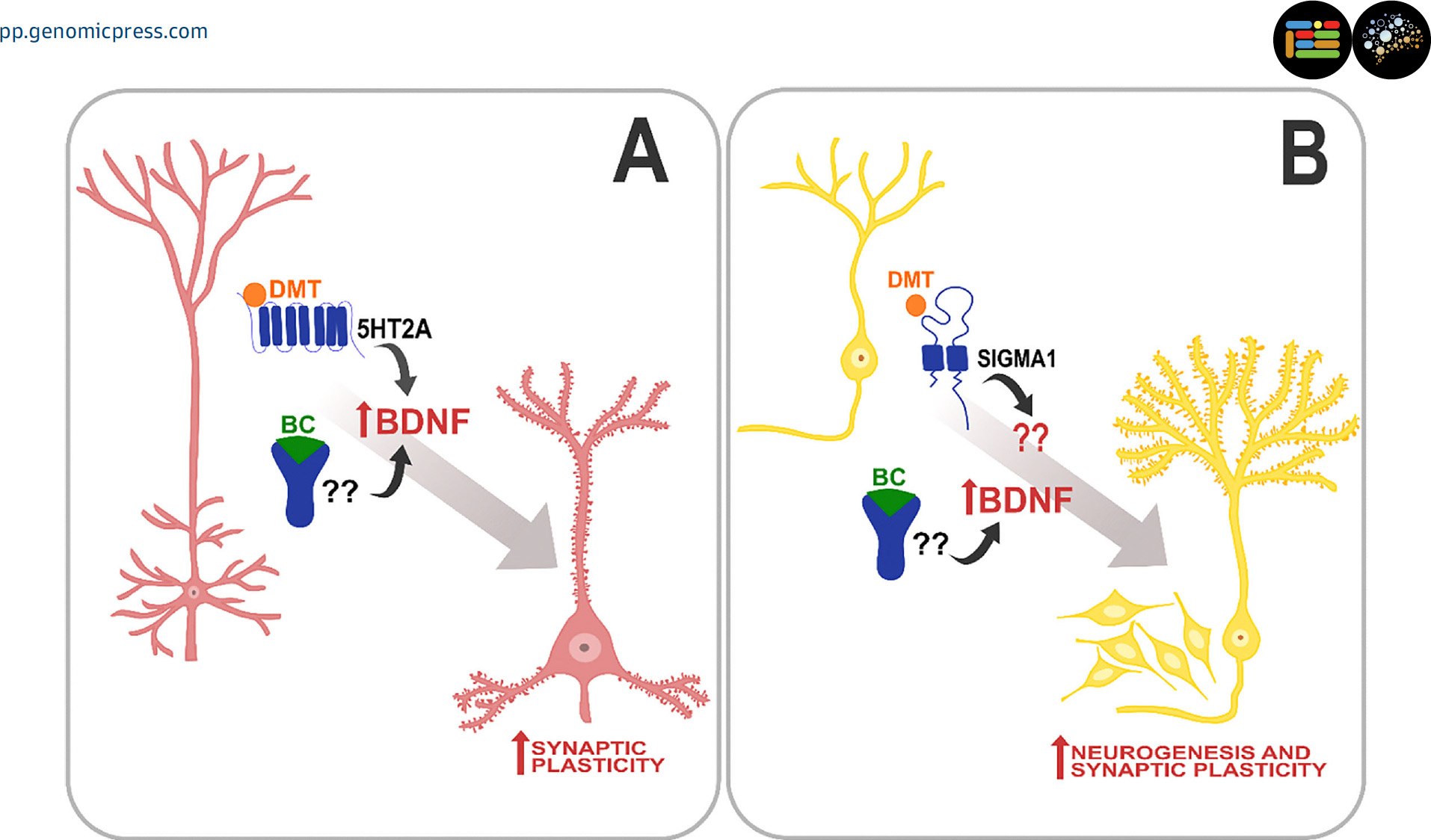
    Plasticity Promoting Mechanisms Triggered by Dimethyltryptamine and β Carboline
    Plasticity-promoting mechanisms triggered by dimethyltryptamine (DMT) and β-carboline (BC). (A) DMT and BC-induced increase in cortical plasticity are linked to enhanced BDNF levels, although this might result from the activation of different receptors. (B) Increased hippocampal plasticity and neurogenesis induced by DMT and BC rely on different molecular pathways. 5HT2A: serotonergic receptor 2A subtype; BC: β-carboline; BDNF: brain-derived neurotrophic factor;DMT: N,N-dimethyltryptamine; SIGMA1: sigma receptor subtype 1. Credit: Rafael Guimarães dos Santos

    The review synthesizes evidence showing that ayahuasca’s effects involve a delicate balance between two serotonin receptor types: 5-HT2A and 5-HT1A. This dual action appears crucial for understanding both the immediate effects of ayahuasca and its potential long-term therapeutic benefits.

    Key Findings on Emotional Processing and Memory

    Key findings from the reviewed literature include:

    • Ayahuasca’s main component, DMT, acts primarily through 5-HT2A receptors to influence emotional processing
    • The brew’s β-carboline compounds may work through different mechanisms to affect memory and anxiety
    • Clinical studies suggest specific effects on fear extinction and emotional processing
    • Brain imaging studies show ayahuasca modulates activity in regions crucial for emotional regulation

    The synthesis of available evidence raises important questions about ayahuasca’s therapeutic potential. Can the timing of ayahuasca administration be optimized for treating specific conditions? Might different preparations of ayahuasca be more effective for different therapeutic purposes? How do individual differences in receptor systems affect treatment outcomes?

    Current evidence reviewed suggests ayahuasca might be particularly promising for treating PTSD and anxiety disorders. However, Dr. dos Santos emphasizes the need for more controlled clinical trials: “While the preclinical and observational evidence is encouraging, we need more rigorous clinical studies to understand the optimal therapeutic applications.”

    The review also examines safety considerations and the importance of controlled settings for therapeutic use, noting that ayahuasca’s complex nature requires careful consideration of individual patient factors.

    Reference: “Effects of ayahuasca on fear and anxiety: cross-talk between 5HT1A and 5HT2A receptors” by Lorena Terene Lopes Guerra, Rafael Guimarães dos Santos and Jaime Eduardo Cecilio Hallak, 10 December 2024, Psychedelics.
    DOI: 10.61373/pp024i.0037;

    Never miss a breakthrough: Join the SciTechDaily newsletter.
    Follow us on Google and Google News.

    Mental Health Psychedelics PTSD Serotonin
    Share. Facebook Twitter Pinterest LinkedIn Email Reddit

    Related Articles

    Promising New Treatment Could Calm Anxiety for Millions of Americans

    Psychedelics Boost Brain Flexibility for Weeks, New Study Shows

    Rapid Relief: Ketamine’s Surprisingly Swift Treatment of PTSD and Depression

    Increased Myelin in Brain’s Gray Matter Linked to Anxiety and PTSD

    Psychedelic Drug From Magic Mushrooms – Psilocybin – Can Be Safely Administered With No Detrimental Effects in Healthy People

    Ketamine Therapy Quickly Reduces Depression and Suicidal Thoughts

    Psychedelics Show Promise in Treating Mental Illness: Depression, Anxiety, Addiction, and PTSD

    New Research Uncovers Details Behind Depression, PTSD, and the Body’s Response to Stress

    Five Most Likely Causes of Post-traumatic Stress in Police Officers Identified in New Research

    Leave A Reply Cancel Reply

    • Facebook
    • Twitter
    • Pinterest
    • YouTube

    Don't Miss a Discovery

    Subscribe for the Latest in Science & Tech!

    Trending News

    Popular Weight-Loss Drugs Like Ozempic Linked to Lower Breast Cancer Risk

    AI Learned the Rules of the Universe and That Became a Problem

    Scientists Found a Hidden Brain Signal That Predicts Social Behavior

    Even GPT-5 Failed This Human Attention Test

    Scientists Discover a Biological Clock Unlike Anything Seen Before

    The Brain May Not Need Full Sleep To Recover, New Research Finds

    Your Gut Microbes May Decide How Many Calories You Really Absorb

    Millions Take This Joint Supplement but Scientists Found a Concerning Alzheimer’s Link

    Follow SciTechDaily
    • Facebook
    • Twitter
    • YouTube
    • Pinterest
    • Newsletter
    • RSS
    SciTech News
    • Biology News
    • Chemistry News
    • Earth News
    • Health News
    • Physics News
    • Science News
    • Space News
    • Technology News
    Recent Posts
    • This AI Learned the Laws of Physics and Could Accelerate Quantum Computing Breakthroughs
    • How Flocking Birds “Defy” One of Physics’ Most Fundamental Laws
    • Your GPS Lies in Cities. Scientists Finally Fixed It
    • Physicists Create a New Kind of Schrödinger’s Cat State From Exotic Quantum Building Blocks
    • One Simple Food Swap Could Cut Carbon Emissions As Much as a Flight Across Europe
    Copyright © 1998 - 2026 SciTechDaily. All Rights Reserved.
    • Science News
    • About
    • Contact
    • Editorial Board
    • Privacy Policy
    • Terms of Use

    Type above and press Enter to search. Press Esc to cancel.