
How confusing inevitability with reality built decades of paradox.
What if general relativity never actually tells us that black holes already exist, but only that their formation is inevitable in an infinite future we can never observe? In a new theory, Daryl Janzen, a physicist at the University of Saskatchewan in Saskatoon, Canada, questions whether we’ve mistaken mathematical inevitability for physical reality, and shows how much of our black hole story rests on that quiet leap.
Black holes are among the most captivating and scientifically intriguing phenomena in modern physics, inspiring both scientists and the public alike.
But do they really exist? What if they are only ever forming, never formed?
Just imagine — what if the whole edifice of black hole physics is built on an invalid logical inference that’s gone unnoticed (or unacknowledged?) for the better part of a century?
Inevitability is not actuality — that’s obvious enough. Yet for sixty years physicists have ignored relativity’s most basic rule, and we’ve taken for granted that the latter is implied by the former. Like fools walking around imagining we’re all dead because someday we’ll die, they look at the evidence that nothing can stop black holes from collapsing toward their horizons and imagine that a process which remains forever incomplete has already come to its end.
Consider the following. We build a spaceship with three items onboard: a hot cup of coffee, a thermometer to measure the coffee’s temperature, and a clock that measures the arctangent of elapsed time since launch. The ship, which has perfect insulating walls, is launched — and through some future technological innovation it is capable of constant proper acceleration away from Earth for all time.
A continuous signal is transmitted back to Earth, sending two pieces of information: the coffee’s temperature and the arctangent time.
According to Newton’s Law of Cooling, the coffee’s temperature will approach the ambient cabin temperature exponentially and asymptotically — meaning it will very quickly approach the cabin temperature, but it actually takes infinite time to reach equilibrium. Therefore, the temperature value sent back to Earth will exponentially approach a finite value, but it will only reach that value exactly in the infinite future.
Since the elapsed time is sent back as its arctangent, that value will also asymptotically approach a finite value of π/2 in the infinite future.
And since the ship will be forever accelerating, the signal that transmits this information will quickly become practically invisible due to redshift. However, in principle the signal will forever be received back on Earth, as the coffee gradually cools and elapsed time increases — all while the ship’s velocity asymptotically approaches the speed of light.
A lost signal, rediscovered
Now imagine that the signal is lost, humanity forgets the experiment, and all records of the spaceship’s existence are lost. Centuries later, an advanced civilization picks up the very weak signal and observes that it’s still continually transmitting the two values.
After some observation, they determine that both values are gradually changing — that they’re asymptotically approaching finite limits. Thus, they know that no matter how long they wait they’ll never observe either of the transmitted values grow or decay beyond those limits.
These scientists are aware that because of the finite speed of light, the values they observe are not the ones presently associated with the physical object. They occurred some time in its past, when the signal was sent.
Due to the experiment’s basic physical setup, it is perfectly clear to us that the two values can’t ever reach their asymptotic limits. But the scientists observing the signal don’t know this. To them, the values very well could be approached asymptotically — or it may be that “now, out there” they’ve already evolved beyond the asymptotic limits, even though they’ll never be seen to reach that state.
But as scientists, they also know this ontological question is meaningless. From an empirical standpoint, from Earth all they can ever know is: when the signal they now observe was emitted, the values were still approaching their asymptotic limits.
And those values will never appear to have been reached “already” — no matter how long they wait.
But still, they wonder: what happens locally after the one value reaches π/2 and the other drops to its asymptotic limit? Surely, the arctangent-like value won’t simply end at a finite number, nor should the exponential decay flatten completely. In reality, has the event where the two values are reached already happened, or is it still to come?
Gravitational collapse to a black hole
The scenario just described mirrors, in all its basic features, the general relativistic description of spherically symmetric collapse to a black hole’s event horizon.
In that scenario, when the radius of a star collapses to the finite value of its event horizon, only a finite amount of proper time will have passed on a clock carried by a particle at its surface. These two values — the star’s radius and the elapsed time since it started collapsing — are approached in essentially the same manner as the coffee’s temperature approaches its asymptotic limit while the arctangent time approaches π/2.
And from the standpoint of external observation, the light emitted outwards from a collapsing star exponentially fades and quickly becomes invisible — though in principle, no matter how long an external observer waits, they will forever “observe” that when the light they are now receiving was emitted, the star still had not collapsed below its event horizon — just as the future civilization above will forever see that the coffee hadn’t yet reached equilibrium when the signal now being observed was sent.
But regardless of which past events are observed now, we’d also like to know whether collapsing stars should be thought to have already crossed this observational threshold, or if they are more accurately thought of as still approaching their event horizons.
In essence, while the image of the star freezes and fades, we’d like to know: Do gravitationally collapsing stars really pass through their event horizons and form massive singularities in our universe? Or, do they instead remain forever collapsing toward their event horizons, approaching asymptotic limits in both radius and proper time just as, in reality, the coffee’s temperature approaches equilibrium with the ship’s cabin while the arctangent time approaches π/2?
Spherical gravitational collapse geometry
General relativistic space-time diagrams are analogous to map projections of the globe, such as the Mercator projection. The key difference is that, instead of projecting Earth’s curved surface onto a flat plane, a space-time diagram projects two dimensions of space-time: one spatial dimension, and time. General relativity treats space-time as a curved geometry, much like the curved surface of Earth.
The figure below shows the same gravitational collapse scenario in three diagrams of the same underlying geometry. This is the Schwarzschild geometry, which describes a spherically symmetric gravitational field. The projection shown is the ingoing Eddington–Finkelstein diagram, which is commonly used to illustrate spherical gravitational collapse.
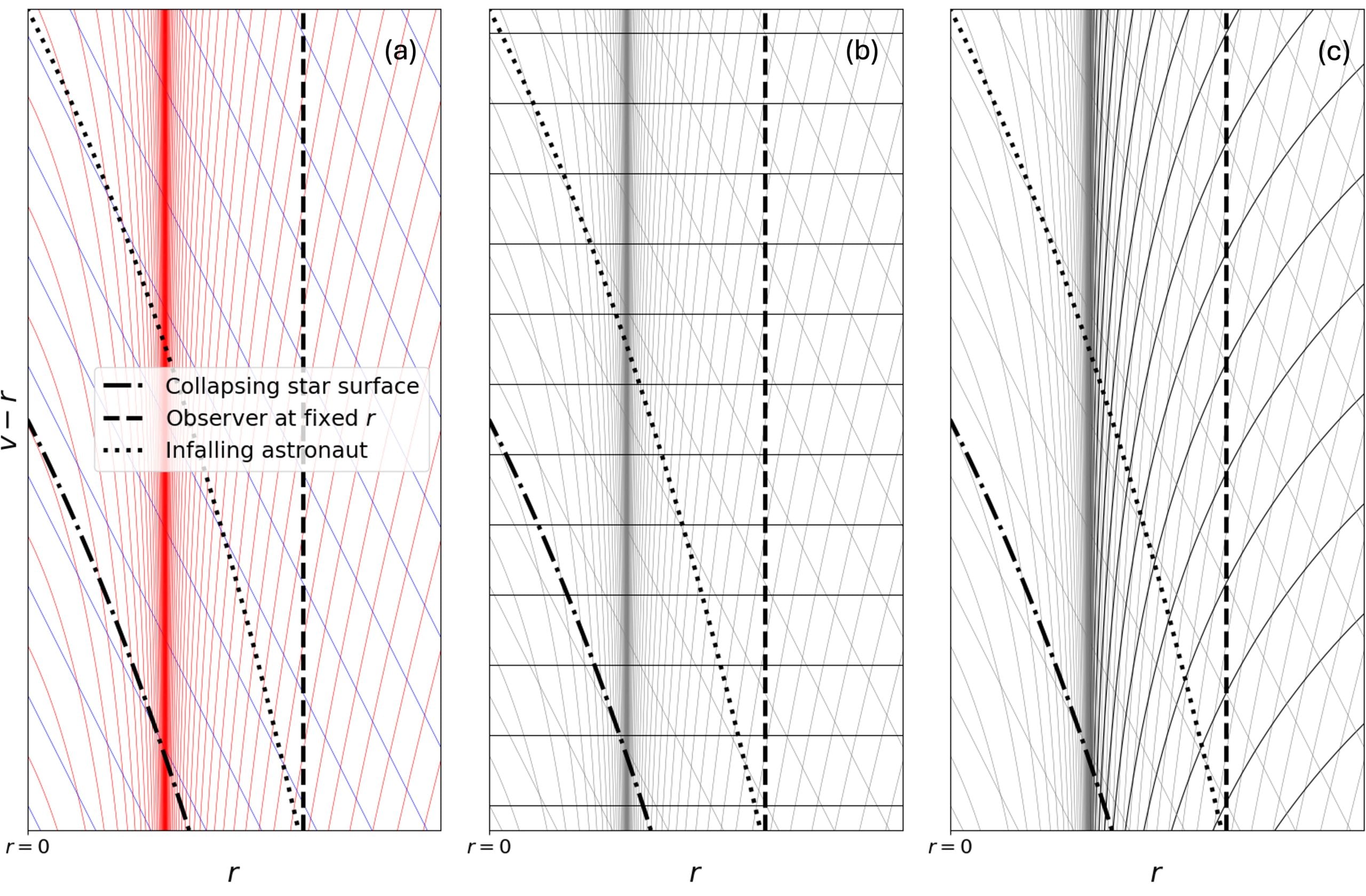
The three diagrams differ only in the way they represent “space” at successive instants of time: panel (a) shows none, panel (b) uses horizontal black lines, and panel (c) uses curved black lines. Credit: Daryl Janzen
The red and blue lines in panel (a) (which are both gray in panels (b) and (c)) show the light cone structure — namely, the paths that photons take when moving radially in this geometry. “Infalling” photons, shown in blue, follow straight, tilted paths and reach r = 0 in finite intervals. “Outgoing” photons, shown in red, only actually move outwards when they are outside the “event horizon” (where the lines bunch together and become vertical). Near the event horizon, the “outgoing” photon lines tilt toward vertical, so an outward-directed photon remains forever at the same radius there. The broad band of nearly-vertical red lines shows how photons close to, but not precisely at, the horizon take increasingly long to escape. Inside the horizon the photon lines actually tilt inward, so even “outward”-directed photons must evolve toward r = 0 in this region.
Three world lines are also shown: the surface of a star, which begins collapsing from a radius outside the horizon, crosses the horizon and reaches r = 0 after a finite interval; an infalling astronaut, who follows a similar path starting from a larger radius; and an observer who remains forever at fixed r outside the collapsing star.
Different interpretations
General relativity is agnostic about which distant events are coincident with one another. This is by design: whether or not any two particular events occur “simultaneously” is not supposed to have any objective meaning in standard general relativistic descriptions. Panel (a) is therefore a faithful representation of the collapse scenario that makes no interpretive leaps. After the star begins collapsing, it inevitably reaches an event horizon after a finite proper time has elapsed, for instance — just as the coffee’s temperature reaches equilibrium in finite arctangent time.
But when does that event occur, for instance, from the perspective of the observer who remains outside?
Panels (b) and (c) present two fundamentally different interpretations of collapse that may be given from an external observer’s perspective, based on two different descriptions of “now” that are available to them — namely, the solid black lines. Panel (b) presents the canonical interpretation: at some finite “time” the star’s surface plunges beneath its event horizon, then “later” it forms a singularity at r = 0; shortly “after” that, the infalling astronaut also crosses the horizon, and “later,” at the top of the panel, also reaches the singularity.
“All the while,” the outside observer remains at fixed r. Additionally, because of the tilting of the photon lines, no matter how long they wait, they will always in principle be able to see the surface of the star and the infalling astronaut as they “were, before” reaching the horizon. While any light from the collapsing star or signal from the infalling astronaut must soon be gravitationally redshifted beyond detectability, the outside observer will in principle always see photons that were emitted “before” the star reached the horizon.
But this is a Cartesian reading of a flat projection of a curved manifold — a move that any geographer would immediately recognize as naïve.
Alternatively, the gravitational collapse scenario can be interpreted with respect to the solid black “now” lines in panel (c) (in fact, these are the lines relevant in the derivation of the geometry as a spherically symmetric space-time). In that scenario, the star begins collapsing “first,” then “later on” the infalling astronaut dives in as well. “Subsequently,” they both reach the event horizon “simultaneously,” each after finite proper time has elapsed — but only after infinite time has passed from the perspective of the outside observer. Since “now” is meaningless “after” infinite time has passed, these spacelike “now” lines do not extend beyond the horizon, which is in the infinite “future” in this scenario.
General relativity doesn’t specify
General relativity does not tell us which of these two alternative interpretations is true. General relativity is, by its very design, agnostic about which simultaneity structure, and therefore which of the two distinct ontological readings of this space-time, accurately represents “external reality” at any moment from the outside observer’s perspective. Therefore, on a faithful general relativistic reading, nothing at all can ever be claimed from the perspective of any external observer about whether the collapsing star has “already” reached its horizon or is “still” collapsing toward it.
General relativity does not say whether the cat is alive or dead.
From the perspective of every point in the external universe, even those infinitesimally close to the collapsing star, it forever remains undecided and unknowable whether the collapsing star actually — i.e. ontologically — is still approaching its event horizon — just as the temperature of the coffee forever approaches equilibrium with the spaceship’s cabin — or has already plunged beneath it.
Yet for half a century physics has focused only on the dead cat. The interpretation of gravitational collapse that’s been standard physics for decades holds that (b) really happens — ignoring both the equally valid picture in (c) and the undecided reality of collapse in general.
The only thing external reality can ever know for sure is that when the information now being received left the star, it had not yet reached its event horizon. Since no external event is ever causally connected to the horizon formation event, this is the only empirically valid claim that can ever be made.
Naming the fallacy
The primary problem with the canonical picture of black holes emerging through gravitational collapse is one of metaphysical overreach: we infer one of two essentially different potentialities to be true while ignoring the other, even though both must remain forever unobservable. The inference is therefore scientifically illegitimate, unjustified metaphysics.
This does not bear on the Penrose-Hawking singularity theorems themselves. Rather, the issue is with ontological overreach in drawing specific physical implications on the basis of these mathematical theorems. The theorems tell us that if certain energy and causality conditions hold, and if space-time is extended in a particular way, then geodesic incompleteness is inevitable. The upshot in the case of black hole singularities is that these must be a global feature of the space-time manifold.
But inevitability and actuality are not the same, and conflating them is a modal fallacy. We might name this the tense-import fallacy — or, more specifically, the present-tense import fallacy — the slide from atemporal mathematical features (event horizons, singularities) to present-tense claims about what has “already” occurred in our universe.
The canonical interpretation of black holes as real, already actualized objects within our universe is tied to a deeply problematic view by which space-time manifolds, along with the individual events such as those in the regions “inside” event horizons — including singularities at r = 0 — physically exist.
But the points in space-time should not be confused with physical reality. Rather, space-time should be understood as a set of events that happen in our existing reality.
From this perspective, the manifold is a descriptive tool, not the fabric of reality itself. It does not have to be maximally extended in any ontological sense; it only has to describe the physical events that occur in our existing universe in its domain of applicability. And there is no reason to expect that this domain should extend beyond an event horizon — namely, to suppose that collapsing stars are not still collapsing, just as the coffee’s temperature is still dropping. No existing theorem disproves this possibility.
The singularity theorems apply to the map, but that does not mean the map’s global structure should be reified and interpreted as physical reality.
From fallacy, to paradox
It is instructive to consider a live instantiation of the present-tense import fallacy. Penrose, for example, in Gravitational Collapse: The Role of General Relativity, began his description of a collapse diagram equivalent to our panel (a) above with the following accurate and precise statement (note that “2m” is used for the event horizon radius here):
The light cones tip over more and more as we approach the center. In a sense, we can say that the gravitational field has become so strong, within r = 2m, that even light cannot escape and is dragged inward toward the center. The observer on the rocket ship, whom we considered above, crosses freely from the r > 2m region into the 0 < r < 2m region. He encounters r = 2m at a perfectly finite time, according to his own local clock, and he experiences nothing special at that point. The space-time there is locally Minkowskian, just as it is everywhere else (r > 0).
But then, through a sleight of hand, the next paragraph employs the present-tense import fallacy, giving exactly the Cartesian reading (b) of the manifold:
Let us consider another observer, however, who is situated far from the star. As we trace the light rays from his eye, back into the past toward the star, we find that they cannot cross into the r < 2m region after the star has collapsed through. They can only intersect the star at a time before the star’s surface crosses r = 2m. No matter how long the external observer waits, he can always (in principle) still see the surface of the star as it was just before it plunged through the Schwarzschild radius. In practice, however, he would soon see nothing of the star’s surface—only a “black hole”—since the observed intensity would die off exponentially, owing to an infinite red shift.
Here, the words “after,” “before,” “always… still,” “as it was” and “just before” are all doing heavy ontological work, tying events along the star’s worldline back to the external observer, assigning them to the external observer’s past. But on a faithful general relativistic reading, this move is unjustified.
And it’s this sleight of hand, subtly triggering the tense-import fallacy, actualizing what’s only inevitable, that sets off a cascade of downstream paradoxes — paradoxes that have occupied a central place in physics ever since.
Penrose introduced his cosmic censorship conjecture in the quoted paper to protect the world from singular pathologies that could come to exist outside event horizons, for example, due to physically realistic angular momenta. But this conjecture is empirically unnecessary from an external standpoint when one recognizes that the external universe does not need to be “censored” by an event horizon at all — because the collapsing star that precedes it forever remains causally linked to the outside.
Neither the formation of the horizon nor the singularity that follows can ever be causally connected to the external universe. For all the external universe can ever know, the star may be still approaching the event horizon.
Similarly, Hawking’s proof that black holes should emit radiation rests on an assumption that there is already a completed event horizon. But for any point in the external universe, the only portion of the collapsing star’s worldline lying in its past light cone is the portion still collapsing toward the horizon. The state required for Hawking’s derivation to have any bearing on empirical reality — the completed event horizon — never enters the past light cone of any external event. A horizon that does not yet exist can’t already radiate into the observable universe.
Finally, on the illicit premise that black holes do emit this radiation, which would carry only information about their overall mass, electric charge and angular momentum, Hawking argued that information must be lost in the process of a black hole’s complete evaporation. This loss of information underpins yet another paradox that has puzzled physicists for decades. But the paradox itself ultimately rests on the same tense-import fallacy.
In the end, there are no paradoxes here. Each rests on a false premise: the assumption that an inevitable, globally defined structure has already been actualized in the external world. Strip away that assumption, and the cascade of “problems” collapses entirely.
So do black holes exist now? Perhaps — though it could equally well be that they never do come to exist — that they forever fall toward an event horizon, just as the coffee’s temperature never reaches its asymptotic limit. And even if they do, their existence has no bearing on anything we can ever observe or measure. In any case, it turns out that the decades of paradoxes built upon their supposed presence were never paradoxes at all, but consequences of a single, subtle interpretive misstep.
Scientific implications
The central outcome of the preceding analysis is twofold.
First, with respect to what black holes are right now in the external universe, general relativity is formally agnostic. The theory offers no preferred simultaneity structure for distant regions, and therefore does not adjudicate between two equally valid possibilities:
- collapsing matter approaches an event horizon only in the infinite future;
- the collapse has already completed, forming an event horizon and singularity.
Nothing in general relativity breaks the symmetry between A and B. The theory simply does not answer the question of which of these represents “what exists out there now.”
Second, general relativity is not agnostic about what remains empirically accessible.
Because photons and gravitational waves propagate at finite speed, every observation we ever make samples the past light cone of the observing event. And by the causal structure of Schwarzschild and Kerr geometries, no point on or inside an event horizon ever lies in any external observer’s past light cone. Therefore:
Every detectable signal from a gravitationally collapsing object — whether electromagnetic or gravitational — must have been emitted at a stage of its evolution when the collapsing surface was still outside its horizon.
This is a strict consequence of causal structure, independent of how one resolves the ambiguity in A–B above. General relativity is ambiguous about “what is out there now,” but unambiguous about “what was true when the signal we observe was emitted.” The proper physical state at the emission event is always pre-horizon.
Much of the literature on black holes tacitly collapses these two domains — treating an ontological assumption about the unobservable present (scenario B) as though it determined the empirical past. This is the present-tense import fallacy: inferring that an inevitable, globally defined structure must already have been actualized, and then projecting that assumption back into the observational domain. The familiar cascade of paradoxes — Hawking radiation, information loss, cosmic censorship — requires this illicit step before any of them can arise.
Once the causal structure is respected, the downstream problems evaporate.
Nothing on or inside a completed horizon is ever causally connected to the external universe, and therefore none of the inferences that depend on treating that region as empirically relevant can be justified.
The scientific implications become clear when we consider gravitational-wave astronomy. When facilities such as LIGO, Virgo and KAGRA detect the inspiral and merger of two “black holes,” the waves they measure were emitted at the moment of collision. And because no signal from a completed horizon can ever reach us:
The colliding objects responsible for every observed merger must have been ultra-compact, still-collapsing bodies that had not yet formed horizons at the moment of impact.
This conclusion is not optional; it follows directly from general relativity’s causal structure.
And by the same reasoning, every merger detectable from any point in the external universe — now or in the distant future — must likewise involve objects still collapsing toward their horizons at the moment their signals were emitted.
In a universe that continues to expand and undergo hierarchical structure formation, ultra-compact Kerr-like bodies will continue to merge and grow. But from any external vantage point, each collision will always be observed in its pre-horizon phase. The observational future of the universe is thus not one of mergers between completed black holes, but of ever-larger, ever-more-compact collapsing objects whose horizons are approached only asymptotically from the outside universe’s perspective.
Never miss a breakthrough: Join the SciTechDaily newsletter.
Follow us on Google and Google News.
58 Comments
A brilliant and logical analysis. If we accept that paradoxes are created through logically fallacious propositions, then we can simply rule them out as being logically falsified. Hence, this proposal is on the right track as it appears to have no paradoxes.
If only mainstream economists, the “dismal scientists”, thought in the same manner as the author of this paper. We could simply wipe away all socialist hypotheses as falsehoods and embrace voluntary exchange and freedom.
This is idiotic analysis.
Name one country where the private sector builds ROADS and it wasn’t a disaster (see: Africa for private ownership of roads, very “anti-socialist.”
Physics is not economics. One is nature; the other is man-made.
Socialism? You don’t know what these words mean. Otherwise, you should still be mad about Bush and Paulson bailing out WallStreet after the 08 bank collapse. Is that not corporate “socialism?”
😂😂😂
Yes perfect!! This is exactly proof I’m looking for. You see we live inside a 4D Hypersphere. When we look up at the MW galactic core we see a flat disk. This is time dilation. It’s actually a 4D spheriod and I’m building the tool to map this visually.
Mostly nonsense. LIGO observations are the answer. Merging black holes form one larger black hole. The gravity waves tell us the collisions and mergers occur in the present and the gravity waves indicating the merger fade and disappear. In the present, during a finite time interval. Nothing inconclusive about it.
Those LIGO observations are consistent with both ontological options discussed in my article, though. And the idea that LIGO observes gravitational waves from collisions of completed black holes actually violates causality. It’s inconsistent with the causal structure of the spacetime geometry.
For readers interested in this topic, I developed a mathematical formalization of singularities as continuum failure, including stress thresholds, phase transition framework, and energy conservation in a preprint available since November 18, 2025:
“Black Hole Singularities as Continuum Failure”
https://www.preprints.org/manuscript/202511.1552
The paper treats event horizons as phase boundaries where geometric description terminates, with the Kretschmann invariant reinterpreted as substrate stress reaching a critical threshold σc.
I tried Google Translate on your last paragraph, but it didn’t work.
We are still at square one because there’s no information that can come out or go in.
Until our technology supersedes
Certain elements of life we can unequivocally agree that we don’t know
Simply a superb paper. Left no stone unturned presently.
What’s next at SciTech Daily? Articles about lumineferous aether?
Thank you so much, John. I sincerely appreciate it.
Brilliant! Truly a well-argued point, that calls out Hawking and Penrose for their slight of hand arguments that made singularities what they needed them to be for their other arguments. A simple well-reasoned argument wins over complicated semi-well-reasoned arguments with hidden logical fallacies every time in my eyes. Thank you for sharing, anyone interested in physics needs to read this.
Thanks so much, Carsen! I’m so glad the analysis made sense and you appreciate the upshot!
I thought you might appreciate a follow-up article I posted on my website yesterday, which walks through the logical structure and significance of the argument in this essay more carefully.
Here’s a link: https://cosmicave.org/2025/12/02/an-overdue-correction-to-six-decades-of-invalid-reasoning-about-black-holes/
Hm. Where is the peer-reviewed paper?
These thougts are not new, I had them at the age of 19. However, I did not go into that field of physics.
Does it make a difference whether there is a “vertical” horizon already or a super-steep, continuously steepening abyss? I guess the steep abyss will emit Hawking radiation also. I also saw abstracts quoting that the quantum information “lost” in a black hole is actually preserved at the surface.
Please submit this paper to a peer-reviewed journal. This will reveal whether this is actually new.
I’m not a scientist, i have a pretty naive look on this argument, but from my naive perspective there are two crucial points where assumptions are made that cannot be made.
The first is Schrödinger’s cat is given as an example of proof of the argument that one can never know.
But the cat experiment is about whether something exists because it is observed to exist, not whether it exists regardless of being observed or not.
It’s become a well known philosophical debate at this point, rather than a scientific hypothesis.
It’s really got nothing to do with the main argument about celestial bodies ever reaching the point where they become singularities.
And that’s my second problem. Once again, the argument rests on what an observer might see, not what actually happens.
It’s like the problem regarding the length of a rule. If you keep dividing it by half, you never reach a point where the rule ends. It continues forever.
But experientially the rule does end. The fallacy is that the mathematics, a conceptual framework designed to help us understand the physical world, IS the physical world. They’re not the same. Similarly, it relies on the philosophy that we create the world around us, rather than it existing whether or not we’re here to see it.
our observations are tied to the effect, slowing down in time with the effect, so that it’s like the phenomenal of helicopter rotor blades appearing stationary because the frame rate of observation matches the object’s spin rate.
But this is a trick of the light, the blades don’t stop. Movement continues.
The singularity is reached, we just can’t see it because the act of observation links us to the frame rate of the object being observed.
Mathematically, it can’t happen, and it can’t happen if the act of observation creates the world around us. But if the universe exists despite whether anyone is here to witness it, or not, it does happen, it will happen, it is happening.
Unless… time is as malleable as space, and there are emerging theories that seem to prove that time and gravity are the same and not equal across space.
In which case, a different argument must be made to hypothesise whether black holes are always in the process of being created, rather than existing, complete. One that ties the laws of space and time together, as it does the observer and the object being watched. Such a conclusion must inevitably lead to the conclusion that, experientially, the whole of existence is effectively heading towards a moment where everything becomes frozen in time and space.
And then you have to argue about conservation of energy and the heat death of the universe and it might be possible to prove that cannot happen given what we currently know about physics.
Which would eventually prove that black holes must complete their formation.
I’m intrigued to see how the findings of other scientific disciplines would affect the outcome of this theory.
I’m not saying the theory is wrong, I’m simply saying the explanation given here is incomplete, maybe over simplified to a fault.
Because I’m no scientist, I’m just an ignorant member of the masses, I might have misread or not understood key parts of the article.
https://vt.tiktok.com/ZSft1Er61/
Buga sphere FTL black holes , reversible spagettification pocket space, reverse gamma function, assuming that science reverse engineers time travel in the future, relativity logic suggests that future us is terraforming mars via FTL black hole tech AI tools
Space odyssey 2025 and beyond, I make music videos and inspire creative thought processes upon these subject matters, I hope you can enjoy me in Tictok @ danielnittmann775 ty
Ummmm…. science level theory?
I’m with u on ur perspective.My current problem is if light is truly massless and the speed light is constant how does gravity an black holes effect it? Einstein says gravity bends light effectively changing the time of when the light arrives.
Your coffee cooling thought experiment is inaccurate. Coffee will not only ACHIEVE room temperature in a finite amount of time, but will actually go BELOW the ambient temperature due to evaporative cooling.
Well said JensS
not if it’s in an enclosed thermos bottle.
Especially when said hot cup of tea in its metal cup has been placed on the floor of my tent in Antarctica.
That whole argument reminds me of Zeno’s Paradox; one can never get to the finish line ahead of the tortoise.
My thought too. In the case of Achilles the mathimatical solution of using infinity is justified because we know Achilles did win the race. With black holes we cannot ever know that they reach singularities so the use of infinity is not justified.
Could it be this hints at a quantum nature to gravity. The black hole exists in a state that is neither collapsing or collapsed?
Way down the rabbit hole I have ideas, and I think they’re good ones, but nothing worked out yet. I need to find someone better versed in things like symmetry groups and qubits, I think, to work with.
Also a sleight of hand: “whether electromagnetic or gravitational”…. Agree with EM, but why gravitational? This implies inflation was/is not possible.
singularities are boners, private road building is corrupt, and black holes seem to be real. we might exist inside black holes. i always liked einstein rosen bridges, and the idea that the gravity beyond the event horizon causes particles to go faster than light and end up “elsewhere” such as another universe, possibly somewhere else within the spacetime mathematical framework.
As we can see, nature uses the same basic procedures no matter how large or small. Black holes are just recyclers. There’s enough black holes through the galaxies that they vacuum up the waste, probably dark energy or dark matter along with visible matter. The same as the movement of magma below the Earth’s surface, the subduction zones absolutely recycle the old crossed and Continental plates into magma. That magma uses volcanoes to spew this magma and lava to make more land. And the recycle continues. The same with black holes, they recycle the matter, dark and visible, and uses it to create new matter, stars and solar systems and galaxies. There’s an underlying connection maybe dimensionally obtuse, where there is a flow unseen to the human eye, that make contact with all of these points we call black holes. And then, finds areas to erupt and create new structure. The same as the subduction zones, we can’t see it, but we know the effects of it.
This reminds me of the Indiana Jones movie.You know the scene where the guy is waving his sword in a karate fashion and Jones uses his revolver.We do know there are infinate sources of undiscovered data and also infinate ways to use that data to evlove.
This argument eliminates singularities from the perspective of someone that happens to be outside the black hole.
What about the observer falling towards the event horizon? Surely general relativity still applies to their reference frame. They still experience a crossing of the event horizon. General relatively must describe this observers experiences just as it describes those of the “external” observer.
The point of view of both observers is equally valid, and one of them did indeed start in our universe. When you say that the falling observer passes out of causality, you are also saying the reverse. The external universe passes our of causality to the falling observer. The theory still needs to predict the observations of the falling observer — these are not not delayed asymptotically to infinity. The falling observer crosses the event horizon in finite time.
Very perceptive, Barry. You are exactly right.
I did deliberately leave out what happens from the perspective of the infalling observer, from the moment they reach the horizon. That’s because the analysis was first and foremost about what can possibly be said to be true about black holes from the perspective of the external universe. And on that point, the causal issues I’ve raised about things like Hawking radiation or the idea that LIGO sees GWs from mergers of completed black holes are, I think, valid.
The basic logical spine of what I’m saying is this:
1. whether any gravitationally collapsing object is presently still larger than or smaller than its event horizon remains forever unknowable: the present ontological state is a binary option that lives forever inside a black box that we can never have observational access to.
2. the causal structure of the geometry, though, is well-determined and imposes those very limits on what we can ever empirically access.
3. what we can ever empirically access, from the outside universe, must therefore be fully compatible with both ontologies.
4. any phenomenological prediction we might derive that is incompatible with either ontology must therefore be false, a clear sign that there was a misstep somewhere in the chain of logic leading to the prediction.
5. Hawking radiation requires the prior existence of a completed horizon. Information loss requires Hawking radiation. Naked singularities can only “come to exist” after collapse has completed. Observations of mergers of completed black holes require those completed black holes to have existed already when they merged, at the time we are now (later on, due to finite c) observing via GWs.
6. Every point in 5 fails on point 4, which is a logical principle deduced directly from the geometry.
And that’s as far as the article goes. You’re right that it totally leaves out what happens from the perspective of the infalling observer when they horizon, which they do in finite proper time. And that’s a super interesting question.
While I don’t have definitive and fully worked out answers for you, I can offer a few observations you might find interesting.
1. Look at the figure again, the one with the three Eddington-Finkelstein diagrams. Obviously, the two foliations in (b) and (c) are not the only possible ones; there are infinitely many of those. But these two are prototypical examples that show the two different ontological possibilities. The one in (c) is actually the t-foliation in stationary Schwarzschild coordinates. I find plotting lines of constant t in the EF diagram INCREDIBLY illuminating. It’s immediately clear from that why t has a singularity at the horizon. Not because the coordinate “is bad there”, as people usually vaguely say, but because the horizon is part of the limiting surface that describes the infinite future state of the entire outside universe.
2. Furthermore, in that dynamical reading that’s given by the t-foliation, you can see that, in contrast to the interpretation in (b) where everything falls into the black hole one after the other, in (c) everything that ever falls into the black hole all reaches the event horizon simultaneously as t–>infty. That’s a very different way of interpreting the relativistic dynamics that’s entirely consistent with the basic spacetime geometry.
3. Now, consider my point about black hole mergers in this context. The fact that any gravitational waves or photons the outside universe can ever observe must have been emitted when the collapsing object was still larger than its event horizon. The causal structure of the geometry requires this. So then that means every collision that ever takes place throughout external time has to have happened before a horizon ever forms. And, for basic astrophysical/cosmological dynamical reasons, this means when the horizon eventually forms the black hole will be very different from, say, a single gravitationally collapsing stellar core, because that core will over cosmic time eventually undergo several mergers into the infinite future.
So I find all these things very fascinating and I think they’re all relevant to the question you are asking, since you’re talking about what’s going on at the moment (and after the moment) when the infalling observer reaches the horizon. And the whole framework shifts when you move from thinking about that event as being simultaneous with right now, in the external cosmological sense, to being potentially simultaneous with infinite cosmic time, after which a whole lot of other stuff will have happened.
And I have one more point for you to consider, which I also think is relevant but in a different way. I think it’s important to be more careful about what the spacetime geometry even is. Is it “the fabric of reality” or is it a geometric map of all the events that ever occur in reality? The usual view is the former, but I think that is, again, quite literally, false. I think spacetime can only be “a map of what occurs in the course of existence,” and I’ll provide links below to the articles that explain why I think this must be so, and why that usual “fabric of reality” view has to be false.
But then, on that read of the physics something really interesting happens. If space-time is only a geometric mapping of events, and the manifold of events is not reality itself, then there is no immediate need to extend the geometry or the coordinates beyond the horizon. It could rather be that the geometric extension is no more meaningful to the physical description than, say, extending angular coordinates on a sphere “past” the poles.
Anyway, those are my thoughts on the very excellent question you raised. Not answers, but some insights that you might find interesting and relevant.
Here are links to the two space-time articles I mentioned:
https://scitechdaily.com/does-space-time-really-exist/
https://scitechdaily.com/space-time-does-not-exist-heres-why-that-matters/
In the first essay, I diagnose the foundational linguistic and ontological confusion in common talk of space-time — the conflation of _existence_ with _occurrence_ — and show how this mistake smuggles a hidden extra temporal dimension into the block-universe picture.
In the second essay, I demonstrate that “space-time exists” is not just unsupported or incoherent, but impossible as a basic concept: events are occurrences, not existents, and treating space-time as an ontologically real object conflates and distorts categories, misapplies the verb ‘exist,’ and corrupts both physics and philosophy of time.
I thought exactly about the infalling object. Since it can’t reach the horizon in the finite amount of time, and the collapsing object finally evaporates due to the Hawking’s radiation (I’ve heard about the paper that even neutron stars emit it, so it doesn’t require the actual final horizon to form) – then infalling object will finally have no place to fall. Most probably, it’ll just become the part of that radiation.
I imagine that, while the collapse goes on, the matter is squeezed between infalling surface of the collapsing core and growing area below the mathematical horizon, which also grows while the collapse progresses. This “area” is not actually an area, it’s just excluded from our Universe’s spacetime. Since all the collapsing matter is quickly squeezed into thin spherical layer, and continue being squeezed, it’s mass quickly becomes nearly proportional to the surface of the collapsing core, and not to the volume – and this explains Hawking’s holographic principle.
And, by the way, since nothing below the event horizon can casually influence the world outside – this also must exclude the gravitational force. It just would totally disappear and couldn’t attract anything.
Everybody is noy my leader, instead of my new follower.
Black Holes are impossible even mathematically.
But with ‘Consensu Clericorum’ they advertise as “scientific consensus”, they can make the water run upwards.
They think we think that Science is a democracy! 🤣😂🤣
The classical analysis is excellent. The other side of the black hole is outside the observable universe. A distant observer cannot ever see matter leave the observable universe, only redshift arbitrarily. It seems almost like an inverse of holographic theory, a bulk geometry in the unobservable (and from the perspective of the distant observer, unreal) interior determined by the, in this case, massive particles asymptotically approaching the boundary.
I’m not sure the point about Hawking radiation follows, though. Wouldn’t it still be analogous to De Sitter radiation – the arbitrarily redshifted virtual partner would suffice for real radiation? Quantum gravity isn’t my field, so that’s just a semi-informed hunch.
*by which I mean something like, “a full quantum field theoretic analysis of the vacuum near the ‘horizon’ would probably admit states of negative energy from the perspective of the aforementioned distant observer, allowing the spontaneous emission of real particles without requiring a virtual particle to ‘cross’ a nonexistant horizon”
https://arxiv.org/abs/2305.18521
“We present a new avenue to black hole evaporation using a heat-kernel approach analogous as for the Schwinger effect… Comparing the particle number and energy flux to the Hawking case, we find both effects to be of similar order. However, our pair production mechanism itself does not explicitly make use of the presence of a black hole event horizon.”
I’ve only ever done this kind of calculation in flat spacetimes, but as far as I can tell, there were no obvious errors in their work here.
JT, thanks for pressing the Hawking radiation point. And sorry for taking a bit to respond. I wanted to be certain I had a valid response.
You were right to feel unsure about that point. I had been under the impression that the calculation required the event horizon to be real in the present slicing defined by the arbitrarily chosen Cauchy surface, but I think you’re right that as long as I can’t remove the horizon in the global extension of whatever could possibly occur, there’s an issue for my argument. If the global extension even lies in a future that will be instantiated, then the quantum field is defined across it and you get two different time domains and the Bogoliubov coefficients don’t cancel.
That’s the main source of tension, right? It’s not “can I fairly say the horizon now exists?” but “can I fairly say the horizon ever comes to exist?” that’s the actual operative question that allows the derivation to work when the answer is yes.
That difference matters in what I was saying. But still, I was uneasy about that point, specifically in the case where the star is forever collapsing. Specifically, if you take the t-slicing seriously in my figure (c), as a description of “how things physically unfold”, I am uneasy with drawing the Cauchy surface across the horizon and allowing the fields to be on both sides for the following reason: according to that slicing, t completely ends before the interior region ever comes to be part of physical reality, if indeed the extension remains a valid description of what proceeds after the horizon formation event. In that case, time evolution is internally well-defined throughout the external universe, and any post-horizon continuation—if considered at all—belongs to a distinct domain. You therefore don’t have two inequivalent time evolutions acting on the same quantum field, and the Bogoliubov mixing responsible for Hawking radiation does not arise.
So then I was wondering if there is actually a testable difference here. If, in the universe’s view the collapsing radius never does reach the horizon radius in finite time, so we’re taking something like the t-slicing seriously, surely it’s no more valid to draw the Cauchy surface across that horizon than it is to draw it across the surface of the star ever, since the metric does not give a valid description of what’s really in that region. It seems the derivation should be split cleanly across the two distinct ontological domains if there’s no way the fields could possibly simultaneously exist in both. So then I got thinking there might actually be an empirical difference between the two different ontologies even when there’s no causal connection in the usual scenario where the horizon does form in finite time — which is really what Hawking’s insight amounts to, isn’t it?
But then a point that’s more important than any of this finally clicked for me, and I would really appreciate your thoughts on this because I think it gives a much cleaner resolution than I’d been thinking.
First, I take it you’re with me on mergers? That if at all times any photons or gravitational waves we observe from a collapsing object must have been emitted before it became smaller than its horizon radius, when we observe a merger the two bodies must have still been larger than their horizons at the time of collision? I think classical causality has to be relevant here, right?
But this tells us something physically important. The moment the merger happens at the collapsing star, the worldline we draw on the collapse diagram ceases to be a valid description. After that, it’s the merger product’s worldline you need to consider instead. And information about the merger propagates outwards along a null line from the merger event, eventually reaching the outside observer’s eyes and beyond.
So what you end up with is a clean cut in the spacetime diagram, from the merger event that happens when the collapsing body’s radius is still larger than the horizon, out along the outgoing null line at that event. Everything below and to the right of that null line is valid physics, while everything above and to the left is no more valid in the description of physical reality than where the geometry crosses to the interior of the collapsing star — it’s an extension of a mathematical model into a domain where the model doesn’t reflect reality.
Now I’m sure you see where I’m going with this. Space-time from that null line gets stitched to a new geometry determined by the new central mass of the merger product. And so on and so forth, every time mass is accreted or there’s another merger.
Now, if you put things together from a real astrophysical/cosmological perspective, far into the universe’s future the system continues to evolve, losing orbital energy through dynamical interactions and radiative emission.
There may be some far future state that stabilises, some superdupermassive black hole at the heart of the local group, when no more matter accretes and no more mergers occur. But until then, we always have this rule imposed by causality: in the universe’s eyes, the black hole has to have been larger than its event horizon when the accretion/merger happened; and everything above the future light cone associated with that event, while valid mathematical extension, is not physically instantiated. You need to stitch what’s below the null line to the space-time of the merger product, tracking the external observer’s worldline with it as you do.
And all of this leads to a much stronger conclusion than what I’d arrived at before. The horizon actually cannot be said to exist “out there” until after whatever final merger/accretion product emerges in the universe; it’s simply not valid to extend the worldline or any part of external space-time above the outgoing null line associated with that event, since the exterior geometry changes then. Therefore, neither the horizon nor the eventual singularity can be said to exist now, in any realistic framework, as long as future mass/charge/angular momentum accretion will occur, changing the geometry. So black holes actually cannot exist in the way we’ve thought about them for the past six decades.
Furthermore, in this stitched-together space-time there is no horizon, at least until after the final black hole forms. So any time parameter you pick for the quantum field is globally well-defined across the physically relevant domain and you don’t get Hawking radiation either from these ever-collapsing/still-accreting “black holes.”
I’d be very interested to know if your reservations remain in light of these new points. In any case, thank you for pressing on the point about Hawking radiation, as I think you did raise a valid concern I hadn’t properly understood before.
Thanks for taking the time to think about it. Completely onboard with your point about mergers, and I think you are right that we can rule out agnosticism about the horizon in practice. As I mentioned, this isn’t my field. Having published some work using the Schwinger mechanism, I always assumed it was how Hawking radiation was produced. But no, the Hawking effect relies explicitly on the horizon and has a different spectral form (thermal vs. something like e^(-1/g) in the local frame). Even absent a horizon you get the Schwinger effect, though the rate quickly drops effectively to zero anywhere but extreme fields. So, hypothetically, this is still empirically testable, as you mention, though don’t ask me when we’ll be able to detect radiation that faint.
Basically, with your clear line of attack, you’ve largely persuaded me that horizons themselves do not “exist” in any sense within our universe — and thus cannot be said to exist at all. Along those lines, I would no longer expect to observe Hawking radiation, though Schwinger radiation should still be present.
My interpretation after sleeping on this for a while– well, there were two. The horizon is like a wall, or edge of the universe, though topologically it’s an open rather than closed boundary. Matter (asymptotically) approaches the wall and bunches up, then the quantum trajectories bounce and head back out, though having been substantially modified by their interaction with all the other infalling matter. With the extreme time dilation, this takes something like a googol years for a supermassive black hole. Nevertheless, the quantum information is returned through the particles, which “reappear” (escape extreme redshift) consistent with Schwinger radiation.
But what about the traditional supernova stellar collapse? Does the matter within the “horizon” actually get forced outside the boundary such that no actual matter from our universe ever really “leaves” it? I can’t rule it out – too far outside my lane to have an intuition, and it does have an appeal to it, as it is consistent with the above interpretation. Alternatively, consider neutronium- a phase transition reached under intense fields inside neutron stars. Perhaps there is some additional quantum gravitational phase reached inside the black hole, such that a strict mass/radius upper bound is set by this configuration of matter consistent with the classical picture. Infalling matter accretes around the horizon, prevented from crossing by some sort of “gravitational exclusion principle.” I poked around the literature and found this is a topic of study in holography / AdS/CFT, and other models that produce things like “gravastars” and “fuzzballs.”
In particular you would find some interesting perspectives on your work from the AdS/CFT researchers, I would think. Your results could end up being quite useful in philosophically “stitching together” classical GR with these quantum gravitational theories.
Sorry for another addendum. The phase transition in the second interpretation would be quite interesting, as it should take infinite time as measured by a distant observer to complete. The black hole would still be “always forming,” never fully formed, and we might not even be able to say this new phase “exists,” in the same sense as the horizon. But on the other hand, I may have made a subtle error in my reasoning here.
Thanks for following up, JT. And sorry for responding more slowly this time. Your comments led to a paper I’ve been working on the past couple days, which I just submitted. It’s a pretty short, six-pager and I’d be keen to see what you think. If you think you’d read it, I suspect you can find my email.
I think it actually is forced outside, otherwise it would just disappear for the external world and couldn’t manifest itself gravitationally.
And it’s not in the sense of word “the force”, since mathematical horizon is an absolute bottom – the surface of the minimum pissible gravitational potential, so that matter isn’t forced outwards, it keeps falling onto the growing surface of the 0 potential.
If time stops at the event horizon, then the infalling traveler never falls in and if time reverses inside the event horizon, then if the infalling traveler went in, then he would come back out. According to old science that may have changed over the years – regarding the direction of time at and inside the event horizon.
And if the above is true then ALL blackholes would be the same size (and mass) but that is not true so somehow the mass enters, which in my opinion disproves the above concept of “time”.
Hmm, but time doesn’t stop at the event horizon. That’s a key subtlety here. None of the logic in the article depends on asserting that — which is good because that specific statement is false.
But then the real question becomes, what happens after infalling observers/particles reach the horizon in finite proper time? And the best answer I have to that is in the longer response I wrote to Barry above.
Dr. Janzen,
Thank you for this fascinating and thought-provoking analysis. Your argument about the non-formation of event horizons in finite external time—and its implications for Hawking radiation—triggered an unexpected line of reasoning for me.
While I’m a science-fiction author rather than a physicist, your work pushed me to revisit an idea I wrote years ago regarding cosmic-ray collisions possibly creating micro black holes. Combining that earlier thinking with your assertion that Hawking radiation may not activate in our finite timeframe led me to a new speculative hypothesis:
if micro black holes cannot evaporate, the universe may be filled with stable, unevaporated MBHs created both in the early universe and by ongoing high-energy cosmic-ray impacts, yielding a natural candidate for cold dark matter.
I’ve written up the idea in a post on my author website, with full acknowledgment that it builds directly on the conceptual framework you outlined.
Thank you again for the clarity and boldness of your argument. It opened a conceptual door I didn’t realize was there.
Nothing new about this theory.
I learned this as a student 30 years ago.
It goes under the name Frozen Star.
This sadly is a sad attempt to reveal to everyone the actual truth about black holes where they come from how they function and what are part is within them or of them this is a very limited expression of the theft that they have tried to steal and siphon from myself in this discovery of my own knowledge around this subject I will tell you as it’s very quite simple we are within a tordial environment AKA vacuum space black holes were here since the beginning of creation as a black hole signifies a universe what’s inside of the black hole is the universe we are within one when we look at a black hole we are looking from within we are not looking from without the outside of this black hole is a rim The event horizon this event horizon holds all of the information in code of everything that is within that black hole AKA universe the information that’s along the rim of the black hole which we are not able to see because we are within it anything that falls in will then embed itself in coding and that’s 0 1 2 3 4S etc coding into that rim the physical matter will disappear the coding will be placed therefore it is embedded into the universe inside whatever it manifests into it will have the embedded code within it this could be people this could be systems this could be organisms etc the black hole is our universe one could say there is no other besides what’s within here in this moment the one that we see is the inside that’s the center of the tordial entrophy. The constant vacuum of space.
General Relativity = Theta = -0
The argument mistakes coordinate singularities for physical ones, replaces curvature conditions with metaphysics of infinite time, and treats causal horizons as material surfaces whose existence must be visually confirmed all of which are conceptual errors resolved by GR itself since 1967.
This isn’t a new theory, this is basic GR. It feels like you’re picking at terms we use rather than actually coming up with anything new.
Assuming time is Schwarzschild time:
A singularity doesn’t form in finite time for external observers. The singularity is in the future and not the centre of a black hole. The event horizon is the boundary, and forms in a finite time. Infalling matter doesn’t reach the horizon in a finite time. The boundary grows. This looks like a contradiction, but the boundary is not created by matter touching it.
This is ridiculous. As a practicing philosopher, maybe you should’ve been a philosopher, not a physicist. However half way through reading what you have wrote. You have demonstrated nothing realistically. Your go to’s were flacious in it of itself . One fallacy you presented , there is no reason to tie the event horizon to this universe casually when the light headed towards it was in the causal chain and the event horizon describes a gravity well . As you already know , gravity waves also are measured at the speed of light. So the 8 billion years old blackholes are just 8 billion year old almost black holes is the argument.
Which is completely ridiculous. The light always heading to the event horizon , always going around the event horizon , and or beneath the event horizon describes the same inescable light that can’t escape which is the point called the event horizon, that can for all purposes can’t be seen at the event horizon . The event horizon is not a place, neither a material thing. It is a moment where the signal, light is no longer being broadcast due to gravity , evident by the gravity which is as you yourself knows is detectable . Not just mathematically shown, but is detectable . As well all the observable black holes event horizon size is proportional to their mass and proportional to their gravity . The singularity beyond the event horizon which we also granted cannot see. Can be the eventhorizon which is equally the center of the blackhole or a plank scaled or smaller center infinitely , because of the nature of the word center.
You are using word play ,and hypotheticals, critiquing hypotheticals. Due to the operation of the entities that are observed as black holes effectively causing light to not escape them. Regardless if they have met the mathematically theoretical perfect measure. Effectively they are blackholes . Because they opposite with a point of which light effectively doesn’t escape due to gravity. Whether the light that is not escaping infinitely is headed at a point in space not seeable , or headed around that point in space not seeable. Detectable by the means of detecting the force opporating on the light. Seen by the light that was escapable around the object which has the mass to do so. This is the equivalent of saying evolution is incorrect , because modern humans today have slightly more mutations than humans 400,0000 years ago and that’s not an equivalent fallacy it’s a valid criticism .
This is much like making a prediction that the light will travel 100,000.41 years with two devices on either side of the milky way to make the measurement and being off by 20 seconds. Because the light was slowed down by several undetectable black bodies the size of asteroids.
Science is a child of philosophy and isn’t empicism .physics is a description of nature described with math and reason .
It stands to reason it means little difference to physics. Calling them almost blackholes when effectively they are because of the physical conditions that are met with the observation. For those of you who don’t understand my critique. The level of skepticism is that of which there are no true defined objects , because of the delay the light has hitting you.
You aren’t actually looking at a phone screen emitting the light , your sensing the light and it’s being recreated in your brain and the nerves holding the object in your hand is an illusion created by your brain and your brain just duel creates the reality of the thing emitting light and so therefore we don’t know it’s a phone. It is a phone, because that’s what we defined is a phone by what it does. Just because we observe it and create a duplicate world in our brains makes the object no less a phone. Even if the experience is microns from actual reality .
You’re welcome to poke holes in my rebuttal, but don’t be guilty of the fallacy fallacy . Which means something isn’t true simply, because it has a fallacious hole in it.
The* empiricism*
It’s wild to think that during black hole mergers the process does not complete, but enough has happened to generate a universe traversing Peng!
The QED finite temperatures that are measurable (see Casimir effect) are a function of (all) acceleration. No event horizon required.
Oppenheimer an Snyder also concluded that gravitational collapse is an inherently asymptotic process, with event horizons forming only at the end of infinite cosmic time. They’re interpretation has been disproven a few times. How is this different?
Unlike a process of diffusion where a subject’s mass/energy is decreasing, a process of fusion meets with resistance and therefore cannot eternally collapse without an eternal source of increasing kinetic energy to counter the Lorentz factor. This is something that Abhas Mitra also overlooks when discussing his Eternally Collapsing Objects. However, the Lorentz factor is repeatedly brought up in The Relativity Model (κTμνξ) as well as the fact that the observation of objects with gravitational waves, magnetic fields, relativistic jets, angular momentum, and even spacetime curvature, cannot be objects to have been compressed to their Schwarzschild radii. All such observations must be of objects that exceed their Schwarzschild radii.