
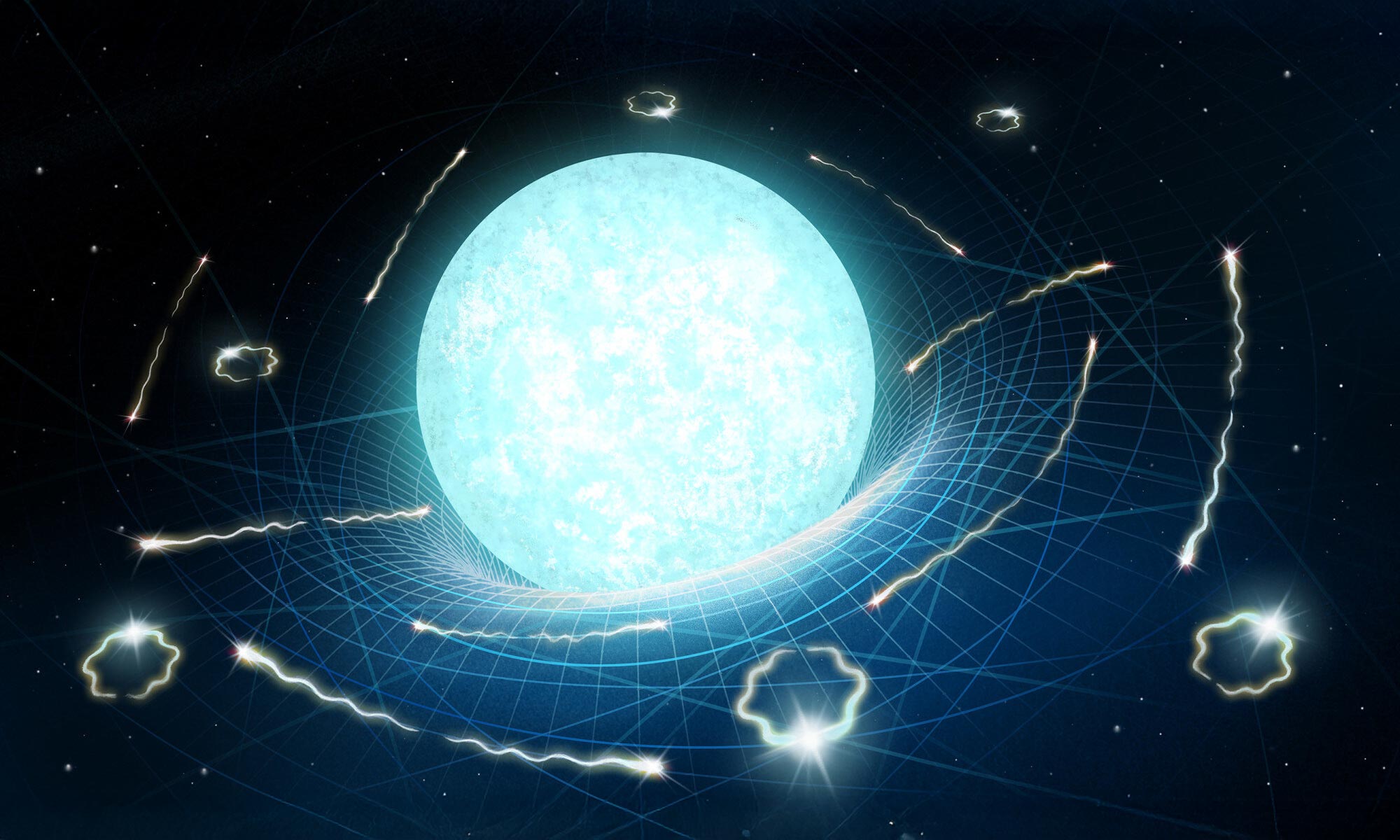
What if black holes weren’t the only things slowly vanishing from existence? Scientists have now shown that all dense cosmic bodies—from neutron stars to white dwarfs—might eventually evaporate via Hawking-like radiation.
Even more shocking, the end of the universe could come far sooner than expected, “only” 1078 years from now, not the impossibly long 101100 years once predicted. In an ambitious blend of astrophysics, quantum theory, and math, this playful yet serious study also computes the eventual fates of the Moon—and even a human.
Black Holes Aren’t Alone
A team of scientists from Radboud University in the Netherlands has taken their bold theory one step further. Black hole expert Heino Falcke, quantum physicist Michael Wondrak, and mathematician Walter van Suijlekom previously proposed that not just black holes, but other dense cosmic objects like neutron stars, could also slowly “evaporate” through a process similar to Hawking radiation.
Their earlier paper caught attention across the scientific world—and beyond. One question kept popping up: How long does this slow cosmic fading actually take? In their latest research, they’ve done the math.
Universe’s Ultimate Deadline
The team found that the ultimate “end” of the universe could arrive in about 1078 years—a 1 followed by 78 zeros—based solely on this Hawking-like radiation. That’s the time it would take for white dwarfs, the most stubborn stars in the cosmos, to fully decay. For comparison, earlier estimates (which ignored this evaporation process) stretched to a mind-boggling 101100 years.
Lead author Heino Falcke: “So the ultimate end of the universe comes much sooner than expected, but fortunately it still takes a very long time.”
The heart of this idea is a fascinating twist on Stephen Hawking’s 1975 theory. Hawking proposed that black holes aren’t entirely black—they can emit faint radiation due to quantum effects near their event horizons. Tiny particle pairs can briefly emerge near the edge of a black hole. One falls in, the other escapes. That escaping particle slowly robs the black hole of mass.
This process, known as Hawking radiation, means that even black holes can shrink and eventually disappear. It was a revolutionary idea—and it challenged Einstein’s view that black holes can only grow. Now, with updated calculations and a broader scope, this research suggests that everything might ultimately fade away, particle by particle.
Density Over Gravity
The researchers calculated that the process of Hawking radiation theoretically also applies to other objects with a gravitational field. The calculations further showed that the ‘evaporation time’ of an object depends only on its density.
To the researchers’ surprise, neutron stars and stellar black holes take the same amount of time to decay: 1067 years. This was unexpected because black holes have a stronger gravitational field, which should cause them to ‘evaporate’ faster. “But black holes have no surface,” says co-author and postdoctoral researcher Michael Wondrak, “They reabsorb some of their own radiation, which inhibits the process.”
Moon and Man’s Final Fate
Because the researchers were at it anyway, they also calculated how long it takes for the Moon and a human to evaporate via Hawking-like radiation. That’s 1090 years (a 1 with 90 zeros). Of course, the researchers subtly note, there are other processes that may cause humans and the moon to disappear faster than calculated.
Co-author Walter van Suijlekom, professor of mathematics at Radboud University, adds that the research is an exciting collaboration of different disciplines and that combining astrophysics, quantum physics, and mathematics leads to new insights. “By asking these kinds of questions and looking at extreme cases, we want to better understand the theory, and perhaps one day, we will unravel the mystery of Hawking radiation.”
Reference: “An upper limit to the lifetime of stellar remnants from gravitational pair production” by Heino Falcke, Michael F. Wondrak and Walter D. van Suijlekom, 12 May 2025, Journal of Cosmology and Astroparticle Physics.
DOI: 10.1088/1475-7516/2025/05/023
Never miss a breakthrough: Join the SciTechDaily newsletter.
Follow us on Google and Google News.
18 Comments
There are no particles. There are waves often conceived of as radiation a wholly viable idea. But “particles,” all particles, are made of the same stuff – and has more systematic dynamism than all the math so far applied. The math is wonderful but it’s about a universe of its own that doesn’t exist . So chasing the universe with the present precepts, will keep you dancing in circles.
The easy example: The Sun obviously goes around the earth, so no sense standing back thinking.
It is amazing how technology and science have discovered many things, and of course God has given us the intelligence to invent, and create things for us to use, to see, to enjoy and all these that God has given to man to invent.
The theory and knowledge when the universe is going to finish, does not come from man to say such time that the universe will disappear,
But only God has the authority and k owledge of His own creation, but He is giving us the intelligence and the tools to continue expanding ourselves infinite in time and space and mass.
You assume a God, but you provide no proof of it. That’s an unscientific approach. That also goes against common sense.
I’m not taking the word of someone who can’t spell knowledge correctly. Or doesn’t care to fix their mistakes.
Note 2505260347_Source1. Analyzing【
1-3. When is the ultimate deadline for the universe?
Based solely on this Hawking radiation, the team discovered that the ultimate “terminal” of the universe could come in about 10^78 years (1 followed by 78 zeros).
This is the time it takes for a white dwarf, the most stubborn star in the universe, to completely collapse. In comparison, the previous estimate that ignored this evaporation process was a whopping 10^1100 years.
Is the calculation right? It’s probably just the end of our universe. The gqms multiverse is not evaporated by Hawking radiation for a longer time. Uh-huh. Particles are continuously created in the dark energy qms and cause the Big Bang event. If you roll your head a bit more and give yourself an idea, the universe itself can be transformed into an infinite number. Uh-huh.
_[2-1,2-2] The vixer black hole does not disappear by Hawking radiation. Because it is itself a unit of density particles. By converting, the constant of the condition satisfaction is reduced to a maximum or xyz, and the increasing xyzabcd… density radiation. Uh-huh.
2-3.
Surprisingly, the researchers found that the time it took for neutron stars and stellar black holes to decay was the same as 10^67 years. This was an unexpected result considering that black holes have a stronger gravitational field and need to ‘evaporate’ faster.
Black holes, however, have no surface. They reabsorb some of their own radiation, interfering with the decay process.
_[2-3] My new physics and math unfold in msbase.qpeoms.
The term collapse is a banc phenomenon in which the distributed mass decreases. This is not the case for black hole vixer and neutron star vixer. It is true that the two have the same lifespan, but the result is due to different conditions of satisfaction and interchange. Can it be expressed as a collapse? Decay is an abnormal change in view of the normal distribution state 1.
It is used for the black hole vixer to move diagonally zz’ linearly or for the vixer transformation.
Neutron stars are in a position where they have the potential to become the boss of a collective leadership. However, they are subordinates governed by the later boss. Together, they become msbase with mass, where they collapse.
≈≈≈=========
Source 1.
https://scitechdaily.com/everything-evaporates-from-neutron-stars-to-you-the-universe-is-on-a-clock/
1.
Everything evaporates: from neutron stars to you, the universe moves with the clock
Artistic representation of a slowly ‘evaporating’ neutron star via Hawking radiation-like radiation.
What if black holes are not the only ones that slowly disappear from existence? Scientists have shown that every dense cosmic object, from neutron stars to white dwarfs, can eventually evaporate through radiation like Hawking’s radiation.
1-1.
What is even more shocking is that the end of the universe could come much sooner than expected, “only” in 10 ⁻⁻ years. Not the impossibly long decade that was once predicted. This delightful yet serious study, an ambitious combination of astrophysics, quantum theory, and mathematics, calculates the moon, and even the ultimate fate of man.
1-2. Black holes are not alone
A team of Dutch scientists took their bold theory to the next level. It has previously been suggested that black holes as well as other dense cosmic objects such as neutron stars can slowly “evaporate” through a process similar to Hawking radiation.
Their previous paper received attention not only from the scientific community but also beyond. A question has been constantly raised. How long will this slow-motion disappearance actually last? In a recent study, they calculated the answer.
1-3. Ultimate deadline for space
Based on this Hawking radiation alone, the team discovered that the ultimate “terminal” of the universe could come in about 10^78 years (1 followed by 78 zeros). This is the time it takes for a white dwarf, the most stubborn star in the universe, to completely collapse. For comparison, the previous estimate that ignored this evaporation process was a whopping 10^1100.
So the ultimate end of the universe comes much earlier than expected. But fortunately, it still takes a very long time until then.
2.
At the heart of this idea is an interesting interpretation of Stephen Hawking’s 1975 theory. Hawking argued that a black hole is not entirely black, but that it can emit faint radiation due to quantum effects near the event horizon.
Pairs of small particles can appear for a while near the edge of the black hole. One falls into the black hole and the other exits the black hole. The mass of the black hole gradually decreases due to this exodus of particles.
2-1.
[This process, known as Hawking radiation, means that even black holes can shrink and eventually disappear]
This was a revolutionary idea and challenged Einstein’s view that black holes had no choice but to grow. Now, based on improved calculations and a wider range, this research suggests that everything can eventually disappear particle by particle.
2-2. Density for gravity
The researchers calculated that the Hawking radiation process theoretically applies to other objects with gravitational fields. In addition, the calculation showed that the ‘evaporation time’ of the object depends only on the density.
3. The Last Destiny of the Moon and Man
Because it was supposed to be done anyway, the researchers also calculated the time it took for the moon and humans to evaporate through a similar radiation to Hawking’s. It’s a 90th win of 10 (90 zeros added to 1). Of course, the researchers cautiously note that there are other processes by which humans and the moon can disappear faster than calculated.
3-1.
This research is an interesting collaboration between various disciplines, and combining astrophysics, quantum physics, and mathematics can give us new insights. By asking these questions and looking at the extreme examples, we want to better understand this theory, and maybe one day we can solve the mystery of Hawking’s radiation.
Nice calc 10^78 for a dwarf.down from 10^1100.this made by considering BH leaks out reabsorbed matter/energy. I can make it 100 yrs if i consider milkyway now un mergung process with And* our galactic space temp at -273.15k merging with -252k of And*.trillions of oir stars vanishing in our space..and our simple questions become shocking our scientists thro media? Finally we find lot of news ancient tribes had better kge and astro tech than our super IQ sci.samans?
We common folks are happy we cannot affordAI glamourous chinese humanoids rocket off with scientists and we enjoy simple galactic ĺife on earth?
ACtually first find where our cosmic constants go wrong??
You are in MY reality, when I go so do you. Sorry for the bad news.
Sorry, but MY reality is all there is. Everything else is theoretical.
Hello sir namaste god bless all family members danke fur god achtu ihre gusendheit viel nerven problem.schonegruss rajveer singh batth village kotala bet po chhourian district Ludhiana Punjab India thanks for alls
All this scientific intellectualism is great but the fact you exist is all that matters….. 😘 Love to all……
Your karma ran over my dogma. I think this is a bunch of nonsense. I am no cosmologist, but I am certain the known universe is only expected to last another 10-20 billion years tops, which is only 10 or 20 to the 9th power. The number 10 to the 78th power is more than the number of atoms in the known universe. Check your work, Poindexter…..
Check your reading compensation, Stephen. “Based in Hawking Radiation alone”, not saying The universe will stick around long enough for HR to be the ultimate date if the universe.
Do you think that the author is claiming that a human or even the moon has any chance of lasting 10^90 years? Maybe next time don’t let your desire to be the biggest dick make you miss the entire point.
Also what theory says the universe will be done in 10-20 billion years? The theory the predicts the earliest that I’ve heard is a big rip, and that’s in 22 billion years, but other than that, every other theory I’ve seen suggests that the universe is still in its infancy. But then I’m not saying I’ve read everything as i don’t know the number of atoms in the known universe or how that is relevant whatsoever to this article.
Youre a more on
So Penrose’s CCC get another check-mark.
Gritology vs Ontology, the above is just another example of the approaching time line split!
It is strange that everyone seems to be only concerned about objects evaporating and busy calculating how long it will take. But what about where the evaporation ends up in ? Equally baffling, attention is only given to objects or masses evaporating their lifetime away, but what about the space around all the objects ? Has it always been there from the beginning patiently waiting for the evaporation to finish ? filling the space up ? And after all the 10^90 years or the 10^1100 years of complete evaporation of everything, are we saying that everything now move into the space around the previous everything, like salt dissolving into sea water? And how “salty” would the only thing left, space, be ?
However, even more fundamental before this proposition, let us consider the first star that was born and lit up the universe. The photons or light waves leaving the star heading outward, one should argue that surely some would escape being ‘captured’ by other objects, such as the earth and moon, and ended up leaving everything behind and reaching forever outward, right ? If we do not rightfully wonder about these escaped photons, then what makes us wonder about the evaporation in this proposition ? And most of it all, was the space that took in all these photons or waves, and the evaporation in this proposition, has it always been there in the first place ? Or was it also something that went through some of its own development process ?
percentages to densities and pressures of densities. umagot to foot pounds of pressures and finding percentages as such