
The sun erupted on January 22-23, 2012 with an M8.7 class flare, captured here in a movie by the Solar Dynamics Observatory (SDO). The flare wasn’t quite as strong as an X-class, but the associated solar energetic particle (SEP) event caused the biggest solar radiation storm since 2003.
Solar activity increases roughly every 11 years and on January 22-23, 2012, the sun erupted causing the largest solar radiation storm since 2003. The solar flare was classified as an M8.7, and while being quite strong, it wasn’t as strong as an X-class flare. Solar flares send energy, light, and high-speed particles into space and are often associated with CMEs, but the sun can also experience solar energetic particle events and disturbances in the solar wind. The National Oceanic and Atmospheric Administration have come up with classifications for the flares and solar storms to help researchers better understand them.
Solar flares are giant explosions on the sun that send energy, light, and high-speed particles into space. These flares are often associated with solar magnetic storms known as coronal mass ejections (CMEs). While these are the most common solar events, the sun can also emit streams of very fast protons – known as solar energetic particle (SEP) events – and disturbances in the solar wind known as corotating interaction regions (CIRs). All of these can produce a variety of “storms” on Earth that can – if strong enough – interfere with short wave radio communications, GPS signals, and Earth’s power grid, among other things.
The amount of solar activity increases approximately every 11 years, and the sun is currently moving toward another solar maximum, likely in 2013. That means more flares will be coming, some small and some big enough to send their radiation all the way to Earth.
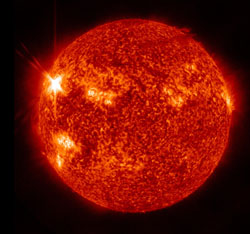
The National Oceanic and Atmospheric Administration has devised categories for the flares and various storms. The biggest flares are known as “X-class flares” based on a classification system that divides solar flares according to their strength. The smallest ones are A-class (near background levels), followed by B, C, M, and X. Similar to the Richter scale for earthquakes, each letter represents a 10-fold increase in energy output. So an X is ten times an M and 100 times a C. Within each letter class there is a finer scale from 1 to 9.
C-class and smaller flares are too weak to noticeably affect Earth. M-class flares can cause brief radio blackouts at the poles and minor radiation storms that might endanger astronauts.
And then come the X-class flares. Although X is the last letter, there are flares more than 10 times the power of an X1, so X-class flares can go higher than 9. The most powerful flare measured with modern methods was in 2003, during the last solar maximum, and it was so powerful that it overloaded the sensors measuring it. The sensors cut out at X15, but the flare was estimated to be as high as an X28.
The biggest X-class flares are by far the largest explosions in the solar system and are awesome to watch. Loops tens of times the size of Earth leap up off the sun’s surface when the sun’s magnetic fields cross over each other and reconnect. In the biggest events, this reconnection process can produce as much energy as a billion hydrogen bombs.
As the Sun ramps up towards its next solar maximum, we are already seeing an increase in activity. The first X-class flare of the current solar cycle erupted on February 15, 2011, and there were more over the summer. On January 23, 2012, the sun unleashed an M8.7 flare accompanied by a CME and an SEP that created one of the strongest radiation storms since 2005.
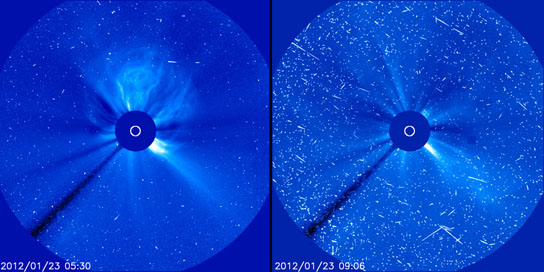
If they’re directed at Earth, such flares and associated solar events can create long lasting radiation storms that can harm satellites, communications systems, and even ground-based technologies and power grids. NASA and NOAA – as well as the US Air Force Weather Agency (AFWA) and others – keep a constant watch on the sun to monitor for X-class flares and their associated magnetic storms. With advance warning many satellites, spacecraft and technologies can be protected from the worst effects.
Never miss a breakthrough: Join the SciTechDaily newsletter.
Follow us on Google and Google News.