
Astronomers may have solved a 40-year-old mystery surrounding a neutron star in the “Rapid Burster” system.
Scientists observing a curious neutron star in a binary system known as the ‘Rapid Burster’ may have solved a forty-year-old mystery surrounding its puzzling X-ray bursts. They discovered that its magnetic field creates a gap around the star, largely preventing it from feeding on matter from its stellar companion. Gas builds up until, under certain conditions, it hits the neutron star all at once, producing intense flashes of X-rays. The discovery was made with space telescopes including ESA’s XMM-Newton.
Discovered in the 1970s, the Rapid Burster is a binary system comprising a low-mass star in its prime and a neutron star – the compact remnant of a massive star’s demise. In such a stellar pair, the gravitational pull of the dense remnant strips the other star of some of its gas; the gas forms an accretion disc and spirals toward the neutron star.
As a result of this accretion process, most neutron star binaries continuously release large amounts of X-rays, which are punctuated by additional X-ray flashes every few hours or days. Scientists can account for these ‘type-I’ bursts, in terms of nuclear reactions that are ignited in the inflowing gas – mainly hydrogen – when it accumulates on the neutron star’s surface.
But the Rapid Burster is a peculiar source: at its brightest, it does emit these type-I flashes, while during periods of lower X-ray emission, it exhibits the much more elusive ‘type-II’ bursts – these are sudden, erratic, and extremely intense releases of X-rays.
The neutron star binary system MXB 1730-335, also known as the ‘Rapid Burster’, is a peculiar X-ray source, one of only two known to exhibit the elusive ‘type-II’ bursts. These bursts are sudden, erratic and extremely intense releases of X-rays that liberate enormous amounts of energy during periods otherwise characterized by very little emission occurring.
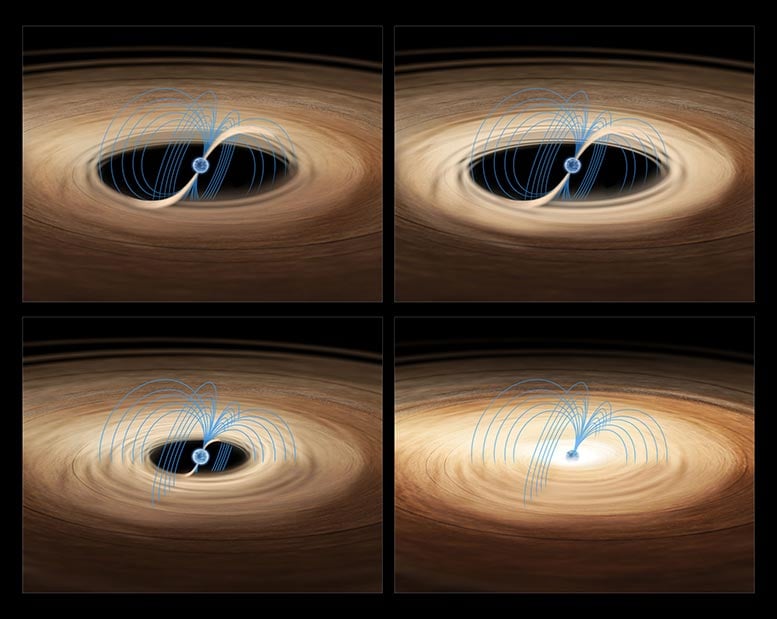
Before the burst, the fast-spinning magnetic field of the neutron star (blue arrow) keeps the gas (white arrows) flowing from the companion star at bay, preventing it from reaching closer to the neutron star and effectively creating an inner edge at the center of the disc. During this phase, only small amounts of gas leak towards the neutron star.
However, as the gas continues to flow and accumulate near this edge, it spins faster and faster, and eventually catches up with the spinning velocity of the magnetic field. The gas then hits the neutron star all at once, giving rise to the dramatic emission of type-II bursts.
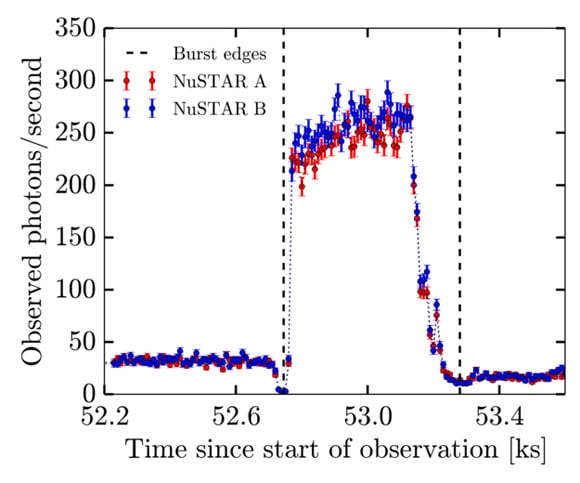
In contrast to type-I bursts, which do not represent a significant release of energy with respect to what is normally emitted by the accreting neutron star, bursts of type-II liberate enormous amounts of energy during periods otherwise characterized by very little emission occurring.
Despite forty years of searches, type-II bursts have been detected only in one other source besides the Rapid Burster. Known as the Bursting Pulsar and discovered in the 1990s, this binary system comprises a low-mass star and a highly magnetized, spinning neutron star – a pulsar – that exhibits only type-II bursts.
Because of the scarcity of sources that display this phenomenon, the underlying physical mechanisms have long been debated, but a new study of the Rapid Burster provides the first evidence for what is occurring.
“The Rapid Burster is the archetypal system to investigate type-II bursts – it’s where they were first observed and the only source that shows both type-I and type-II bursts,” says Jakob van den Eijnden, a Ph.D. student at the Anton Pannekoek Institute for Astronomy in Amsterdam, The Netherlands, and lead author of a Letter published in Monthly Notices of the Royal Astronomical Society.
In this study, Jakob and his colleagues organized an observing campaign using three X-ray space telescopes to find out more about this system.
Under the coordination of co-author Tullio Bagnoli, who was also based at the Anton Pannekoek Institute for Astronomy, the team managed to observe the source bursting over a few days in October 2015 with a combination of NASA’s NuSTAR and Swift, and ESA’s XMM-Newton.
They first monitored the source with Swift, timing the observations for a period when they expected a series of type-II bursts to take place. Then, soon after the first burst was detected, the scientists set the other observatories into motion, using XMM-Newton to measure X-rays emitted directly by the neutron star’s surface or by gas in the accretion disc, and NuSTAR to detect higher-energy X-rays, which are emitted by the neutron star and reflected off the disc.
With these data, the scientists scrutinized the structure of the accretion disc to understand what happens to it before, during, and after these copious releases of X-rays.
According to one model, type-II bursts occur because the fast-spinning magnetic field of the neutron star keeps the gas flowing from the companion star at bay, preventing it from reaching closer to the neutron star and effectively creating an inner edge at the center of the disc. However, as the gas continues to flow and accumulate near this edge, it spins faster and faster and eventually catches up with the spinning velocity of the magnetic field.
“It’s as if we threw something towards a merry-go-round that is spinning very fast: it would bounce off, unless it’s thrown at the same velocity as the machine,” explains Jakob.
“A similar balancing act happens between the inflowing gas and the spinning magnetic field: as long as the gas hasn’t the right speed, it cannot get to the neutron star and it can only pile up at the edge. By the time it reaches the right velocity, a lot of gas has accumulated and it hits the neutron star all at once, giving rise to the dramatic emission of type-II bursts.”
This model predicts that, while the material is piling up, a gap should form between the neutron star and the edge of the accretion disc.
In other models, the intense flashes are explained as arising from instabilities in the flow of the accreting gas or from general-relativistic effects. In either case, these would take place much closer to the neutron star and not give rise to such a gap.
“A gap is exactly what we found at the Rapid Burster,” says Nathalie Degenaar, a researcher at Anton Pannekoek Institute for Astronomy and Jakob’s Ph.D. advisor. “This strongly suggests that the type-II bursts are caused by the magnetic field.”
The observations indicate that there is a gap of roughly 90 km between the neutron star and the inner edge of the accretion disc. While not impressive on cosmic scales, the size of the gap is much larger than the neutron star itself, which has a radius of about 10 km.
This finding is in line with results from a previous study by Nathalie and collaborators, who had observed a similar gap around the Bursting Pulsar – the other source known to produce type-II bursts.
In the new study of the Rapid Burster, the scientists also measured the strength of the neutron star’s magnetic field: at 6 × 10⁸ G, it is around a billion times stronger than Earth’s and, most important, over five times stronger than observed in other neutron stars with a low-mass stellar companion. This could hint at the young age of this binary system, suggesting that the accretion process has not been going on for long enough to damp the magnetic field down, as is thought to have happened in similar systems.
If this neutron star binary really is as young as its strong magnetic field indicates, then it is expected to spin much slower than its older counterparts: future measurements of the star’s spinning rate might help confirm this unusual scenario.
“This result is a big step towards solving a forty-year-old puzzle in neutron star astronomy, while also revealing new details about the interaction between magnetic fields and accretion discs in these exotic objects,” concludes Norbert Schartel, XMM-Newton Project Scientist at ESA.
Publications:
- “A strongly truncated inner accretion disc in the Rapid Burster” by J. van den Eijnden, T. Bagnoli, N. Degenaar, A. M. Lohfink, M. L. Parker, J. J. M in ‘t Zand and A. C. Fabian, 1 March 2017, Monthly Notices of the RoyalAstronomical Society.
DOI: 10.1093/mnrasl/slw244 - “High-resolution X-Ray Spectroscopy of the Bursting Pulsar GRO J1744-28” by N. Degenaar, J. M. Miller, F. A. Harrison, J. A. Kennea, C. Kouveliotou and G. Younes, 3 November 2014, The Astrophysical Journal Letters.
DOI: 10.1088/2041-8205/796/1/L9
Never miss a breakthrough: Join the SciTechDaily newsletter.
Follow us on Google and Google News.