
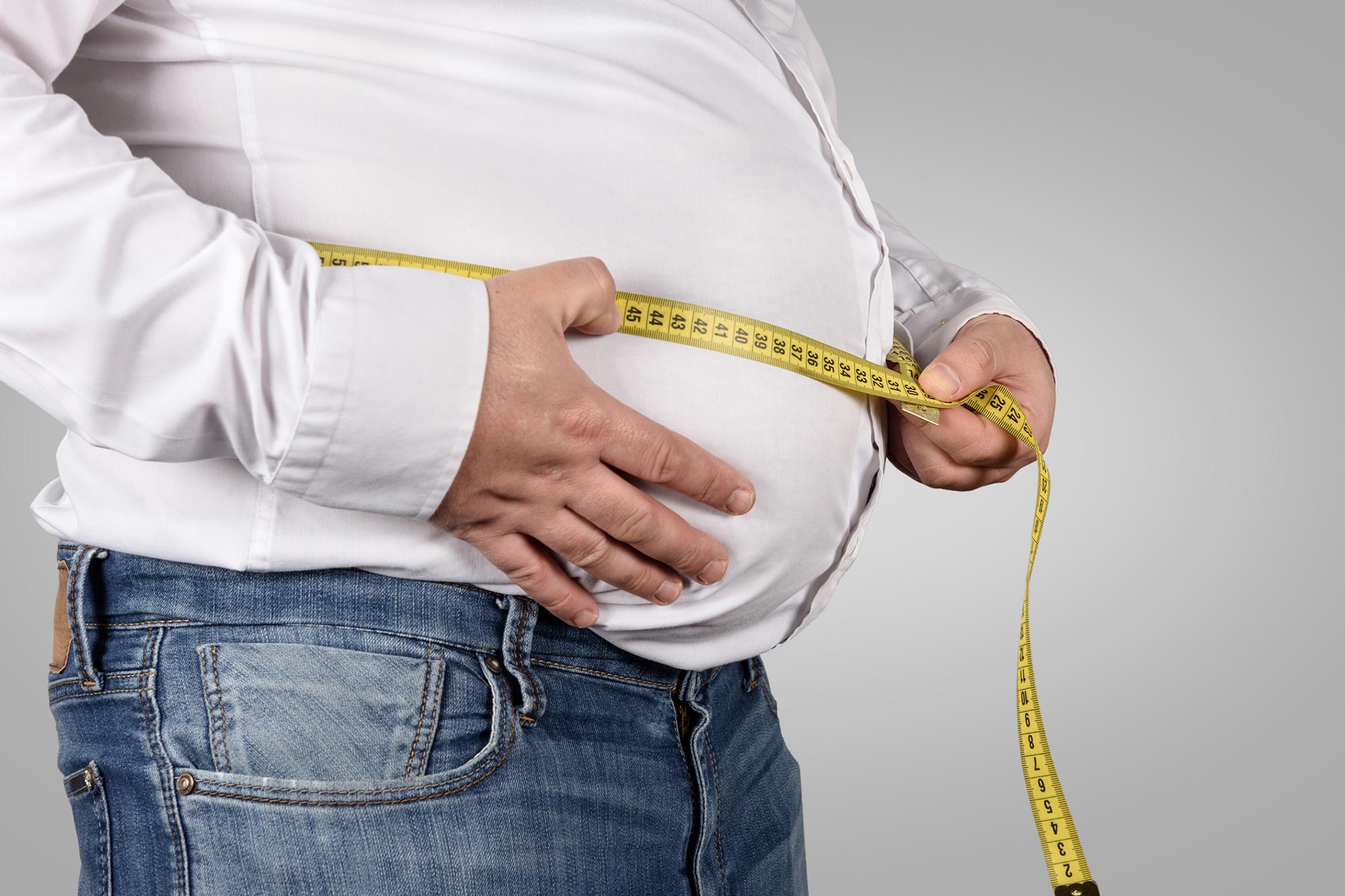
For 60 years, HSL was known for releasing energy from fat, but people born without it lose fat instead of gaining weight—a mystery that Prof. Langin and colleagues have now solved.
After six decades of research on fat metabolism, a new discovery is challenging long-held assumptions about how the body regulates energy. Scientists have found that a key enzyme, long thought to function only in breaking down stored fat, also plays an unexpected role inside the nucleus of fat cells.
Our fat cells, known as adipocytes, do far more than store extra body weight. They serve as vital regulators of the body’s energy supply. These cells store fat in small structures called lipid droplets, which act as reserves that the body can draw upon when energy is needed (for instance, during periods of fasting between meals).
To access these reserves, the body relies on a protein called HSL, which functions like an energy control switch. When energy levels drop, hormones such as adrenaline activate HSL, prompting it to release stored fat to fuel different organs.
Without HSL, it might seem logical that fat would simply build up because the body could no longer access its stored energy. Surprisingly, research involving mice and humans with mutations in the HSL gene reveals the opposite effect. Rather than leading to obesity, the loss of this protein causes a decrease in fat tissue, resulting in a condition called lipodystrophy.
Although obesity and lipodystrophy appear to be opposing conditions, they share an important similarity: in both, adipocytes fail to function properly. This dysfunction disrupts normal metabolism and contributes to similar metabolic and cardiovascular health problems.
A Surprising Discovery Inside Fat Cells
To understand this peculiarity, the research team led by Dominique Langin, professor at the University of Toulouse within the I2MC, noticed that HSL was located in an unexpected area. In adipocytes, the protein is known to be on the surface of lipid droplets, where it acts as an enzyme breaking down fat. But the study reveals that it is also present in the nucleus of fat cells.
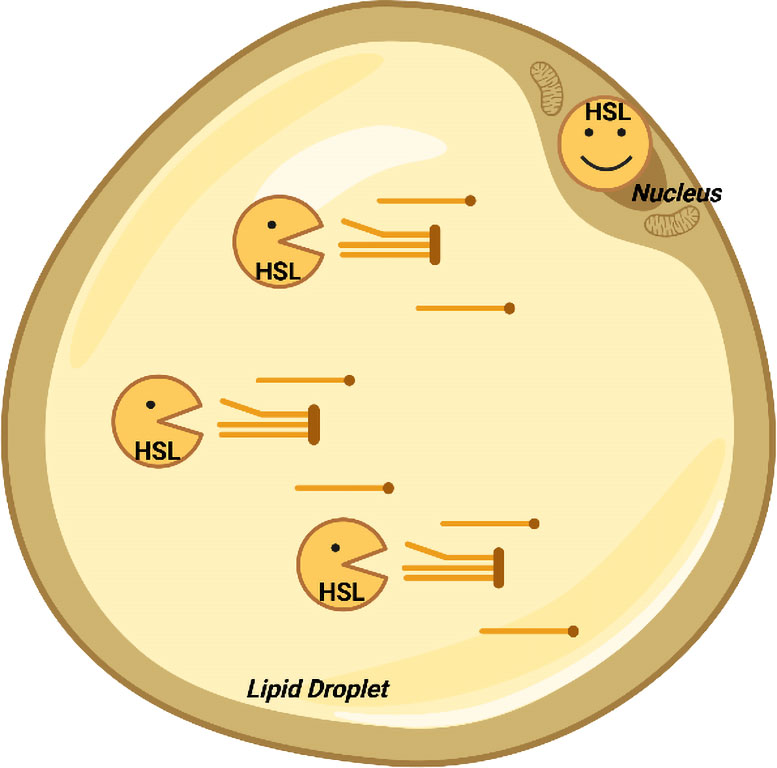
“In the nucleus of adipocytes, HSL is able to associate with many other proteins and take part in a program that maintains an optimal amount of adipose tissue and keeps adipocytes ‘healthy’,” explains Jérémy Dufau, co-author of the study, who defended his doctoral thesis on this subject.
The Fine Regulation of HSL
Moreover, the study shows that the amount of HSL in the nucleus is finely regulated. Adrenaline, which activates the enzyme on the lipid droplet, also promotes its exit from the nucleus. This is what happens during fasting. In a pathological context, the amount of nuclear HSL is increased in obese mice.
“HSL has been known since the 1960s as a fat-mobilizing enzyme. But we now know that it also plays an essential role in the nucleus of adipocytes, where it helps maintain healthy adipose tissue,” concludes Dominique Langin. This new role explains the lipodystrophy observed in patients lacking HSL and opens avenues for a better understanding of metabolic diseases such as obesity and its complications.
This discovery comes at a timely moment. Overweight and obesity affect one in two adults in France. Worldwide, two and a half billion people are affected. Obesity increases the risk of many diseases, including diabetes and heart disease, and impairs quality of life. Continued research is essential to improve prevention and patient care.
Reference: “Nuclear hormone-sensitive lipase regulates adipose tissue mass and adipocyte metabolism” by Jérémy Dufau, Emeline Recazens, Laura Bottin, Camille Bergoglio, Aline Mairal, Karima Chaoui, Marie-Adeline Marques, Veronica Jimenez, Miquel García, Tongtong Wang, Henrik Laurell, Jason S. Iacovoni, Remy Flores-Flores, Pierre-Damien Denechaud, Khalil Acheikh Ibn Oumar, Ez-Zoubir Amri, Catherine Postic, Jean-Paul Concordet, Pierre Gourdy, Niklas Mejhert, Mikael Rydén, Odile Burlet-Schiltz, Fatima Bosch, Christian Wolfrum, Etienne Mouisel, Genevieve Tavernier and Dominique Langin, 23 October 2025, Cell Metabolism.
DOI: 10.1016/j.cmet.2025.09.014
Funding: European Foundation for the Study of Diabetes 407 (EFSD/Novo Nordisk Programme for Diabetes Research in Europe 2019 to D.L.), Agence Nationale de la Recherche (ANR-17- 409 CE14-0015Hepadialogue to C.P. and D.L.; ANR-23-IAHU-0011 IHU Health Age to D.L.), European Research Council (ERC) 411 under the European Union’s Horizon 2020 research and innovation programme (SPHERES, ERC)
Never miss a breakthrough: Join the SciTechDaily newsletter.
Follow us on Google and Google News.
15 Comments
HSL = hormone-sensitive lipase
You’re welcome.
👍
I need the HSL
ISooooo now what
Yes, thank you. One of the most important principles of journalism: when using acronyms please define, at least once. Please please please.
Danke Schoen
👍
According to the Global Obesity Observatory, France has only a 15% obesity problem, not 50%.
Study paid for by drug company that makes billion offdiabetic medicines. Untrustful bias study.
Regardless of the role of HSL, statistically, the US FDA approved the expanded use of added MSG as an ‘alleged’ “flavor enhancer” in 1980 with the US obesity epidemic presenting by 1990 (CDC data). While statistics are not recognized as proof of cause and effect, just about any idiot who can add one plus one and get two can see the obvious relationship. Furthermore, in the US and globally, obesity keeps increasing with the increasing consumption of added MSG. Added MSG should be permanently banned from all commercially prepared food products. As to an individual consumer product, let the buyer beware.
You’re absolutely correct in that Margarine Sailor Greene, as well as her sister Marjorie Taylor, should be banned from all things that would involve ANY interaction with the consumer!
HSL IS ACRONYM FOR WHAT PROTEIN?
Hormone Sensitive Lipase
I think Charles G. Shaver’s comment on added MSG, whether germane to this article or not, was a legitimate concern. As I understand it, artificially produced MSG consists of up to 50% chiral molecules, whereas naturally derived MSG, produced by biological processes, contains few, if any, chiral molecules. With all the recent awareness about the significance of that knowledge, one would think those horrible decisions made regarding the use of chemical plants in our food, and the decision to allow food companies to mask the adulteration of food by calling added chiral MSG “natural flavoring” on the ingredient lists on food labels, would be a priority issue. Asian food culture, lacking specific scientific knowledge about what enhances “umami” flavors, has identified numerous sources of MSG produced through natural biological processes. I add natural MSG to most of the soups and stews I cook with a few drops of Vietnamese fish sauce, but I avoid buying food products with added MSG like the plague.
Thank you, Nicholas Jones, for the one thumb up. However, admittedly unfamiliar with the chirality of added MSG, I find with prevention still being vastly superior to perpetual treatments, and even ultimate “cures,” that added artificially cultured “free” (can cross the blood-brain barrier) MSG is germane to all articles on obesity, even those on surgical procedures. Nice to hear something of an ‘echo’ for a change. And, good for you for avoiding bad MSG and sharing what you know.