
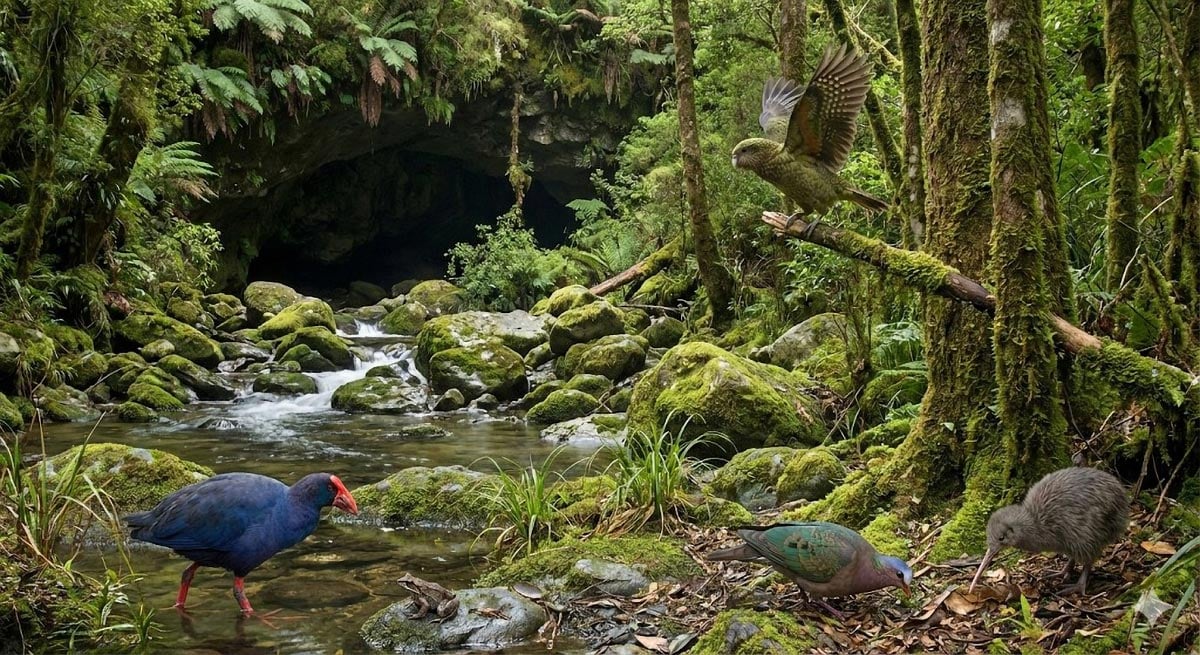
Deep within a cave on New Zealand’s North Island, scientists have uncovered a long-lost record of life from a million years ago.
In a cave system near Waitomo on Aotearoa’s North Island, scientists have uncovered a packed deposit of ancient bones that captures New Zealand at a moment the fossil record rarely preserves. The find is the first time researchers have recovered such a large set of fossils from around one million years ago, and it includes a surprise: an early relative of the kākāpō, the famously hefty parrot that today cannot fly.
The site holds remains from 12 bird species and four frog species, giving researchers an unusually detailed sample of the wildlife that once lived in the region. Because caves can act like natural storage vaults, preserving fragile bones that would normally disappear in open landscapes, discoveries like this can reveal entire communities rather than isolated specimens.
The research, published in Alcheringa: An Australasian Journal of Palaeontology, argues that New Zealand’s ecosystems were being repeatedly reshaped long before humans arrived. Instead of a stable cast of species enduring unchanged for millennia, the evidence points to dramatic turnovers linked to severe climate shifts and major volcanic events, with extinctions followed by replacements as habitats transformed.
Lead author Flinders University Associate Professor Trevor Worthy says the study changes the baseline for understanding what “natural” once looked like in New Zealand.
“This is a newly recognized avifauna for New Zealand, one that was replaced by the one humans encountered a million years later,” says Associate Professor Worthy, from the College of Science and Engineering at Flinders University.
“This remarkable find suggests our ancient forests were once home to a diverse group of birds that did not survive the next million years.”
Fossils and Extinctions Before Humans
The fossils were examined by palaeontologists from Flinders University and Canterbury Museum, working alongside volcanologists Joel Baker from the University of Auckland and Simon Barker of Victoria University of Wellington.
Their analysis suggests that roughly 33–50% of species disappeared during the million years leading up to human settlement in Aotearoa New Zealand.
According to co-author Dr. Paul Scofield, Senior Curator of Natural History at Canterbury Museum, these losses were linked to rapid environmental change and large-scale volcanic events.
“From our excavations at St Bathans in Central Otago over many years, we have a snapshot of life in Aotearoa between 20 and 16 million years ago. These new findings cast light on the 15 million-year period from then to 1 million years ago, which is largely absent from New Zealand’s fossil record,” says Dr. Scofield.
“This wasn’t a missing chapter in New Zealand’s ancient history, it was a missing volume.”
Ancient Relatives of Iconic Birds
Among the most notable discoveries is a previously unknown parrot species, Strigops insulaborealis, which belongs to the same lineage as the modern kākāpō. While today’s kākāpō is a large, ground-dwelling bird that cannot fly, its ancient relative may not have shared that limitation.
Studies of the fossil bones indicate that the extinct parrot had weaker legs than the modern kākāpō, suggesting it was less adapted for climbing. Scientists say additional research will be needed to determine whether it was capable of flight.
The cave also preserved the remains of an extinct ancestor of the takahē, offering new insight into the evolutionary history of one of New Zealand’s most recognisable birds. In addition, researchers identified a now-lost pigeon species closely related to Australian bronzewing pigeons.
“The shifting forest and shrubland habitats forced a reset of the bird populations,” adds Dr. Scofield.
“We believe this was a major driver for the evolutionary diversification of birds and other fauna in the North Island.”
Dating a Million-Year-Old Cave
The fossils could be accurately dated as they were between two layers of volcanic ash preserved in the cave. One layer was from an eruption 1.55 million years ago, while the other was from a massive eruption 1 million years ago.
The more recent eruption would have blanketed much of the North Island in meters of ash. Most of it would have been washed away, but some would have been preserved in caves. The older layer found at this fossil site proves it is the oldest-known cave in the North Island.
Associate Professor Worthy says the fossils “provide a critical, missing baseline for New Zealand’s natural history.”
“For decades, the extinction of New Zealand’s birds was viewed primarily through the lens of human arrival 750 years ago. This study proves that natural forces like super-volcanoes and dramatic climate shifts were already sculpting the unique identity of our wildlife over a million years ago.”
Reference: “The first Early Pleistocene (ca 1 Ma) fossil terrestrial vertebrate fauna from a cave in New Zealand reveals substantial avifaunal turnover in the last million years” by Trevor H. Worthy, R. Paul Scofield, Sneha Suresh, Simon J. Barker, Colin J. N. Wilson, Paul W. Williams and Joel A. Baker, 26 January 2026, Alcheringa: An Australasian Journal of Palaeontology.
DOI: 10.1080/03115518.2025.2605684
Never miss a breakthrough: Join the SciTechDaily newsletter.
Follow us on Google and Google News.
20 Comments
Nothing on earth is “millions of years” old. Your Radiometric dating on volcanic rock as millions of years old is not trustworthy. A group of scientists a number of years ago tested some volcanic rock, using the Radiometric dating method of using Uranium Argon. They said it was “millions of years” old. The volcanic rock was from the Mt. St. Hellens eruption in 1980! Man’s philosophy in the belief of evolution is a fraud.
What do you base the assertion that nothing on earth is millions of years old?
A rock spewed out by Mt St H could have been in the bowels of the mountain for years
No, a rock from St. Helens is brand new. So new, in fact, that the technique used to “date” the samples (potassium-argon dating) is totally inappropriate for that context. In 1994, when the St Helens material was sent off to the lab, it was well known that igneous samples need to be 100,000 years old at *minimum* for K/Ar to be usable. Ham, Austin, et al. knew this very well, but yhey wasted the money for a disingenuous lie.
He or She won’t reply, because they have No idea what your talking about. Fantastic information regarding the Cave in New Zealand. Thank you!!
He’s a religious nut from the look of it.
Yup! Exactly!
Our earth is more than a million years old
💯
Still thinks the earth is flat !
You are clueless, you do realize that when a volcano throws rocks, they are not new. They will pick up rock from deep within the earth and move them outward
I agree. But I’m just going on my gut instincts. I’m not formally educated. This just all seems like game and it always changes. Scientist and Drs. Are all just as competitive and inventing as athletes,artists,and actors. It’s fascinating that’s all,just like heaven,no one knows for sure.
Your right it’s always changing, due to the more information we uncover.
Oh there’s definitely a group of us that DO know for sure when it comes to heaven. We call ourselves Christians & we’re not just pretty sure, we’re absolutely positive. But I do want to ask a question about this article, so it says millions of years old & then mentions changes from drastic climate changes… So are you telling me that climate change existed BEFORE Fossil fuels did…..? Very interesting, since this is what I have been trying to point out to the climate change groupies that fly around in private jets lecturing to us about climate change for YEARS now but they don’t hear truth like most of us do.
Well I feel the World has been taught “Wrong Knowledge” because the Paleontologist Community has a category called Pseudo Fossil which is a copout! Also I have a slab of granite which is Igneous Rock. This piece of granite was harvested from a dead volcano in Italy this Granite has a Dragon like creature that with a miniature horse hanging in front of its mouth. You can see an arrow like projectile attached to the end of its tongue so it shot it’s tongue projectile and pierced the miniature horse you can see that it enters the back and exits the front of the miniature horse and directly below was it’s hatchling waiting for it’s meal! This obviously shouldn’t exist but it does they said sometimes granite swirls into a perfect Mythical Creature so once I got this response I knew what I had to do.
When make dinosaur
He or She won’t reply, because they have No idea what your talking about. Fantastic information regarding the Cave in New Zealand. Thank you!!
It really doesn’t matter Jesus is still coming back for his bride.
Yes He is
Jesus was real, heaven however, is very hard to believe in. Who wants to sing praises to the music of a harp for eternity? If sex isn’t involved it won’t be a reward. Sex isn’t sin, it’s the most sacred act one can commit. Religion is real, church is fake.
Science is real, scientist need to grow some balls. When you discover something new, say so. Don’t be afraid to go against the established norms when they are wrong. People don’t trust science because scientists can’t be trusted.