
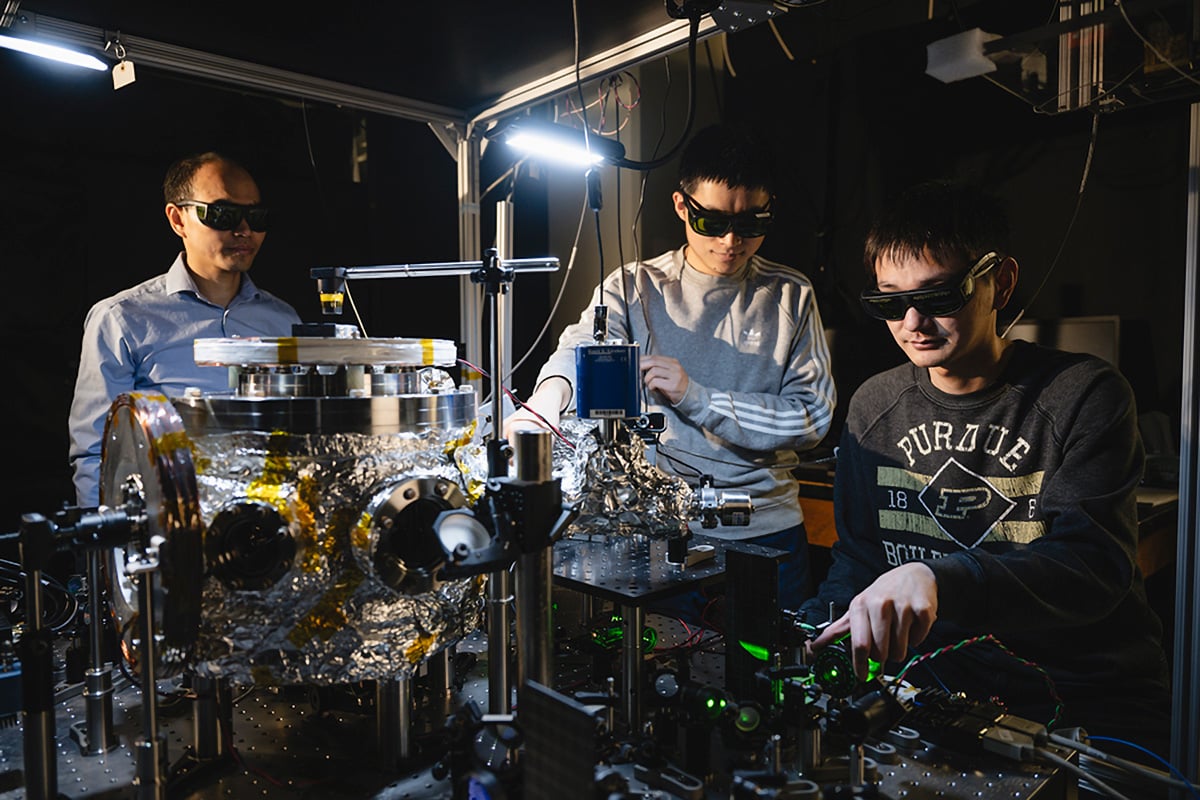
A new milestone in levitated optomechanics has been achieved by Prof. Tongcang Li’s group, who observed the Berry phase of electron spins in nano-sized diamonds levitated in a vacuum.
Physicists at Purdue are throwing the world’s smallest disco party. The disco ball itself is a fluorescent nanodiamond, which they have levitated and spun at incredibly high speeds. The fluorescent diamond emits and scatters multicolor lights in different directions as it rotates. The party continues as they study the effects of fast rotation on the spin qubits within their system and are able to observe the Berry phase.
The team, led by Tongcang Li, professor of Physics and Astronomy and Electrical and Computer Engineering at Purdue University, published their results in Nature Communications. Reviewers of the publication described this work as “arguably a groundbreaking moment for the study of rotating quantum systems and levitodynamics” and “a new milestone for the levitated optomechanics community.”
“Imagine tiny diamonds floating in an empty space or vacuum. Inside these diamonds, there are spin qubits that scientists can use to make precise measurements and explore the mysterious relationship between quantum mechanics and gravity,” explains Li, who is also a member of the Purdue Quantum Science and Engineering Institute. “In the past, experiments with these floating diamonds had trouble in preventing their loss in a vacuum and reading out the spin qubits. However, in our work, we successfully levitated a diamond in a high vacuum using a special ion trap. For the first time, we could observe and control the behavior of the spin qubits inside the levitated diamond in high vacuum.”
Observing the Berry Phase
The team made the diamonds rotate incredibly fast—up to 1.2 billion times per minute! By doing this, they were able to observe how the rotation affected the spin qubits in a unique way known as the Berry phase.
“This breakthrough helps us better understand and study the fascinating world of quantum physics,” he says.
The fluorescent nanodiamonds, with an average diameter of about 750 nm, were produced through high-pressure, high-temperature synthesis. These diamonds were irradiated with high-energy electrons to create nitrogen-vacancy color centers, which host electron spin qubits. When illuminated by a green laser, they emitted red light, which was used to read out their electron spin states. An additional infrared laser was shone at the levitated nanodiamond to monitor its rotation. Like a disco ball, as the nanodiamond rotated, the direction of the scattered infrared light changed, carrying the rotation information of the nanodiamond.
The authors of this paper were mostly from Purdue University and are members of Li’s research group: Yuanbin Jin (postdoc), Kunhong Shen (PhD student), Xingyu Gao (PhD student), and Peng Ju (recent PhD graduate). Li, Jin, Shen, and Ju conceived and designed the project and Jin and Shen built the setup. Jin subsequently performed measurements and calculations and the team collectively discussed the results. Two non-Purdue authors are Alejandro Grine, principal member of technical staff at Sandia National Laboratories, and Chong Zu, assistant professor at Washington University in St. Louis. Li’s team discussed the experiment results with Grine and Zu who provided suggestions for improvement of the experiment and manuscript.
“For the design of our integrated surface ion trap,” explains Jin, “we used a commercial software, COMSOL Multiphysics, to perform 3D simulations. We calculate the trapping position and the microwave transmittance using different parameters to optimize the design. We added extra electrodes to conveniently control the motion of a levitated diamond. And for fabrication, the surface ion trap is fabricated on a sapphire wafer using photolithography. A 300-nm-thick gold layer is deposited on the sapphire wafer to create the electrodes of the surface ion trap.”
Controlling Diamond Spin
So which way are the diamonds spinning and can they be speed or direction manipulated? Shen says yes, they can adjust the spin direction and levitation.
“We can adjust the driving voltage to change the spinning direction,” he explains. “The levitated diamond can rotate around the z-axis (which is perpendicular to the surface of the ion trap), shown in the schematic, either clockwise or counterclockwise, depending on our driving signal. If we don’t apply the driving signal, the diamond will spin omnidirectionally, like a ball of yarn.”
Levitated nanodiamonds with embedded spin qubits have been proposed for precision measurements and for creating large quantum superpositions to test the limit of quantum mechanics and the quantum nature of gravity.
“General relativity and quantum mechanics are two of the most important scientific breakthroughs in the 20th century. However, we still do not know how gravity might be quantized,” says Li. “Achieving the ability to study quantum gravity experimentally would be a tremendous breakthrough. In addition, rotating diamonds with embedded spin qubits provide a platform to study the coupling between mechanical motion and quantum spins.”
This discovery could have a ripple effect in industrial applications. Li says that levitated micro and nano-scale particles in vacuum can serve as excellent accelerometers and electric field sensors. For example, the US Air Force Research Laboratory (AFRL) are using optically-levitated nanoparticles to develop solutions for critical problems in navigation and communication.
“At Purdue University, we have state-of-the-art facilities for our research in levitated optomechanics,” says Li. “We have two specialized, home-built systems dedicated to this area of study. Additionally, we have access to the shared facilities at the Birck Nanotechnology Center, which enables us to fabricate and characterize the integrated surface ion trap on campus. We are also fortunate to have talented students and postdocs capable of conducting cutting-edge research. Furthermore, my group has been working in this field for ten years, and our extensive experience has allowed us to make rapid progress.”
Reference: “Quantum control and Berry phase of electron spins in rotating levitated diamonds in high vacuum” by Yuanbin Jin, Kunhong Shen, Peng Ju, Xingyu Gao, Chong Zu, Alejandro J. Grine and Tongcang Li, 13 June 2024, Nature Communications.
DOI: 10.1038/s41467-024-49175-3
This research was supported by the National Science Foundation (grant number PHY-2110591), the Office of Naval Research (grant number N00014-18-1-2371), and the Gordon and Betty Moore Foundation (grant DOI 10.37807/gbmf12259). The project is also partially supported by the Laboratory Directed Research and Development program at Sandia National Laboratories.
Never miss a breakthrough: Join the SciTechDaily newsletter.
Follow us on Google and Google News.
10 Comments
Physicists Throw World’s Tiniest Disco Party With Levitated Nanodiamonds.
Ask the physicist:
1. How do you confirm that it is the tiniestt disco in the world?
2. Can physicists ignore the rigor of their language and the scientific nature of their theories?
Scientific research guided by correct theories can help humanity avoid detours, failures, and pomposity. Please witness the exemplary collaboration between theoretical physicists and experimentalists (https://scitechdaily.com/microscope-spacecrafts-most-precise-test-of-key-component-of-the-theory-of-general-relativity/#comment-854286). Some people in contemporary physics has always lived in a self righteous children’s story world. Whose values have been overturned by such a comical and ridiculous reality? CP violation opened the dirtiest and ugliest era in the history of physics.
Space has physical properties of zero viscosity and absolute incompressibility. Zero viscosity and absolute incompressibility are physical characteristics of ideal fluids. The space with ideal fluid physical characteristics forms vortices via topological phase transitions, which is not difficult to understand mathematically. Once the topological vortex is formed, it occupies space and maintains its presence in time. This is the transition from chaos to order via two bidirectional coupled continuous chaotic systems.
Each topological vortex is a natural gravitational field. According to the topological vortex gravitational field theory, the disco party between topological vortices and their twin antivortices has no tiniest disco, only smaller ones. Topological vortices either exist or do not exist. If topological vortices exist, their fractal structure is influenced by environmental factors, theoretically there is no minimum, only smaller, and similarly there is no maximum, only larger.
Symmetry of topological vortex can be used to explore particle behavior under spatial, temporal, and quantum number reversals, involving quantum gravity, discrete and continuous changes. It underpins the consistency of natural laws and experiment reproducibility. The perpetually swirling topological vortices defy traditional physics’ expectations, heavily influencing traditional physics theories and potentially unveiling new particles and forces.
From what I’ve gathered about the Berry phase, without a formal background in QM, is that it’s sometimes called a “geometric phase” and Focault’s pendulum provides maybe the most relatable example for illustrating the effect. At the poles the pendulum oscillation plane cycles once per day, at the equator it doesn’t change, and in between those extremes it is the *sine* of the latitude that predicts intermediate oscillation plane cycling rates. Things that are not intuitive fascinate me, and to me it’s not trivial to develop a significant intuition about this effect. My first inclinations are to think that of course it’s going to be a basic non-exciting interpolation situation and of course it’ll be a trigonometric function of the latitude, that it’s going to vary most gradually with changes in lowest latitudes (smaller angles off the equator) and have a certain immediate inertia about it at the equator making it slowest to change there, and of course it’s symmetric heading to either pole. My lack of formal background QM is making it difficult for me to predict what they’re seeing, despite all that. My intuitions have nonetheless led me to suggest here before that with two identical objects spinning on the same axis the opportunities for rapid entanglement, and possibly for synonymous retroreflective gravitational energy flows, becomes maximized. Where diamond vacancy sites are set up by electron beams there seems to be a significant opportunity for mechanical and quantum vacancy spins to align very close to the same axis. That mechanical and quantum vacancy spin effect do coordinate to some extent seems to run afoul of the notions that magnetic monopoles can be fundamental particles, not physics cartoon Cheshire cats, and that magnetic fields can exist apart from electron spins.
“magnetic fields can exist apart from electron spins”
My mistake, it’s apart from *charged particle* spins that I meant to say. May have some more thoughts on this later but kind of hoping I’m done with it for now, other than to note that I probably should have also spent some time to make my equatorial situation comments there a bit more concise.
“mechanical and quantum vacancy spin effect”
Sorry, should be “mechanical (classical) and vacancy (quantum) charge-based spin effects” I suppose.
“mechanical (classical) and vacancy (quantum) charge-based”
The first is an “extrinsic” spin effect just as the second is considered an “intrinsic” spin effect. The concept of holes (vacancies) may be a good example of mixing the two ideas together somewhat, providing a 2-D particle effect (hole surface) that may behave as a sort of pseudo-fundamental quasi-particle, meaning possibly a hybrid of classical and neighboring grouping quantum effects with a sort of quasi-crystalline, or holographic, aspect appearing possible, blurring the classical and quantum together and complicating things remarkably.
Is your spin effect related to topological spin?
Is topological spin a physical reality?
My spin is at a wonderful latitude I am however shy about going into further details, but thanks for asking. At this point I guess I am just wondering if I’ve misunderstood something you could easily help clarify.
Topological spin does not have the clearest scope here at this point, maybe you could explain any reservations you may have about what seem to be surface currents that remind me of the “skin effect” in waveguides but maybe such currents are instead hogging the spontaneous low-noise face of the overall surface current concept. I mean I have no idea, right? I would’ve been a weak cheerleader, so it is what it is, whatever it is.
An attorney from company A could focus on the vacancy walls while another attorney, from company B, could focus on the charge enclosed, and 99.999% of the populace would have no clue they’re both trying to patent the exact same thing, most likely both very, very poorly right off the bat to get things going smooth for them from the get-go.
I don’t know. Anyway, maybe I had an unconscious daydream where could ride in and save the day for everyone except the two companies, but no, they all wore me out a long time ago anyway.
Best wishes to you!
“quasi-crystalline, or holographic”
As far as “holographic, on further reflection I should add that I’m referring to an effect also seen with photos of many bubbles or dew drops, the self-similarity is in the multiple reflections. Quasi-crystals are a mix of randomness and order, and I should’ve just left that first suggestion out because I don’t have anything much else to add about quasi-crystals here. Just something intriguing in general about forming quasi-crystals with spin, I guess.