
Close Menu
    Facebook X (Twitter) Instagram
    SciTechDaily
    • Biology
    • Chemistry
    • Earth
    • Health
    • Physics
    • Science
    • Space
    • Technology
    Facebook X (Twitter) Pinterest YouTube RSS
    SciTechDaily
    Home»Technology»Pioneering Quantum Simulations on Photonic Chips: A New Era in Quantum Computing
    Technology

    Pioneering Quantum Simulations on Photonic Chips: A New Era in Quantum Computing

    By University of RochesterJuly 1, 20231 Comment3 Mins Read
    Facebook Twitter Pinterest Telegram LinkedIn WhatsApp Email Reddit
    Share
    Facebook Twitter LinkedIn Pinterest Telegram Email Reddit
    Synthetic Space Quantum Simulator Model
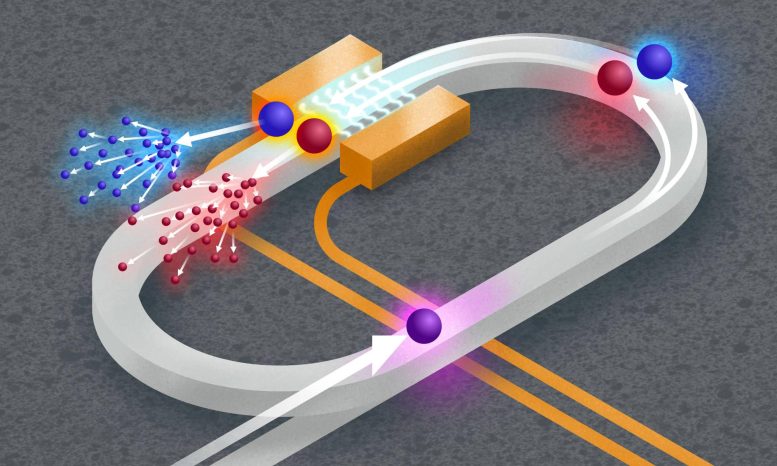
    A new system developed by researchers at the University of Rochester allows them to conduct quantum simulations in a synthetic space that mimics the physical world by controlling the frequency, or color, of quantum entangled photons as time elapses. Credit: University of Rochester illustration / Michael Osadciw

    A system using photonics-based synthetic dimensions could be used to help explain complex natural phenomena.

    Researchers at the University of Rochester have developed a chip-scale optical quantum simulation system using controlled photon frequency to simulate complex natural phenomena at the quantum level, reducing the physical footprint and resource requirements of traditional methods. This innovation, heralding a quantum-correlated synthetic crystal, could pave the way for more complex future simulations.

    Scientists have made an important step toward developing computers advanced enough to simulate complex natural phenomena at the quantum level. While these types of simulations are too cumbersome or outright impossible for classical computers to handle, photonics-based quantum computing systems could provide a solution.

    A team of researchers from the University of Rochester’s Hajim School of Engineering & Applied Sciences developed a new chip-scale optical quantum simulation system that could help make such a system feasible. The team, led by Qiang Lin, a professor of electrical and computer engineering and optics, published their findings on June 22 in the journal Nature Photonics.

    Lin’s team ran the simulations in a synthetic space that mimics the physical world by controlling the frequency, or color, of quantum entangled photons as time elapses. This approach differs from the traditional photonics-based computing methods in which the paths of photons are controlled, and also drastically reduces the physical footprint and resource requirements.

    “For the first time, we have been able to produce a quantum-correlated synthetic crystal,” says Lin. “Our approach significantly extends the dimensions of the synthetic space, enabling us to perform simulations of several quantum-scale phenomena such as random walks of quantum entangled photons.”

    The researchers say that this system can serve as a basis for more intricate simulations in the future.

    “Though the systems being simulated are well understood, this proof-of-principle experiment demonstrates the power of this new approach for scaling up to more complex simulations and computation tasks, something we are very excited to investigate in the future,” says Usman Javid ’23 PhD (optics), the lead author on the study.

    Reference: “Chip-scale simulations in a quantum-correlated synthetic space” by Usman A. Javid, Raymond Lopez-Rios, Jingwei Ling, Austin Graf, Jeremy Staffa and Qiang Lin, 22 June 2023, Nature Photonics.
    DOI: 10.1038/s41566-023-01236-7

    Other coauthors from Lin’s group include Raymond Lopez-Rios, Jingwei Ling, Austin Graf, and Jeremy Staffa.

    The project was supported with funding from the National Science Foundation, the Defense Threat Reduction Agency’s Joint Science and Technology Office for Chemical and Biological Defense, and the Defense Advanced Research Projects Agency.

    Never miss a breakthrough: Join the SciTechDaily newsletter.
    Follow us on Google and Google News.

    Optics Photonics Popular Quantum Computing University of Rochester
    Share. Facebook Twitter Pinterest LinkedIn Email Reddit

    Related Articles

    Stanford’s Simple New Quantum Computer Design: Photonic Computation in a Synthetic Time Dimension

    Solving Complex Problems at the Speed of Light

    More Powerful and Smaller Particle Accelerators Possible With “Game Changer” Laser

    Russian Scientists Break Google’s Quantum Algorithm

    “Perfect” Solar Energy Absorber Created by Laser Etching Metal With Nanoscale Structures

    Blanket of Entangled Light Pulses for Larger and More Powerful Quantum Computers

    Prototype Large-Scale Quantum Processor Made Entirely of Light

    New Tunable Optical Chips Can Be Used As Building-Blocks for Next Generation Quantum Computers

    A New Model of a Quantum Computer

    1 Comment

    1. kamir bouchareb st on January 30, 2025 12:42 pm

      good

      Reply
    Leave A Reply Cancel Reply

    • Facebook
    • Twitter
    • Pinterest
    • YouTube

    Don't Miss a Discovery

    Subscribe for the Latest in Science & Tech!

    Trending News

    Scientists Discover How Coffee Impacts Memory, Mood, and Gut Health

    Why Did the Neanderthals Disappear? Scientists Reveal Humans Had a Hidden Advantage

    Physicists Propose Strange Experiment Where Time Goes Quantum

    Magnesium Magic: New Drug Melts Fat Even on a High-Fat, High-Sugar Diet

    Weight-Loss Drugs Like Ozempic May Come With an Unexpected Cost

    Mezcal “Worm” in a Bottle Mystery: DNA Testing Reveals a Surprise

    New Research Reveals That Your Morning Coffee Activates an Ancient Longevity Switch

    This Is What Makes You Irresistible to Mosquitoes

    Follow SciTechDaily
    • Facebook
    • Twitter
    • YouTube
    • Pinterest
    • Newsletter
    • RSS
    SciTech News
    • Biology News
    • Chemistry News
    • Earth News
    • Health News
    • Physics News
    • Science News
    • Space News
    • Technology News
    Recent Posts
    • This New Memory Technology Could Make Devices Last Months on One Charge
    • Scientists Turn Cancer’s Own Bacteria Against It in Breakthrough Therapy
    • Cannabis Can Make You Remember Things That Never Happened
    • Doctors Are Surprised by What This Vaccine Is Doing to the Heart
    • Quantum Breakthrough Turns Simple Forces Into Powerful New Interactions
    Copyright © 1998 - 2026 SciTechDaily. All Rights Reserved.
    • Science News
    • About
    • Contact
    • Editorial Board
    • Privacy Policy
    • Terms of Use

    Type above and press Enter to search. Press Esc to cancel.