
Close Menu
    Facebook X (Twitter) Instagram
    SciTechDaily
    • Biology
    • Chemistry
    • Earth
    • Health
    • Physics
    • Science
    • Space
    • Technology
    Facebook X (Twitter) Pinterest YouTube RSS
    SciTechDaily
    Home»Space»NASA’s Planet-Hunting Satellite Catches a Comet in Motion
    Space

    NASA’s Planet-Hunting Satellite Catches a Comet in Motion

    By Claire Saravia, NASA's Goddard Space Flight CenterAugust 7, 2018No Comments4 Mins Read
    Facebook Twitter Pinterest Telegram LinkedIn WhatsApp Email Reddit
    Share
    Facebook Twitter LinkedIn Pinterest Telegram Email Reddit
    Planet Hunting TESS Catches a Comet Before Starting Science
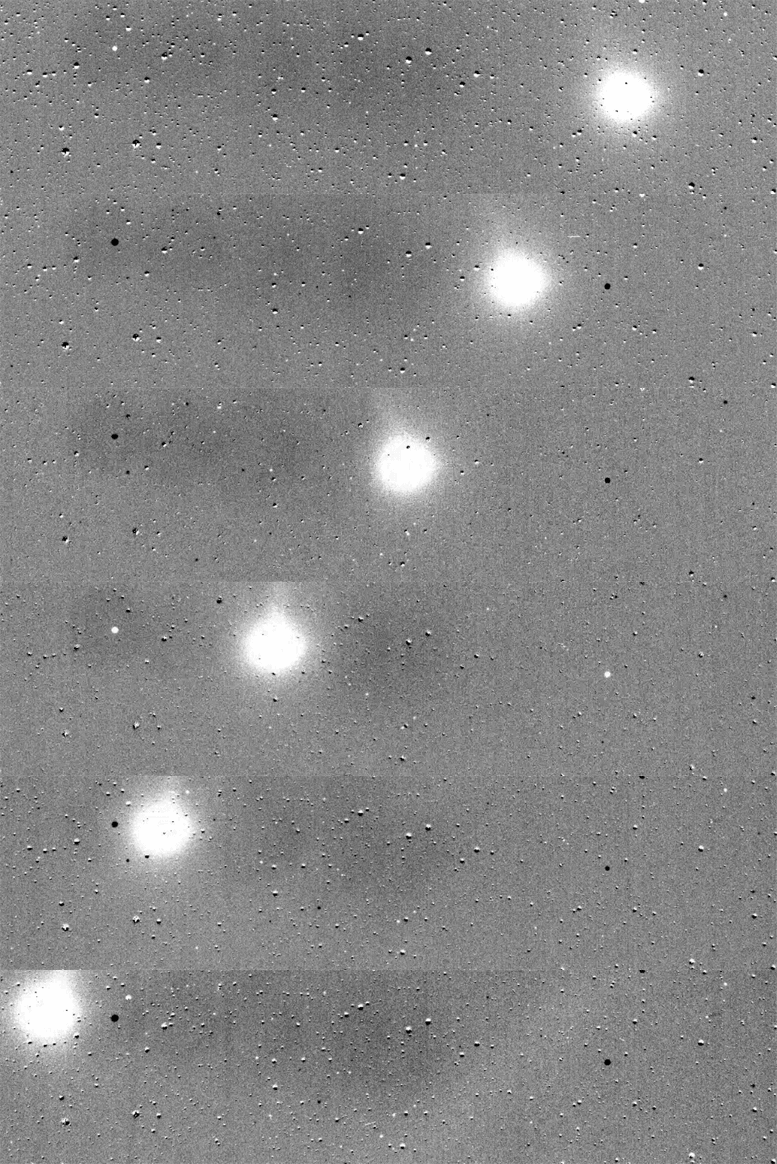
    This sequence is compiled from a series of images taken on July 25 by the Transiting Exoplanet Survey Satellite. The angular extent of the widest field of view is six degrees. Visible in the images are the comet C/2018 N1, asteroids, variable stars, asteroids, and reflected light from Mars. TESS is expected to find thousands of planets around other nearby stars. Credit: Massachusetts Institute of Technology/NASA’s Goddard Space Flight Center

    Before NASA’s Transiting Exoplanet Survey Satellite (TESS) started science operations on July 25, 2018, the planet hunter sent back a stunning sequence of serendipitous images showing the motion of a comet. Taken over the course of 17 hours on July 25, these TESS images helped demonstrate the satellite’s ability to collect a prolonged set of stable periodic images covering a broad region of the sky — all critical factors in finding transiting planets orbiting nearby stars.

    Over the course of these tests, TESS took images of C/2018 N1, a comet discovered by NASA’s Near-Earth Object Wide-field Infrared Survey Explorer (NEOWISE) satellite on June 29. The comet, located about 29 million miles (48 million kilometers) from Earth in the southern constellation Piscis Austrinus, is seen to move across the frame from right to left as it orbits the Sun. The comet’s tail, which consists of gases carried away from the comet by an outflow from the Sun called the solar wind, extends to the top of the frame and gradually pivots as the comet glides across the field of view.


    This video is compiled from a series of images taken on July 25 by the Transiting Exoplanet Survey Satellite. The angular extent of the widest field of view is six degrees. Visible in the images are the comet C/2018 N1, asteroids, variable stars, asteroids and reflected light from Mars. TESS is expected to find thousands of planets around other nearby stars. Credit: Massachusetts Institute of Technology/NASA’s Goddard Space Flight Center

    In addition to the comet, the images reveal a treasure trove of other astronomical activity. The stars appear to shift between white and black as a result of image processing. The shift also highlights variable stars — which change brightness either as a result of pulsation, rapid rotation, or by eclipsing binary neighbors. Asteroids in our solar system appear as small white dots moving across the field of view. Toward the end of the video, one can see a faint broad arc of light moving across the middle section of the frame from left to right. This is stray light from Mars, which is located outside the frame. The images were taken when Mars was at its brightest near opposition, or its closest distance, to Earth.

    These images were taken during a short period near the end of the mission’s commissioning phase, prior to the start of science operations. The movie presents just a small fraction of TESS’s active field of view. The team continues to fine-tune the spacecraft’s performance as it searches for distant worlds.

    TESS is a NASA Astrophysics Explorer mission led and operated by MIT in Cambridge, Massachusetts, and managed by NASA’s Goddard Space Flight Center in Greenbelt, Maryland. Dr. George Ricker of MIT’s Kavli Institute for Astrophysics and Space Research serves as the principal investigator for the mission. Additional partners include Northrop Grumman, based in Falls Church, Virginia; NASA’s Ames Research Center in California’s Silicon Valley; the Harvard-Smithsonian Center for Astrophysics in Cambridge, Massachusetts; MIT’s Lincoln Laboratory in Lexington, Massachusetts; and the Space Telescope Science Institute in Baltimore. More than a dozen universities, research institutes, and observatories worldwide are participants in the mission.

    Never miss a breakthrough: Join the SciTechDaily newsletter.
    Follow us on Google and Google News.

    Astronomy Comet Planetary Science TESS
    Share. Facebook Twitter Pinterest LinkedIn Email Reddit

    Related Articles

    This Alien Solar System Doesn’t Follow the Rules – and Scientists Are Intrigued

    Physicists Open a “Message in a Bottle” From Interstellar Space

    Planet-Eating Stars May Be More Common Than We Thought

    Astronomers Uncover Vast Array of Strange Alien Worlds

    International Planet Hunters Discover Dozens of Strange New Worlds

    30 Exocomets Discovered in a Young Planetary System

    NASA Prepares For Comet’s Close Encounter with Mars

    ScienceCast Video Examines the Possibility of Colliding Atmospheres between Mars and Comet Siding Spring

    Comet 2013 A1 to Make a Very Close Flyby of Mars

    Leave A Reply Cancel Reply

    • Facebook
    • Twitter
    • Pinterest
    • YouTube

    Don't Miss a Discovery

    Subscribe for the Latest in Science & Tech!

    Trending News

    Millions Take These IBS Drugs, But a New Study Finds Serious Risks

    Scientists Unlock Hidden Secrets of 2,300-Year-Old Mummies Using Cutting-Edge CT Scanner

    Bread Might Be Making You Gain Weight Even Without Eating More Calories

    Scientists Discover Massive Magma Reservoir Beneath Tuscany

    Europe’s Most Active Volcano Just Got Stranger – Here’s Why Scientists Are Rethinking It

    Alzheimer’s Symptoms May Start Outside the Brain, Study Finds

    Millions Take This Popular Supplement – Scientists Discover a Concerning Link to Heart Failure

    The Universe Is Expanding Too Fast and Scientists Can’t Explain Why

    Follow SciTechDaily
    • Facebook
    • Twitter
    • YouTube
    • Pinterest
    • Newsletter
    • RSS
    SciTech News
    • Biology News
    • Chemistry News
    • Earth News
    • Health News
    • Physics News
    • Science News
    • Space News
    • Technology News
    Recent Posts
    • Scientists Say a Hidden Structure May Exist Inside Earth’s Core
    • Doctors Surprised by the Power of a Simple Drug Against Colon Cancer
    • Why Popular Diabetes Drugs Like Ozempic Don’t Work for Everyone: The “Genetic Glitch”
    • Scientists Create Improved Insulin Cells That Reverse Diabetes in Mice
    • Scientists Stunned After Finding Plant Thought Extinct for 60 Years
    Copyright © 1998 - 2026 SciTechDaily. All Rights Reserved.
    • Science News
    • About
    • Contact
    • Editorial Board
    • Privacy Policy
    • Terms of Use

    Type above and press Enter to search. Press Esc to cancel.