
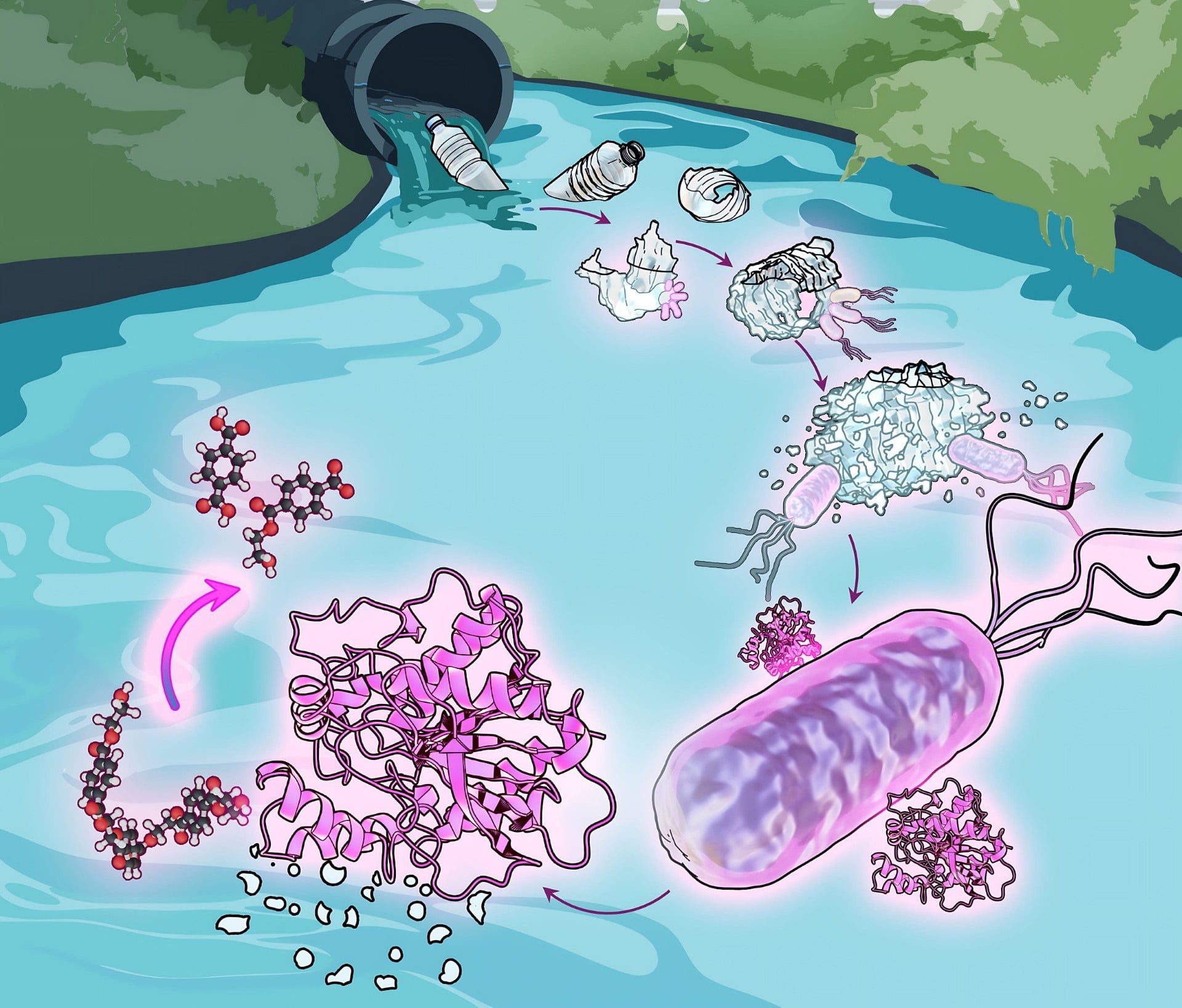
This discovery could pave the way for bioengineered solutions to tackle plastic waste cleanup.
Researchers have long observed that a common family of environmental bacteria, Comamonadacae, grow on plastics littered throughout urban rivers and wastewater systems. But what, exactly, these Comamonas bacteria are doing has remained a mystery.
Now, Northwestern University-led researchers have discovered how cells of a Comamonas bacterium are breaking down plastic for food. First, they chew the plastic into small pieces, called nanoplastics. Then, they secrete a specialized enzyme that breaks down the plastic even further. Finally, the bacteria use a ring of carbon atoms from the plastic as a food source, the researchers found.
The discovery opens new possibilities for developing bacteria-based engineering solutions to help clean up difficult-to-remove plastic waste, which pollutes drinking water and harms wildlife.
The study will be published on Thursday (Oct. 3) in the journal Environmental Science & Technology.
“We have systematically shown, for the first time, that a wastewater bacterium can take a starting plastic material, deteriorate it, fragment it, break it down, and use it as a source of carbon,” said Northwestern’s Ludmilla Aristilde, who led the study. “It is amazing that this bacterium can perform that entire process, and we identified a key enzyme responsible for breaking down the plastic materials. This could be optimized and exploited to help get rid of plastics in the environment.”
An expert in the dynamics of organics in environmental processes, Aristilde is an associate professor of environmental engineering at Northwestern’s McCormick School of Engineering. She also is a member of the Center for Synthetic Biology, International Institute for Nanotechnology and Paula M. Trienens Institute for Sustainability and Energy. The study’s co-first authors are Rebecca Wilkes, a former Ph.D. student in Aristilde’s lab, and Nanqing Zhou, a current postdoctoral associate in Aristilde’s lab. Several former graduate and undergraduate researchers from the Aristilde Lab also contributed to the work.
The pollution problem
The new study builds on previous research from Aristilde’s team, which unraveled the mechanisms that enable Comamonas testosteri to metabolize simple carbons generated from broken down plants and plastics. In the new research, Aristilde and her team again looked to C. testosteroni, which grows on polyethylene terephthalate (PET), a type of plastic commonly used in food packaging and beverage bottles. Because it does not break down easily, PET is a major contributor to plastic pollution.
“It’s important to note that PET plastics represent 12% of total global plastics usage,” Aristilde said. “And it accounts for up to 50% of microplastics in wastewaters.”
Innate ability to degrade plastics
To better understand how C. testosteroni interacts with and feeds on the plastic, Aristilde and her team used multiple theoretical and experimental approaches. First, they took bacterium — isolated from wastewater — and grew it on PET films and pellets. Then, they used advanced microscopy to observe how the surface of the plastic material changed over time. Next, they examined the water around the bacteria, searching for evidence of plastic broken down into smaller nano-sized pieces. And, finally, the researchers looked inside the bacteria to pinpoint tools the bacteria used to help degrade the PET.
“In the presence of the bacterium, the microplastics were broken down into tiny nanoparticles of plastics,” Aristilde said. “We found that the wastewater bacterium has an innate ability to degrade plastic all the way down to monomers, small building blocks which join together to form polymers. These small units are a bioavailable source of carbon that bacteria can use for growth.”
After confirming that C. testosteroni, indeed, can break down plastics, Aristilde next wanted to learn how. Through omics techniques that can measure all enzymes inside the cell, her team discovered one specific enzyme the bacterium expressed when exposed to PET plastics. To further explore this enzyme’s role, Aristilde asked collaborators at Oak Ridge National Laboratory in Tennessee to prepare bacterial cells without the abilities to express the enzyme. Remarkably, without that enzyme, the bacteria’s ability to degrade plastic was lost or significantly diminished.
How plastics change in water
Although Aristilde imagines this discovery potentially could be harnessed for environmental solutions, she also says this new knowledge can help people better understand how plastics evolve in wastewater.
“Wastewater is a huge reservoir of microplastics and nanoplastics,” Aristilde said. “Most people think nanoplastics enter wastewater treatment plants as nanoplastics. But we’re showing that nanoplastics can be formed during wastewater treatment through microbial activity. That’s something we need to pay attention to as our society tries to understand the behavior of plastics throughout its journey from wastewater to receiving rivers and lakes.”
Reference: “Mechanisms of Polyethylene Terephthalate Pellet Fragmentation into Nanoplastics and Assimilable Carbons by Wastewater Comamonas” by Rebecca A. Wilkes, Nanqing Zhou, Austin L. Carroll, Ojaswi Aryal, Kelly P. Teitel, Rebecca S. Wilson, Lichun Zhang, Arushi Kapoor, Edgar Castaneda, Adam M. Guss, Jacob R. Waldbauer and Ludmilla Aristilde, 3 October 2024, Environmental Science & Technology.
DOI: 10.1021/acs.est.4c06645
The study was supported by the National Science Foundation (award number CHE-2109097).
Never miss a breakthrough: Join the SciTechDaily newsletter.
Follow us on Google and Google News.
10 Comments
A good solution for ending plastic pollution .
This can be exploited more to give us a solution we have all been waiting for
This is dangerous because it will allow the continued use of plastic which is derived from fossil fuels and killing our planet. Just Stop Oil!!
This is not a life savior, it is results of human disgusting wasteful and irresponsible behavior… Humans are pathetic and self serving parasite…
You are speaking out your own self hatred. With this mindset you are the problem you are criticizing.
God will provide.
Indeed our GODS are bacterium. My trillions of bacteria and viruses praise the almighty Bacterium Queen.
I agree. Our Creator has built in counterbalances for everything. Now, we can pray for wisdom in how we use this.
Since our bodies are riddled with nanoplastics, what happens when these bacteria enter our bodies?could be the next plague?
Oh, Dear. Another worry. But now that it’s entered my mind…. I’ll have to allow it to dwell there. Sadly, I’m too old to figure out anything helpful. Perhaps this bacterium could be useful as a vaccine. Or drops in our water before we Brita filter it. They say boiling the water clusters the plastic, and running it thru a coffee filter removes
a lot of the plastic.
Who knows. So few people make decisions that affect so many.