
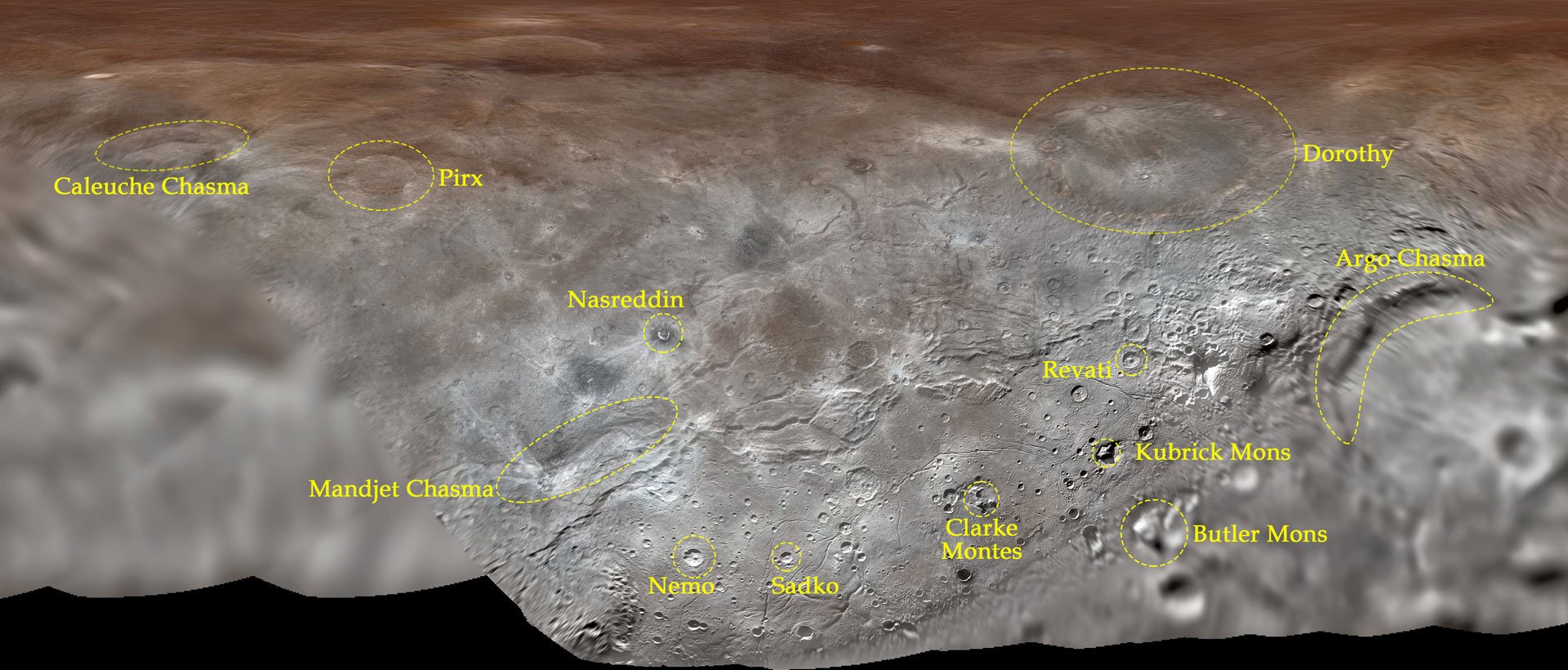
Legendary explorers and visionaries, real and fictitious, are among those immortalized by the IAU in the first set of official surface-feature names for Pluto’s largest moon, Charon. The names were proposed by the New Horizons team and approved by IAU Working Group for Planetary System Nomenclature.
The International Astronomical Union (IAU), the internationally recognized authority for naming celestial bodies and their surface features, recently approved a dozen names proposed by NASA’s New Horizons team, which led the first reconnaissance of Pluto and its moons in 2015 with the New Horizons spacecraft. The New Horizons team had been using many of the chosen names informally to describe the many valleys, crevices, and craters discovered during the first close-up look at the surface Charon.
Charon is one of the larger bodies in the Kuiper Belt, and has a wealth of geological features, as well as a collection of craters similar to those seen on most moons. These features and some of Charon’s craters have now been assigned official names by the IAU.
The New Horizons team was instrumental in moving the new names through approval, and included the leader of the New Horizons missions, Dr. Alan Stern, and science team members Mark Showalter — the group’s chairman and liaison to the IAU — Ross Beyer, Will Grundy, William McKinnon, Jeff Moore, Cathy Olkin, Paul Schenk and Amanda Zangari. The team gathered most of their ideas during the Our Plutoonline public naming campaign in 2015.
The names approved by the IAU encompass the diverse range of recommendations the team received from around the world during the Our Pluto campaign. As well as the efforts of the New Horizons team, members of the public all over the world helped to name the features of Charon by contributing their suggestions for names of the features of this far-flung moon.
Honoring the epic exploration of Pluto that New Horizons accomplished, many of the feature names in the Pluto system pay homage to the spirit of human exploration, honoring travelers, explorers, and scientists, pioneering journeys, and mysterious destinations. Rita Schulz, chair of the IAU Working Group for Planetary System Nomenclature, commented that “I am pleased that the features on Charon have been named with an international spirit.”
The approved Charon names focus on the literature and mythology of exploration. They are listed here:
Argo Chasma is named for the ship sailed by Jason and the Argonauts, in the epic Latin poem Argonautica, during their quest for the Golden Fleece.
Butler Mons honors Octavia E. Butler, the first science fiction writer to win a MacArthur fellowship, and whose Xenogenesis trilogy describes humankind’s departure from Earth and subsequent return.
Caleuche Chasma is named for the mythological ghost ship that travels the seas around the small island of Chiloé, off the coast of Chile; according to legend, the Caleuche explores the coastline collecting the dead, who then live aboard it forever.
Clarke Montes honors Sir Arthur C. Clarke, the prolific science fiction writer, and futurist whose novels and short stories (including 2001: A Space Odyssey) were imaginative depictions of space exploration.
Dorothy Crater recognizes the protagonist in the series of children’s novels, by L. Frank Baum, that follows Dorothy Gale’s travels to and adventures in the magical world of Oz.
Kubrick Mons honors film director Stanley Kubrick, whose iconic 2001: A Space Odyssey tells the story of humanity’s evolution from tool-using hominids to space explorers and beyond.
Mandjet Chasma is named for one of the boats in Egyptian mythology that carried the sun god Ra (Re) across the sky each day — making it one of the earliest mythological examples of a vessel of space travel.
Nasreddin Crater is named for the protagonist in thousands of humorous folktales told throughout the Middle East, southern Europe, and parts of Asia.
Nemo Crater is named for the captain of the Nautilus, the submarine in Jules Verne’s novels Twenty Thousand Leagues Under the Sea (1870) and The Mysterious Island (1874).
Pirx Crater is named for the main character in a series of short stories by Stanislaw Lem, who travels between the Earth, Moon, and Mars.
Revati Crater is named for the main character in the Hindu epic narrative Mahabharata — widely regarded as the first in history (circa 400 BC) to include the concept of time travel.
Sadko Crater recognizes the adventurer who traveled to the bottom of the sea in the medieval Russian epic Bylina.
Never miss a breakthrough: Join the SciTechDaily newsletter.
Follow us on Google and Google News.