
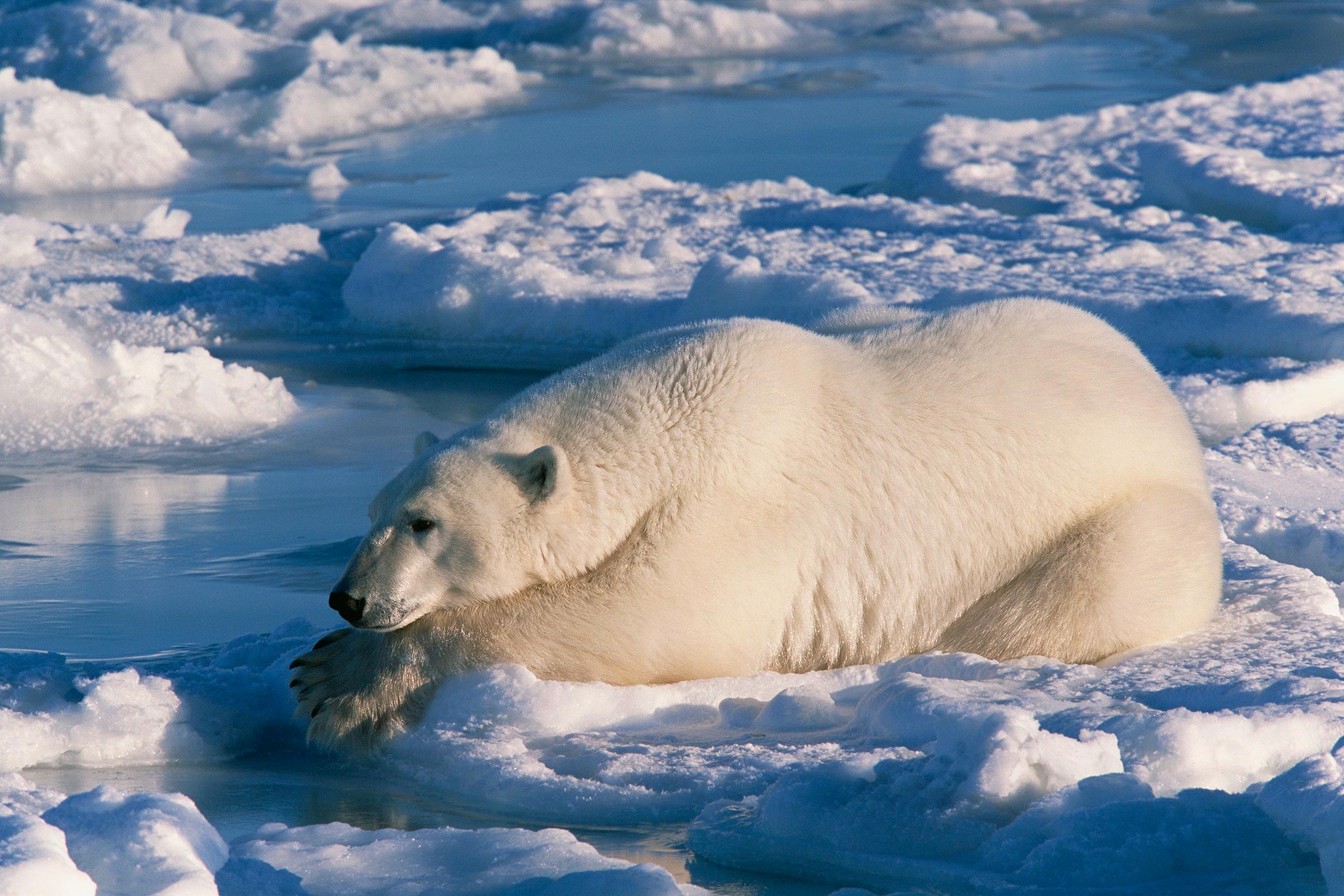
Polar bears have a built-in defense against ice — greasy fur.
A team of scientists has discovered that their fur is coated in a unique sebum blend that prevents ice from sticking, helping them survive extreme cold. This discovery doesn’t just shed light on polar bear adaptations; it also has potential applications in developing new anti-ice coatings.
The Greasy Secret of Polar Bear Fur
A team of international scientists has uncovered the secret behind why ice doesn’t stick to polar bear fur — grease. This natural defense helps these Arctic predators survive in one of the harshest environments on Earth.
By analyzing fur samples from six wild polar bears, researchers identified a crucial component: sebum, a greasy substance that coats the hair. Made up of cholesterol, diacylglycerols, and fatty acids, this sebum creates a protective barrier that prevents ice from clinging to the fur.
Potential Applications Beyond the Arctic
Beyond deepening our understanding of polar bear adaptations — and even Inuit ecological knowledge — this discovery has potential practical applications. A synthetic version of polar bear sebum could be developed for use in anti-icing coatings, including advanced ski skins for winter sports.
Julian Carolan, PhD Candidate from Trinity College Dublin’s School of Chemistry and the AMBER Research Ireland Centre, is the first author of the journal article, which has been published today (January 29) as the cover story in leading international journal Science Advances.
He said: “We measured ice adhesion strength, which is a useful measure of how well ice sticks to fur; hydrophobicity, which dictates whether water can be shed before it freezes; and freezing delay time, which simply shows how long it takes for a drop of water to freeze at certain temperatures on a given surface. We then compared the performance of the polar bear hair with that of human hair and two types of specialist human-made ‘ski skins’.

Sebum: The Key to Ice-Free Fur
“The sebum quickly jumped out as being the key component giving this anti-icing effect as we discovered the adhesion strength was greatly impacted when the hair was washed. Unwashed, greasy hair made it much harder for ice to stick. In contrast when the polar bear hair was washed and the grease largely removed it performed similarly to human hair, to which ice sticks easily whether it is washed or greasy.”
That finding led the team to perform a detailed chemical analysis of polar bear sebum. As well as identifying the key components (cholesterol, diacylglycerols, and fatty acids), they were surprised to find “squalene” was absent. This fatty metabolite is present in human hair, and in the hair of other aquatic animals, like sea otters, which suggests its absence in polar bear hair is very important from an anti-icing perspective.
Nature’s Anti-Icing Inspiration
Dr. Richard Hobbs, Assistant Professor and Royal Society-Science Foundation Ireland University Research Fellow in Trinity’s School of Chemistry and the AMBER Research Ireland Centre, is a senior author of the journal article. He added: “Animals living in polar habitats have emerged as a source of inspiration for the development of new anti-icing materials.
“For example, Anne Kietzig’s group at McGill recently found that the hierarchical structure of Gentoo penguin feathers afforded them anti-icing properties that relied on the feather structure rather than the preen oil coating. Our work shows that polar bear fur provides an alternative strategy to produce an anti-icing surface based on the characteristic blend of lipids present in their fur sebum or hair grease.
“This work not only represents the first study of the composition of polar bear fur sebum, but it also resolves the question of why polar bears don’t suffer from ice accumulation. Despite having thick layers of insulating blubber and fur, and spending extensive periods in water at sub-zero temperatures, it seems that the fur grease provides a natural route for polar bears to easily shed ice when it forms due to the low ice adhesion on their fur.
“We expect that these natural lipid coatings produced by the bear will help us to develop new more sustainable anti-icing coatings that may replace problematic ‘forever chemicals’ like PFAS that have been used as anti-icing coatings.”
A New Perspective on Polar Bear Hunting
In addition to the structural explanations, these interesting discoveries also help us better understand hunting behaviors – both of polar bears and of native Inuit populations.
Prof. Bodil Holst, University of Bergen, is a senior author of the journal article. She added: “One of the polar bears’ main hunting strategies is ‘still hunting’, where they lay motionless beside a breathing hole on sea ice waiting for seals to surface. Still hunting frequently develops into an ‘aquatic stalk’ with the polar bear using its hind paws to slide into the water to pursue its prey, and the lower the ice adhesion, the less noise generated and the faster and quieter the slide.
“Our findings also help us understand the subtlety of the steps taken by Inuit people to optimize hunting strategies to mimic the polar bear method of still hunting. Inuit hunting stools are sometimes shod with polar bear fur on the feet to avoid noise when moving on the ice, while people also sometimes wear ‘polar bear trousers’, ensuring the entire contact area with the ice is covered in low ice-adhesion polar bear fur for optimal noise reduction.”
Preserving the Natural Anti-Icing Effect
Notably, the traditional Inuit preparation method protects the sebum on the fur by ensuring the hair-covered side of the skin is not washed. This is unlike, for example, a fox skin, which would traditionally be cleaned by rubbing the hair side with soapstone or dry clay.
Reference: “Anti-icing properties of polar bear fur” by Julian Carolan, Martin Jakubec, Neubi F. XavierJr., Adam Pestana Motala, Ersilia Bifulco, Jon Aars, Magnus Andersen, Anne Lisbeth Schmidt, Marc Brunet Cabré, Vikaramjeet Singh, Paula E. Colavita, Espen Werdal Selfors, Marco Sacchi, Shane O’Reilly, Øyvind Halskau, Manish K. Tiwari, Richard G. Hobbs and Bodil Holst, 29 January 2025, Science Advances.
DOI: 10.1126/sciadv.ads7321
Never miss a breakthrough: Join the SciTechDaily newsletter.
Follow us on Google and Google News.