
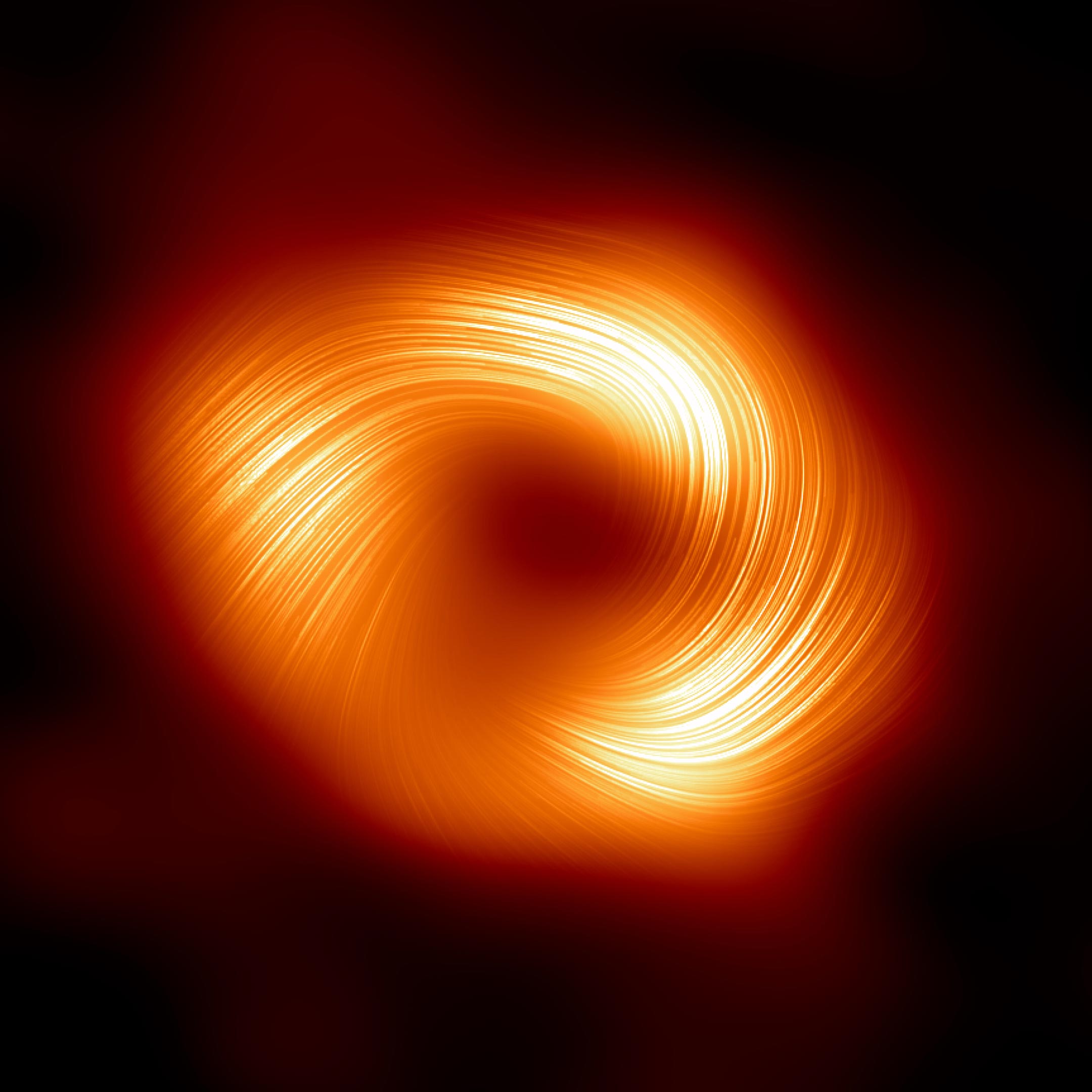
Recent findings by the EHT collaboration reveal strong, organized magnetic fields around Sagittarius A*, suggesting common traits among black holes.
Detailed comparisons with M87’s black hole show similarities, hinting at universal black hole characteristics. Future enhancements in observation technology promise deeper insights and more detailed imaging of black holes.
Strong Magnetic Fields Spiraling at the Edge of Sagittarius A*

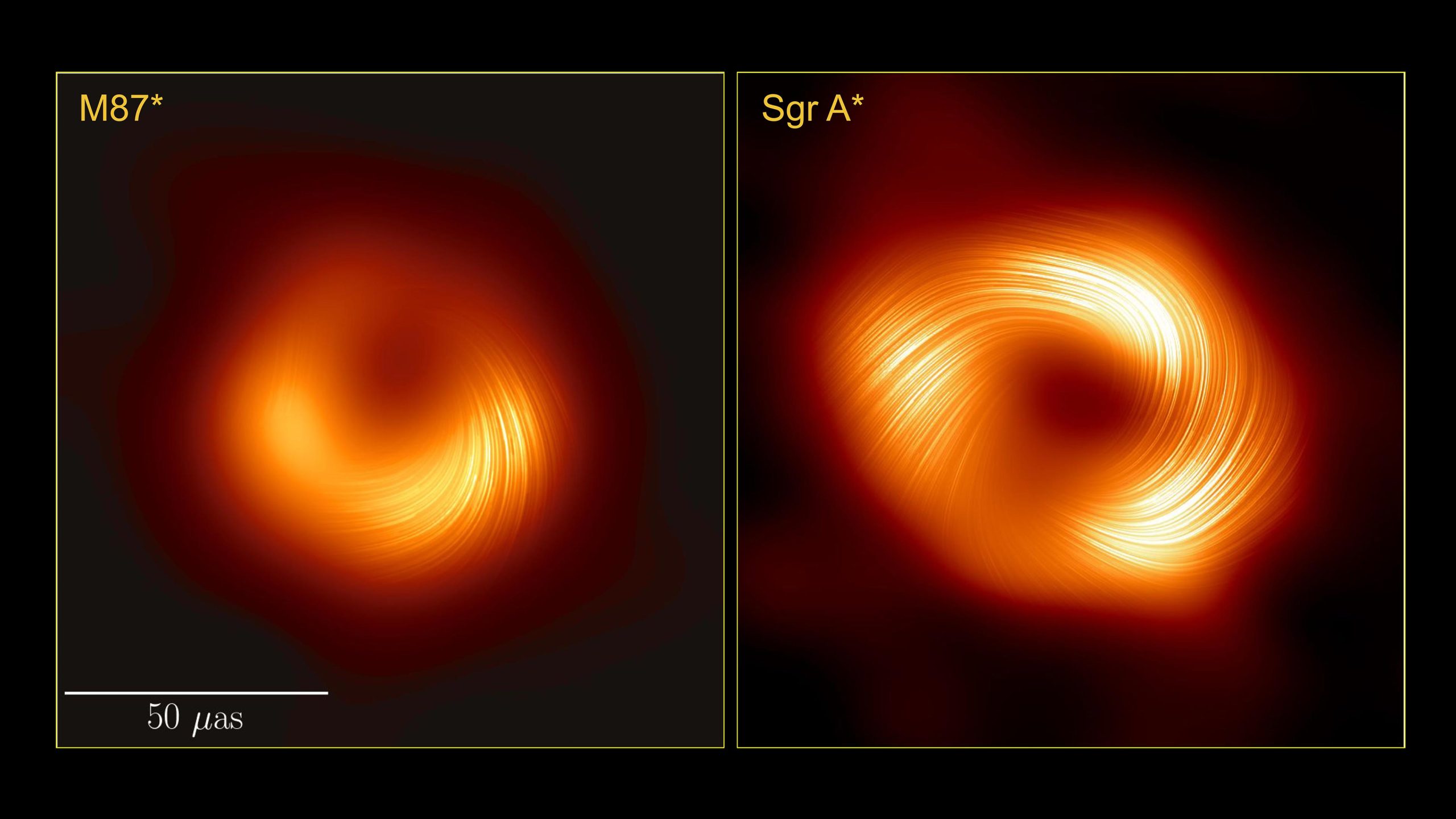
Comparative Analysis: Sgr A* and M87
Scientists unveiled the first image of Sgr A* — which is approximately 27,000 light-years away from Earth — in 2022, revealing that while the Milky Way’s supermassive black hole is more than a thousand times smaller and less massive than M87’s, it looks remarkably similar. This made scientists wonder whether the two shared common traits outside of their looks. To find out, the team decided to study Sgr A* in polarized light.
Previous studies of light around M87* revealed that the magnetic fields around the black hole giant allowed it to launch powerful jets of material back into the surrounding environment. Building on this work, the new images have revealed that the same may be true for Sgr A*.
The Role of Magnetic Fields in Black Hole Dynamics
“What we’re seeing now is that there are strong, twisted, and organized magnetic fields near the black hole at the center of the Milky Way galaxy,” said Sara Issaoun, CfA NASA Hubble Fellowship Program Einstein Fellow, Smithsonian Astrophysical Observatory (SAO) astrophysicist, and co-lead of the project. “Along with Sgr A* having a strikingly similar polarization structure to that seen in the much larger and more powerful M87* black hole, we’ve learned that strong and ordered magnetic fields are critical to how black holes interact with the gas and matter around them.”
Polarized Light: A Tool for Unraveling Black Hole Mysteries
Light is an oscillating, or moving, electromagnetic wave that allows us to see objects. Sometimes, light oscillates in a preferred orientation, and we call it “polarized.” Although polarized light surrounds us, to human eyes it is indistinguishable from “normal” light. In the plasma around these black holes, particles whirling around magnetic field lines impart a polarization pattern perpendicular to the field. This allows astronomers to see in increasingly vivid detail what’s happening in black hole regions and map their magnetic field lines.
“By imaging polarized light from hot glowing gas near black holes, we are directly inferring the structure and strength of the magnetic fields that thread the flow of gas and matter that the black hole feeds on and ejects,” said Harvard Black Hole Initiative Fellow and project co-lead Angelo Ricarte. “Polarized light teaches us a lot more about the astrophysics, the properties of the gas, and mechanisms that take place as a black hole feeds.”
Technological Challenges and Achievements in Black Hole Imaging
But imaging black holes in polarized light isn’t as easy as putting on a pair of polarized sunglasses, and this is particularly true of Sgr A*, which is changing so fast that it doesn’t sit still for pictures. Imaging the supermassive black hole requires sophisticated tools above and beyond those previously used for capturing M87*, a much steadier target.
CfA postdoctoral fellow and SAO astrophysicist Paul Tiede said, “It is exciting that we were able to make a polarized image of Sgr A* at all. The first image took months of extensive analysis to understand its dynamical nature and unveil its average structure. Making a polarized image adds on the challenge of the dynamics of the magnetic fields around the black hole. Our models often predicted highly turbulent magnetic fields, making it extremely difficult to construct a polarized image. Fortunately, our black hole is much calmer, making the first image possible.”
Future Prospects: Expanding Black Hole Research
Scientists are excited to have images of both supermassive black holes in polarized light because these images, and the data that come with them, provide new ways to compare and contrast black holes of different sizes and masses. As technology improves, the images are likely to reveal even more secrets of black holes and their similarities or differences.
Michi Bauböck, postdoctoral researcher at the University of Illinois Urbana-Champaign, said, “M87* and Sgr A* are different in a few important ways: M87* is much bigger, and it’s pulling in matter from its surroundings at a much faster rate. So, we might have expected that the magnetic fields also look very different. But in this case, they turned out to be quite similar, which may mean that this structure is common to all black holes. A better understanding of the magnetic fields near black holes helps us answer several open questions—from how jets are formed and launched to what powers the bright flares we see in infrared and X-ray light.”
Enhancements in Black Hole Imaging Techniques
The EHT has conducted several observations since 2017 and is scheduled to observe Sgr A* again in April 2024. Each year, the images improve as the EHT incorporates new telescopes, larger bandwidth, and new observing frequencies. Planned expansions for the next decade will enable high-fidelity movies of Sgr A*, may reveal a hidden jet, and could allow astronomers to observe similar polarization features in other black holes. Meanwhile, extending the EHT into space will provide sharper images of black holes than ever before.
The CfA is leading several major initiatives to sharply enhance the EHT over the next decade. The next-generation EHT (ngEHT) project is undertaking a transformative upgrade of the EHT, aiming to bring multiple new radio dishes online, enable simultaneous multi-color observations, and increase the overall sensitivity of the array. The ngEHT expansion will enable the array to make real-time movies of supermassive black holes on event horizon scales. These movies will resolve detailed structure and dynamics near the event horizon, bringing into focus “strong-field” gravity features predicted by General Relativity as well as the interplay of accretion and relativistic jet-launching that sculpts large-scale structures in the Universe.
Meanwhile, the Black Hole Explorer (BHEX) mission concept will extend the EHT into space, producing the sharpest images in the history of astronomy. BHEX will enable the detection and imaging of the “photon ring” – a sharp ring feature formed by strongly lensed emission around black holes. The properties of a black hole are imprinted on the size and shape of the photon ring, revealing masses and spins for dozens of black holes, in turn showing how these strange objects grow and interact with their host galaxies.
For more on these studies, see Peering Into the Magnetic Soul of the Milky Way’s Central Black Hole.
References:
“First Sagittarius A* Event Horizon Telescope Results. VII. Polarization of the Ring” by Kazunori Akiyama, Antxon Alberdi, Walter Alef, Juan Carlos Algaba, Richard Anantua, Keiichi Asada, Rebecca Azulay, Uwe Bach, Anne-Kathrin Baczko, David Ball, Mislav Balokovic, Bidisha Bandyopadhyay, John Barrett, Michi Bauböck, Bradford A. Benson, Dan Bintley, Lindy Blackburn, Raymond Blundell, Katherine L. Bouman, Geoffrey C. Bower, Hope Boyce, Michael Bremer, Christiaan D. Brinkerink, Roger Brissenden, Silke Britzen, Avery E. Broderick, Dominique Broguiere, Thomas Bronzwaer, Sandra Bustamante, Do-Young Byun, John E. Carlstrom, Chiara Ceccobello, Andrew Chael, Chi-kwan Chan, Dominic O. Chang, Koushik Chatterjee, Shami Chatterjee, Ming-Tang Chen, Yongjun Chen, Xiaopeng Cheng, Ilje Cho, Pierre Christian, Nicholas S. Conroy, John E. Conway, James M. Cordes, Thomas M. Crawford, Geoffrey B. Crew, Alejandro Cruz-Osorio, Yuzhu Cui, Rohan Dahale, Jordy Davelaar, Mariafelicia De Laurentis, Roger Deane, Jessica Dempsey, Gregory Desvignes, Jason Dexter, Vedant Dhruv, Indu K. Dihingia, Sheperd S. Doeleman, Sean Taylor Dougal, Sergio A. Dzib, Ralph P. Eatough, Razieh Emami, Heino Falcke, Joseph Farah, Vincent L. Fish, Edward Fomalont, H. Alyson Ford, Marianna Foschi, Raquel Fraga-Encinas, William T. Freeman, Per Friberg, Christian M. Fromm, Antonio Fuentes, Peter Galison, Charles F. Gammie, Roberto García, Olivier Gentaz, Boris Georgiev, Ciriaco Goddi, Roman Gold, Arturo I. Gómez-Ruiz, José L. Gómez, Minfeng Gu, Mark Gurwell, Kazuhiro Hada, Daryl Haggard, Kari Haworth, Michael H. Hecht, Ronald Hesper, Dirk Heumann, Luis C. Ho, Paul Ho, Mareki Honma, Chih-Wei L. Huang, Lei Huang, David H. Hughes, Shiro Ikeda, C. M. Violette Impellizzeri, Makoto Inoue, Sara Issaoun, David J. James, Buell T. Jannuzi, Michael Janssen, Britton Jeter, Wu Jiang, Alejandra Jiménez-Rosales, Michael D. Johnson, Svetlana Jorstad, Abhishek V. Joshi, Taehyun Jung, Mansour Karami, Ramesh Karuppusamy, Tomohisa Kawashima, Garrett K. Keating, Mark Kettenis, Dong-Jin Kim, Jae-Young Kim, Jongsoo Kim, Junhan Kim, Motoki Kino, Jun Yi Koay, Prashant Kocherlakota, Yutaro Kofuji, Patrick M. Koch, Shoko Koyama, Carsten Kramer, Joana A. Kramer, Michael Kramer, Thomas P. Krichbaum, Cheng-Yu Kuo, Noemi La Bella, Tod R. Lauer, Daeyoung Lee, Sang-Sung Lee, Po Kin Leung, Aviad Levis, Zhiyuan Li, Rocco Lico, Greg Lindahl, Michael Lindqvist, Mikhail Lisakov, Jun Liu, Kuo Liu, Elisabetta Liuzzo, Wen-Ping Lo, Andrei P. Lobanov, Laurent Loinard, Colin J. Lonsdale, Amy E. Lowitz, Ru-Sen Lu, Nicholas R. MacDonald, Jirong Mao,, Nicola Marchili, Sera Markoff, Daniel P. Marrone, Alan P. Marscher, Iván Martí-Vidal, Satoki Matsushita, Lynn D. Matthews, Lia Medeiros, Karl M. Menten, Daniel Michalik, Izumi Mizuno, Yosuke Mizuno, James M. Moran, Kotaro Moriyama, Monika Moscibrodzka, Wanga Mulaudzi, Cornelia Müller, Hendrik Müller, Alejandro Mus, Gibwa Musoke, Ioannis Myserlis, Andrew Nadolski, Hiroshi Nagai, Neil M. Nagar, Masanori Nakamura, Gopal Narayanan, Iniyan Natarajan, Antonios Nathanail, Santiago Navarro Fuentes, Joey Neilsen, Roberto Neri, Chunchong Ni, Aristeidis Noutsos, Michael A. Nowak, Junghwan Oh, Hiroki Okino, Hèctor Olivares, Gisela N. Ortiz-León, Tomoaki Oyama, Feryal Özel, Daniel C. M. Palumbo, Georgios Filippos Paraschos, Jongho Park, Harriet Parsons, Nimesh Patel, Ue-Li Pen, Dominic W. Pesce, Vincent Piétu, Richard Plambeck, Aleksandar PopStefanija, Oliver Porth, Felix M. Pötzl, Ben Prather, Jorge A. Preciado-López, Dimitrios Psaltis, Hung-Yi Pu, Venkatessh Ramakrishnan, Ramprasad Rao, Mark G. Rawlings, Alexander W. Raymond, Luciano Rezzolla, Angelo Ricarte, Bart Ripperda, Freek Roelofs, Alan Rogers, Cristina Romero-Cañizales, Eduardo Ros, Arash Roshanineshat, Helge Rottmann, Alan L. Roy, Ignacio Ruiz, Chet Ruszczyk, Kazi L. J. Rygl, Salvador Sánchez, David Sánchez-Argüelles, Miguel Sánchez-Portal, Mahito Sasada, Kaushik Satapathy, Tuomas Savolainen, F. Peter Schloerb, Jonathan Schonfeld, Karl-Friedrich Schuster, Lijing Shao, Zhiqiang Shen, Des Small, Bong Won Sohn, Jason SooHoo, León David Sosapanta Salas, Kamal Souccar, Joshua S. Stanway, He Sun, Fumie Tazaki, Alexandra J. Tetarenko, Paul Tiede, Remo P. J. Tilanus, Michael Titus, Pablo Torne, Teresa Toscano, Efthalia Traianou, Tyler Trent, Sascha Trippe, Matthew Turk, Ilse van Bemmel, Huib Jan van Langevelde, Daniel R. van Rossum, Jesse Vos, Jan Wagner, Derek Ward-Thompson, John Wardle, Jasmin E. Washington, Jonathan Weintroub, Robert Wharton, Maciek Wielgus, Kaj Wiik, Gunther Witzel, Michael F. Wondrak, George N. Wong, Qingwen Wu, Nitika Yadlapalli, Paul Yamaguchi, Aristomenis Yfantis, Doosoo Yoon, Andrè Young, Ken Young, Ziri Younsi, Wei Yu, Feng Yuan, Ye-Fei Yuan, J. Anton Zensus, Shuo Zhang, Guang-Yao Zhao and Shan-Shan Zhao, 27 March 2024, The Astrophysical Journal Letters.
DOI: 10.3847/2041-8213/ad2df0
“First Sagittarius A* Event Horizon Telescope Results. VIII. Physical Interpretation of the Polarized Ring” by Kazunori Akiyama, Antxon Alberdi, Walter Alef, Juan Carlos Algaba, Richard Anantua, Keiichi Asada, Rebecca Azulay, Uwe Bach, Anne-Kathrin Baczko, David Ball, Mislav Baloković, Bidisha Bandyopadhyay, John Barrett, Michi Bauböck, Bradford A. Benson, Dan Bintley, Lindy Blackburn, Raymond Blundell, Katherine L. Bouman, Geoffrey C. Bower, Hope Boyce, Michael Bremer, Christiaan D. Brinkerink, Roger Brissenden, Silke Britzen, Avery E. Broderick, Dominique Broguiere, Thomas Bronzwaer, Sandra Bustamante, Do-Young Byun, John E. Carlstrom, Chiara Ceccobello, Andrew Chael, Chi-kwan Chan, Dominic O. Chang, Koushik Chatterjee, Shami Chatterjee, Ming-Tang Chen, Yongjun Chen,, Xiaopeng Cheng, Ilje Cho, Pierre Christian, Nicholas S. Conroy, John E. Conway, James M. Cordes, Thomas M. Crawford, Geoffrey B. Crew, Alejandro Cruz-Osorio, Yuzhu Cui, Rohan Dahale, Jordy Davelaar, Mariafelicia De Laurentis, Roger Deane, Jessica Dempsey, Gregory Desvignes, Jason Dexter, Vedant Dhruv, Indu K. Dihingia, Sheperd S. Doeleman, Sean Dougall, Sergio A. Dzib, Ralph P. Eatough, Razieh Emami, Heino Falcke, Joseph Farah, Vincent L. Fish, Edward Fomalont, H. Alyson Ford, Marianna Foschi, Raquel Fraga-Encinas, William T. Freeman, Per Friberg, Christian M. Fromm, Antonio Fuentes, Peter Galison, Charles F. Gammie, Roberto García, Olivier Gentaz, Boris Georgiev, Ciriaco Goddi, Roman Gold, Arturo I. Gómez-Ruiz, José L. Gómez, Minfeng Gu, Mark Gurwell, Kazuhiro Hada, Daryl Haggard, Kari Haworth, Michael H. Hecht, Ronald Hesper, Dirk Heumann, Luis C. Ho, Paul Ho, Mareki Honma, Chih-Wei L. Huang, Lei Huan, David H. Hughes, Shiro Ikeda, C. M. Violette Impellizzeri, Makoto Inoue, Sara Issaoun, David J. James, Buell T. Jannuzi, Michael Janssen, Britton Jeter, Wu Jiang, Alejandra Jiménez-Rosales, Michael D. Johnson, Svetlana Jorstad, Abhishek V. Joshi, Taehyun Jung, Mansour Karami, Ramesh Karuppusamy, Tomohisa Kawashima, Garrett K. Keating, Mark Kettenis, Dong-Jin Kim, Jae-Young Kim, Jongsoo Kim, Junhan Kim, Motoki Kino, Jun Yi Koay, Prashant Kocherlakota, Yutaro Kofuji, Patrick M. Koch, Shoko Koyama, Carsten Kramer, Joana A. Kramer, Michael Kramer, Thomas P. Krichbaum, Cheng-Yu Kuo, Noemi La Bella, Tod R. Lauer, Daeyoung Lee, Sang-Sung Lee, Po Kin Leung, Aviad Levis, Zhiyuan Li, Rocco Lico, Greg Lindahl, Michael Lindqvist, Mikhail Lisakov, Jun Liu, Kuo Liu, Elisabetta Liuzzo, Wen-Ping Lo, Andrei P. Lobanov, Laurent Loinard, Colin J. Lonsdale, Amy E. Lowitz, Ru-Sen Lu, Nicholas R. MacDonald, Jirong Mao, Nicola Marchili, Sera Markoff, Daniel P. Marrone, Alan P. Marscher, Iván Martí-Vidal, Satoki Matsushita, Lynn D. Matthews, Lia Medeiros, Karl M. Menten, Daniel Michalik, Izumi Mizuno, Yosuke Mizuno, James M. Moran, Kotaro Moriyama, Monika Moscibrodzka, Wanga Mulaudzi, Cornelia Müller, Hendrik Müller, Alejandro Mus, Gibwa Musoke, Ioannis Myserlis, Andrew Nadolski, Hiroshi Nagai, Neil M. Nagar, Masanori Nakamura, Gopal Narayanan, Iniyan Natarajan, Antonios Nathanail, Santiago Navarro Fuentes, Joey Neilsen, Roberto Neri, Chunchong Ni, Aristeidis Noutsos, Michael A. Nowak, Junghwan Oh, Hiroki Okino, Héctor Olivares, Gisela N. Ortiz-León, Tomoaki Oyama, Feryal Özel, Daniel C. M. Palumbo, Georgios Filippos Paraschos, Jongho Park, Harriet Parsons, Nimesh Patel, Ue-Li Pen, Dominic W. Pesce, Vincent Piétu, Richard Plambeck, Aleksandar PopStefanija, Oliver Porth, Felix M. Pötzl, Ben Prather, Jorge A. Preciado-López, Dimitrios Psaltis, Hung-Yi Pu, Venkatessh Ramakrishnan, Ramprasad Rao, Mark G. Rawlings, Alexander W. Raymond, Luciano Rezzolla, Angelo Ricarte, Bart Ripperda, Freek Roelofs, Alan Rogers, Cristina Romero-Cañizales, Eduardo Ros, Arash Roshanineshat, Helge Rottmann, Alan L. Roy, Ignacio Ruiz, Chet Ruszczyk, Kazi L. J. Rygl, Salvador Sánchez, David Sánchez-Argüelles, Miguel Sánchez-Portal, Mahito Sasada, Kaushik Satapathy, Tuomas Savolainen, F. Peter Schloerb, Jonathan Schonfeld, Karl-Friedrich Schuster, Lijing Shao, Zhiqiang Shen, Des Small, Bong Won Sohn, Jason SooHoo, León David Sosapanta Salas, Kamal Souccar, Joshua S. Stanway, He Sun, Fumie Tazaki, Alexandra J. Tetarenko, Paul Tiede, Remo P. J. Tilanus, Michael Titus, Pablo Torne, Teresa Toscano, Efthalia Traianou, Tyler Trent, Sascha Trippe, Matthew Turk, Ilse van Bemmel, Huib Jan van Langevelde, Daniel R. van Rossum, Jesse Vos, Jan Wagner, Derek Ward-Thompson, John Wardle, Jasmin E. Washington, Jonathan Weintroub, Robert Wharton, Maciek Wielgus, Kaj Wiik, Gunther Witzel, Michael F. Wondrak, George N. Wong, Qingwen Wu, Nitika Yadlapalli, Paul Yamaguchi, Aristomenis Yfantis, Doosoo Yoon, André Young, Ken Young, Ziri Younsi, Wei Yu, Feng Yuan, Ye-Fei Yuan, J. Anton Zensus, Shuo Zhang, Guang-Yao Zhao, Shan-Shan Zhao and Mahdi Najafi-Ziyazi, 27 March 2024, The Astrophysical Journal Letters.
DOI: 10.3847/2041-8213/ad2df1
The individual telescopes involved in the EHT in April 2017, when the observations were conducted, were: the Atacama Large Millimeter/submillimeter Array (ALMA), the Atacama Pathfinder Experiment (APEX), the IRAM 30-meter Telescope, the James Clerk Maxwell Telescope (JCMT), the Large Millimeter Telescope Alfonso Serrano (LMT), the Submillimeter Array (SMA), the UArizona Submillimeter Telescope (SMT), the South Pole Telescope (SPT). Since then, the EHT has added the Greenland Telescope (GLT), which is operated by ASIAA and the CfA, the NOrthern Extended Millimeter Array (NOEMA), and the UArizona 12-meter Telescope on Kitt Peak to its network.
Never miss a breakthrough: Join the SciTechDaily newsletter.
Follow us on Google and Google News.
8 Comments
There seems to be considerable interest in spinning magnetic fields. Where is the
research on the velocity of these fields as the distance from the center of rotation
increases. It’s obvious that velocity would exceed the speed of light at some distance
from the center of rotation for strong fields with high rotational speeds – is this what
occurs or does the light speed limit hold even for a magnetic field?
If all the electrons are turned into weak bosons by the gravity, they’ll probably lack the agility to orbit atoms and generate light above some super-low frequency as when normal electron orbits change, but they still will have charge that orbits with the hole, so they still can generate a magnetic field with light-speed virtual photons. That the hole spin rate is close to the theoretical maximum allowed by hole width could be an indication that lightspeed is greater at the surface than expected, I suppose.
I loaded the declaration: “gravity transforms electrons into weak force carriers” into google and got:
“No, according to current physics understanding, gravity does not transform electrons into weak force carriers; this statement is incorrect because gravity and the weak force are distinct fundamental forces, each with their own unique force carriers, and there is no known mechanism that would allow gravity to directly convert one type of particle into another like that.”
The thing seems to reason by running in circles with something trivial it brings up. It also seems a little too adept at using self-generated confusion between theory and reality.
“No known mechanism” seems to be an AI usage flag.
We didn’t get into non-mechanical mechanisms in any physics class I took
What’s the “mechanism” that moderates the height of a pendulum weight? A Lagrangian box with a crank on it?
“What’s the “mechanism” that moderates the height of a pendulum weight?”
That’s too easy, it’s just a pivot.
What’s the “mechanism” for frame dragging? It’s apparently a fabric. A “continuum” became unsatisfying there. It’s a pretty slick change. The fabric also apparently has a “mechanism” for not “fraying” in normal circumstances, keeping the universe smooth and confident enough to be a perfect dark matter containment/detection medium.
Non-English patent writers are known to use “mechanism” to describe an electric chip. Even that’s not as bad as talking about “mechanisms” involving invisible particles and fields. “Natural mechanism” would be an extra syllable wasted for nothing except a loss of generality. “Process”/”sub-process” instead of “mechanism”/”sub-mechanism,” possibly moving down to “stages”/”sub-stages” and finally to “steps”/”sub-steps.”
“Non-English patent writers are known to use “mechanism” to describe an electric chip”
…. specifically, an electronic chip lacking any motion sensors.
“stages”/”sub-stages”
phases/subphases are also good in some cases, specifically where it can clarify the nature of boundary states without needing to say more. A possible problem is steps are normally considered discrete and thus they would likely create an unlikely hybrid continuum/discrete system suggestion, meaning one is stuck with an odd word like “sub-sub-phases.”
“Sub-mechanism” apparently typically implies a phase or sub-phase in a chemistry process. “Mechanism” fits quantum masses, chemistry/QM reasonably well, while “process” fits massless boson dominated QED (light/EM and charged/uncharged matter) better. It’s goofy to ask for a “mechanism” to validate a hypothesized interaction between light and gravity in space, outside of something like a telescope, which just makes for an extra goofy and needy ask.
Maybe it’s simply neutron formation with protons that binds the electrons to prevent light emission. Whatever it takes for sufficient gravity to make electrons incapable of the rapid motion needed to generate light would provide a better “mechanism” than saying light is actually emitted by a hole but is so bent that it returns. A bound outer charged layer on a spinning object should still be able to generate magnetism.