
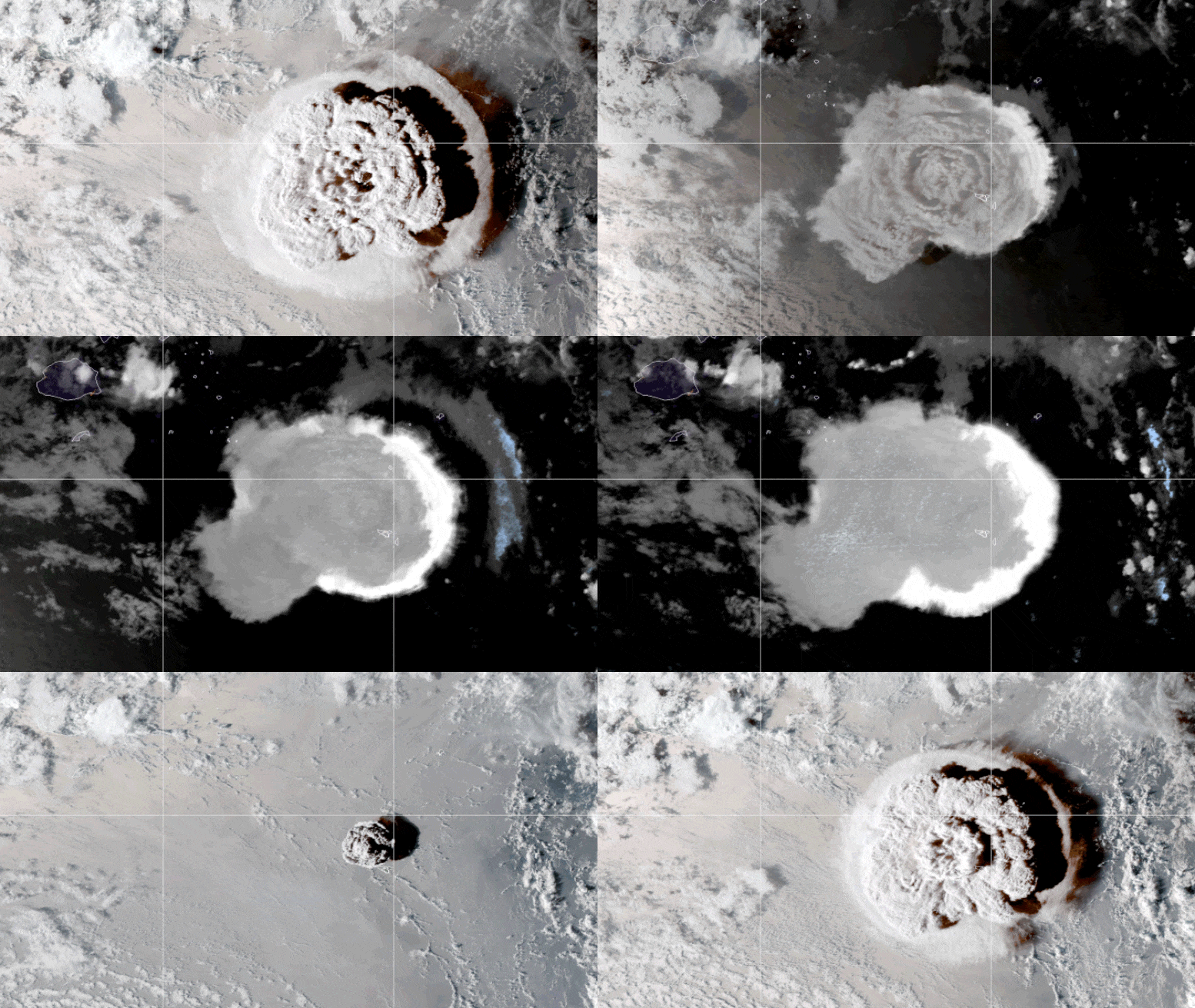
The eruption of Hunga Tonga-Hunga Ha’apai in January 2022 was unique in observed science, creating waves that reverberated around the earth and reached 100 km (60 miles) into the ionosphere.
A new study has confirmed that one of the most explosive volcanic events of the modern era happened earlier this year — the eruption of the Hunga Tonga-Hunga Ha’apai submarine volcano on January 15, 2022.
Recently published in the journal Nature, the study combines extensive satellite data with ground-level observations to show that the eruption was unique in observed science in both its magnitude and speed, and in the range of the fast-moving gravity and atmospheric waves it created. The research was led by researchers from the University of Bath.
Atmospheric gravity waves are not to be confused with astrophysical gravitational waves. A gravity wave is a vertical wave. A trigger mechanism that causes the air to be displaced vertically is necessary to initiate a gravity wave. Mountains and thunderstorm updrafts are two examples of trigger factors that can cause gravity waves.
Following a series of smaller seismic events beginning in December 2021, Hunga Tonga erupted on January 15 of this year, producing a vertical plume that extended more than 50 km (30 miles) above the surface of the earth. The heat released from the water and hot ash in the plume remained the biggest source of gravity waves on Earth for the next 12 hours. The eruption also produced ripple-like gravity waves that satellite observations show extended across the Pacific basin.
Fastest Atmospheric Waves Ever Recorded
The eruption also triggered waves in our atmosphere that reverberated around the planet at least six times and reached close to their theoretical maximum speeds – the fastest ever seen within our atmosphere, at 320 meters per second or 720 miles per hour. The fact that a single event dominated such a large region is described by the paper’s authors as unique in the observational record, and one that will help scientists improve future atmospheric weather and climate models.
Dr. Corwin Wright, a Royal Society University Research Fellow based at the Centre for Space, Atmospheric and Oceanic Science at the University of Bath, is the paper’s lead author. He said: “This was a genuinely huge explosion, and truly unique in terms of what’s been observed by science to date. We’ve never seen atmospheric waves going around the whole world before, or at this speed — they were traveling very close to the theoretical limit.
“The eruption was an amazing natural experiment. The data we’ve been able to gather on it will enhance our understanding of our atmosphere and will help us improve our weather and climate models.”
Potential Long-Term Effects on the Ozone Layer
Co-author Dr. Scott Osprey from the National Centre for Atmospheric Science, based within the Department of Physics, University of Oxford, expects to see further impacts from the Hunga Tonga eruption: “Our study nicely shows how the striking display of global waves is driven by the huge amounts of seawater vaporized during the eruption. However, my gut feeling is that there is more to come from this eruption. As the exceptional amount of water vapor spreads throughout the stratosphere, eyes will turn to the Antarctic ozone hole and just how severe it will be in the spring.”
Researchers from the University of Bath, Oxford University, North West Research Associates, University of Massachusetts Lowell, Forschungszentrum Juelich, AIRES, Sorbonne Université, Virginia Tech, Raytheon Technologies, University of Colorado, and NASA worked on the study.
The researchers received funding from the Natural Environment Research Council, Royal Society, NASA, and European Research Council.
The Bath researchers are now focusing on working with colleagues at weather and climate forecasting centers to see how the information gathered from the eruption can be used to make predictions better in the future.
Reference: “Surface-to-space atmospheric waves from Hunga Tonga-Hunga Ha’apai eruption” by Corwin J. Wright, Neil P. Hindley, M. Joan Alexander, Mathew Barlow, Lars Hoffmann, Cathryn N. Mitchell, Fred Prata, Marie Bouillon, Justin Carstens, Cathy Clerbaux, Scott M. Osprey, Nick Powell, Cora E. Randall and Jia Yue, 30 June 2022, Nature.
DOI: 10.1038/s41586-022-05012-5
Never miss a breakthrough: Join the SciTechDaily newsletter.
Follow us on Google and Google News.
3 Comments
This article gives me such hope for taking the people up with us when me and mine resurrect from the dead. That we are related to creation. That when we resurrect and hear “Come up here,” we go up and the others like us, too. “And they heard a great voice from heaven saying unto them, Come up hither. And they ascended up to heaven in a cloud; and their enemies beheld them…” The Hunga Tonga volcano eruption caused me to lose four of my inner parts, to surgery, because I explained the Canary Islands La Palma volcano in Spain to an elder.
Only an observation but CERN is the antipodes of Tonga.
Since when are seismic waves gravity waves? Concurrent with the first alleged detection of gravity waves by LIGO there was a volcanic eruption on a Japanese island. In my model of the universe space is mostly empty and gravity, mass and inertia practically disappear in deep space (e.g. the inverse square law) with no way gravity waves can travel there. Perhaps LIGO is detecting something but I seriously doubt it’s gravity.