

The Physics of the Accelerating Universe Survey has unveiled a groundbreaking catalog detailing distances to millions of galaxies with unparalleled precision.
A groundbreaking catalog, detailing millions of distant galaxies and providing distance measurements with unprecedented precision over a field of view and depth never before explored, has been released.
This catalog is the work of the Physics of the Accelerating Universe Survey (PAUS), an international collaboration led by the Institute of Space Sciences (ICE-CSIC) under Spain’s Ministry of Science, Innovation, and Universities (MICIU). The survey includes 14 institutions from six countries, including the University of Portsmouth.
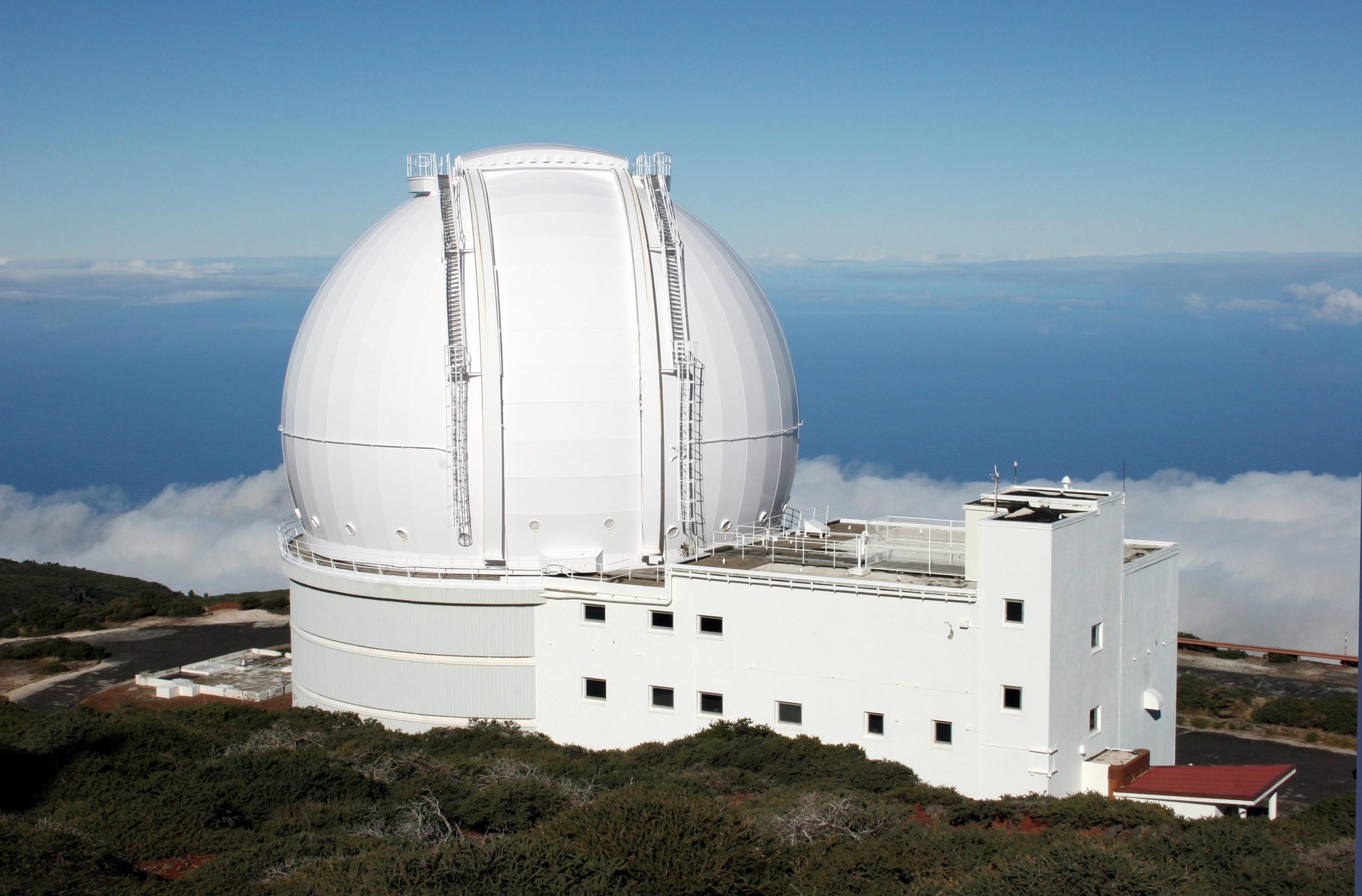
Compiled over 200 nights between 2015 and 2019 using the PAUCam camera on the William Herschel Telescope in La Palma, the catalog is now available to the public on the PAUS website and the CosmoHub web portal.
Enhancing Cosmic Understanding
Spanning a sky area of 50 square degrees—equivalent to approximately 250 full moons—the catalog provides data on 1.8 million astronomical objects. This information will allow astronomers to create more accurate maps of cosmic structures and study phenomena like dark matter and dark energy, deepening our understanding of the universe’s formation and expansion.
Enrique Gaztañaga, Director of the PAUS Survey and Professor at the University of Portsmouth’s Institute of Cosmology and Gravitation, said: “The PAU Survey offers a groundbreaking approach to creating cosmic maps, made possible through the design and development of a novel instrument and a dedicated survey to collect and analyze data in ways never done before. It has been a privilege to collaborate with such a talented and dependable group.”

Innovative Techniques and Dark Energy Insights
The accelerated expansion of the Universe is attributed to dark energy, which constitutes about 70 percent of the Universe, yet its nature remains a mystery. The PAUS survey offers new insights into this enigma, providing an accurate and comprehensive characterization of millions of galaxies up to distances of more than 10 billion light years.
This catalog is a valuable resource for the astronomical community, aiding in the scientific analysis and calibration of other cosmological surveys.
The PAUCam camera was specially designed to accurately measure galaxy distances, enabling the study of the Universe’s expansion under the influence of dark matter and dark energy.
“The PAU Survey offers a groundbreaking approach to creating cosmic maps, made possible through the design and development of a novel instrument and a dedicated survey to collect and analyse data in ways never done before.”
Enrique Gaztañaga, Director of the PAUS Survey and Professor at the University of Portsmouth’s Institute of Cosmology and Gravitation
Methodology and Future Research
The project builds on existing deep images from the Canada-France-Hawaii Telescope Lensing Survey (CFHTLenS), carried out with the Canada-France-Hawaii Telescope in Hawaii, and the Kilo-Degree Survey (KiDS) carried out with the European Southern Observatory’s VLT Survey Telescope in Chile. By combining these datasets, PAUS has achieved highly accurate distance and time information for deep-space objects.
This catalog represents a significant advancement in cosmic research with its extensive catalog offering photometric redshift measurements that determine the distances of galaxies as they appeared billions of years ago.
To achieve these measurements, the PAU camera employs 40 filters across different colors, representing narrow bands in the optical spectrum. This technique involves photographing the same field multiple times through various color filters. As objects move away from us, the light they emit experiences a redshift, shifting toward the red end of the spectrum. In astronomy, redshift is crucial for calculating the distance of an object from Earth.
David Navarro-Gironés, PhD student at ICE-CSIC and first author of the paper published today, said: “The precision in measuring galaxy distances depends on the number of filters you use, as each filter provides different information about the galaxy.
“The great advantage of PAUS is that it combines information from 40 different filters, allowing for highly accurate distance measurements. This level of precision is crucial for the study of the structure of the universe, which in turn requires data from a large number of galaxies.”
The release is detailed in two articles published recently in the Monthly Notices of the Royal Astronomical Society (MNRAS): one measuring distances and another one on calibration of the PAUS data.
In the coming months, the team will also present an ongoing study on galaxy clustering and intrinsic galaxy shape alignments, contributing to a deeper understanding of how our universe formed and evolved.
References:
“The PAU survey: photometric redshift estimation in deep wide fields” by D Navarro-Gironés, E Gaztañaga, M Crocce, A Wittje, H Hildebrandt, A H Wright, M Siudek, M Eriksen, S Serrano, P Renard, E J Gonzalez, C M Baugh, L Cabayol, J Carretero, R Casas, F J Castander, I V Daza-Perilla, J De Vicente, E Fernandez, J García-Bellido, H Hoekstra, G Manzoni, R Miquel, C Padilla, E Sánchez, I Sevilla-Noarbe and P Tallada-Crespí, 1 October 2024, Monthly Notices of the Royal Astronomical Society.
DOI: 10.1093/mnras/stae1686
“The PAU survey: photometric calibration of narrow band images” by F J Castander, S Serrano, M Eriksen, E Gaztañaga, R Casas, A Alarcon, A H Bauer, E Fernández, D Navarro-Gironés, N Tonello, L Cabayol, J Carretero, J De Vicente, J Garcia-Bellido, H Hildebrandt, H Hoekstra, B Joachimi, R Miquel, C Padilla, P Renard, E Sanchez, I Sevilla-Noarre and P Tallada-Crespí, 17 June 2024, Monthly Notices of the Royal Astronomical Society.
DOI: 10.1093/mnras/stae1507
Never miss a breakthrough: Join the SciTechDaily newsletter.
Follow us on Google and Google News.