
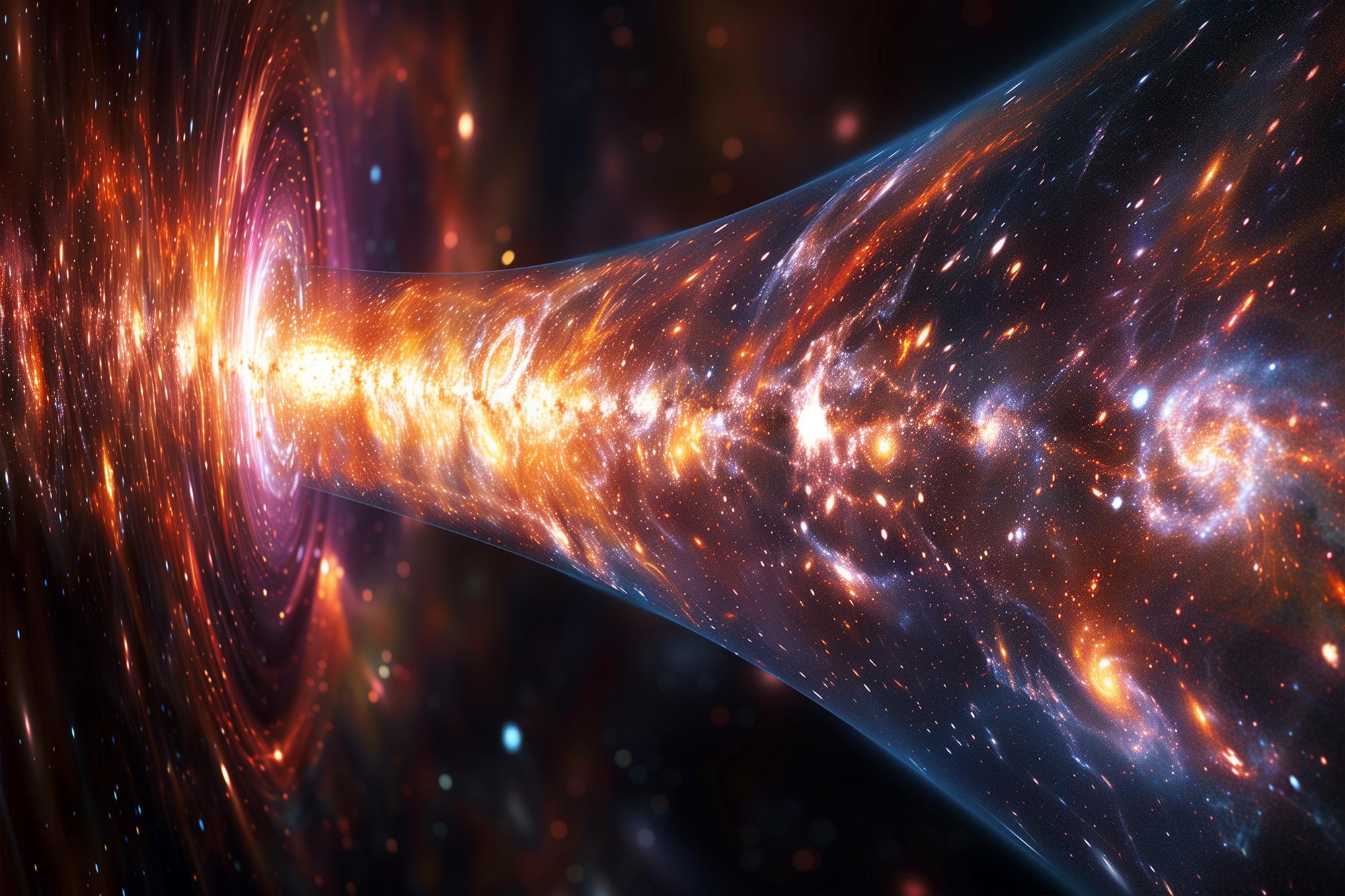
Albert Einstein’s prediction about how gravity behaves has been tested on a cosmic scale.
- Albert Einstein’s prediction about how gravity behaves has been supported by an international team of researchers who studied how the force acts on cosmic scales.
- Dark Energy Spectroscopic Instrument (DESI) researchers found that the way galaxies cluster is consistent with our standard model of gravity and the predictions from Einstein’s theory of General Relativity.
- A complex analysis of the first year of data from DESI provides one of the most stringent tests yet of General Relativity and how gravity behaves at cosmic scales.
- Looking at galaxies and how they cluster throughout time reveals how cosmic structure grows, which lets DESI test theories of modified gravity – an alternative explanation for our universe’s accelerating expansion.
- DESI is managed by the US Department of Energy’s (DOE) Lawrence Berkeley National Laboratory (Berkeley Lab). UK involvement in DESI includes the University of Portsmouth, Durham University, and UCL as full member institutions, together with individual researchers at the universities of Cambridge, Edinburgh, St Andrews, Sussex, and Warwick.

Einstein’s Gravity Theory on a Cosmic Scale
Albert Einstein’s predictions about gravity have been confirmed by an international team of researchers who explored how this fundamental force operates on a cosmic scale.
Using the Dark Energy Spectroscopic Instrument (DESI), scientists, including astrophysicists from the University of Portsmouth, mapped the clustering of nearly six million galaxies over a period spanning up to 11 billion years.
Their detailed analysis of DESI’s first year of data represents one of the most rigorous tests of Einstein’s General Relativity at such vast scales, providing crucial insights into how gravity shapes the universe.
Universe’s Expanding Structure Analyzed
By studying how galaxies cluster over time, researchers uncovered patterns that reveal how the structure of the universe has evolved.
This allowed DESI’s scientists to test theories of modified gravity – an alternative explanation for our universe’s accelerating expansion typically attributed to dark energy.
They found that the way galaxies cluster is consistent with our standard model of gravity and the predictions made by Einstein.
The result validates the leading model of the universe and limits possible theories of modified gravity, which have been proposed as alternative ways to explain unexpected observations such as the expansion of the universe.
Research Collaboration and Insights
Several UK universities were involved in DESI’s latest research findings including the University of Portsmouth, Durham University, and University College London.
The DESI collaboration shared their results in a number of papers posted to the online repository arXiv today.
Dr. Seshadri Nadathur, Associate Professor at the University of Portsmouth’s Institute of Cosmology and Gravitation, led the group producing the new analysis.
Dr. Nadathur said: “The data we have gathered with DESI allows us to measure the subtle patterns in how galaxies cluster together. What is really exciting is that we can use these patterns not only to measure how fast the Universe has been expanding, but even test our understanding of gravity itself! So far General Relativity is holding up well, but we have seen some surprises with dark energy.”
“What is really exciting is that we can use these patterns not only to measure how fast the Universe has been expanding, but even test our understanding of gravity itself! So far General Relativity is holding up well, but we have seen some surprises with dark energy.”
Dr. Seshadri Nadathur, Associate Professor
Exploring Fundamental Physics Questions
Nathan Findlay, a PhD student at the University of Portsmouth, also led part of the work on quantifying some of the uncertainties in the analysis. He said: “The fact that we can learn about dark matter, dark energy, the history and fate of the Universe, even the correct theory of gravity – all these fundamental questions in physics – using this data from DESI is mind-blowing, really. It’s very exciting to be part of it.”
Testing Gravity at Cosmological Scales
Dr. Pauline Zarrouk, a cosmologist at the French National Center for Scientific Research (CNRS) working at the Laboratory of Nuclear and High-Energy Physics (LPNHE), co-led the new analysis.
Dr. Zarrouk, who was a postdoctoral researcher at Durham University’s Institute for Computational Cosmology, and is now an academic visitor in the institute, said: “General relativity has been very well tested at the scale of solar systems, but we also needed to test that our assumption works at much larger scales.
“Studying the rate at which galaxies formed lets us directly test our theories and, so far, we’re lining up with what General Relativity predicts at cosmological scales.”
Neutrino Mass and Galactic Clustering
A detailed analysis of the DESI data, co-led by Durham University researchers Dr. Willem Elbers and Professor Carlos Frenk, provided new upper limits on the mass of neutrinos, the only fundamental particles whose masses have not yet been precisely measured in the laboratory.
Neutrinos influence the clustering pattern of galaxies ever so slightly but this can be measured with the quality of the DESI data. Neutrino laboratory experiments set a floor on the neutrino mass; remarkably, the distribution of galaxies in DESI sets a ceiling on this mass which is now very close to the floor, with a value of about a ten millionth of the mass of the electron.
Durham University is a key member of the DESI collaboration and also designed and built the fibre optic system which funnels light onto DESI’s spectrograph. Durham scientists also carried out supercomputer simulations of the Universe, crucial for the interpretation of DESI’s data.
DESI team member Professor Carlos Frenk, of the Institute for Computational Cosmology, Durham University, said: “General Relativity is one of the most elegant and profound theories in Physics. That the Universe seems to conform to its precepts is truly remarkable, a testament to Einstein’s talent and to that of the astronomers who have devised methods to test it.
“Equally remarkable is the insight that DESI has brought to the long-standing mystery of the neutrino mass. These are tiny elementary particles with very small masses but the force of gravity that they collectively produce affects how galaxies move and cluster in space. The unprecedented size and quality of the DESI dataset has made it possible to detect this tiny effect and this is very exciting for both cosmologists and particle physicists.”
DESI’s Contributions to Physics and Cosmology
DESI contains 5,000 fiber-optic “eyes,” each of which can collect light from a galaxy in just 20 minutes. Researchers at UCL, also a key member of the DESI collaboration, helped design, assemble and build DESI’s optical corrector – six lenses, the largest 1.1m across, that focus light on to the “eyes.”
Today’s latest results also provide an extended analysis of DESI’s first year of data, which in April made the largest 3D map of our universe to date and revealed hints that dark energy might be evolving over time.
The April results looked at a particular feature of how galaxies cluster known as baryon acoustic oscillations (BAO). The new analysis, called a “full-shape analysis”, broadens the scope to extract more information from the data, measuring how galaxies and matter are distributed on different scales throughout space.
Like the previous study, today’s results used a technique to hide the result from the scientists until the end, mitigating any unconscious bias.
For more on this discovery:
About DESI
DESI is a cutting-edge instrument capable of capturing light from 5,000 galaxies simultaneously. It was designed, built, and is operated with funding from the US Department of Energy’s Office of Science.
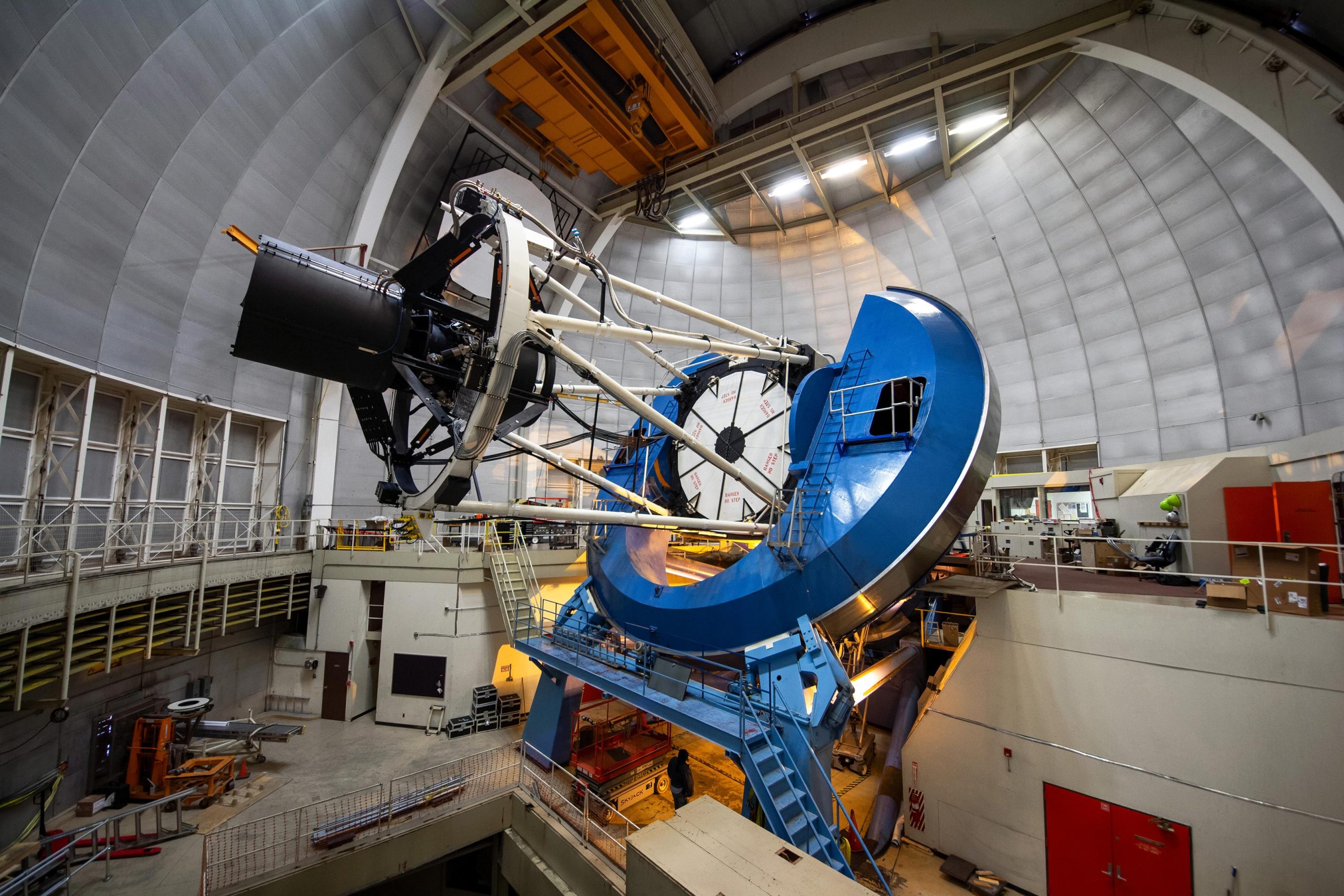
Located in Arizona, DESI is mounted on the Nicholas U. Mayall 4-meter Telescope at Kitt Peak National Observatory, part of the US National Science Foundation’s NOIRLab program. Now in its fourth year of a five-year survey, DESI aims to gather data from approximately 40 million galaxies and quasars by the project’s conclusion.
The collaboration is currently analyzing data collected during the first three years of the survey, with plans to release updated measurements on dark energy and the universe’s expansion history by spring 2025. Today’s expanded results are consistent with earlier findings that hinted at an evolving dark energy, further building anticipation for the next phase of analysis.
The DESI collaboration respectfully acknowledges that its research takes place on Iolkam Du’ag (Kitt Peak), a site of profound cultural significance to the Tohono O’odham Nation.
Never miss a breakthrough: Join the SciTechDaily newsletter.
Follow us on Google and Google News.
12 Comments
“Carlos Frenk, of the Institute for Computational Cosmology, Durham University, said: “General Relativity is one of the most elegant and profound theories in Physics. That the Universe seems to conform to its precepts is truly remarkable, a testament to Einstein’s talent and to that of the astronomers who have devised methods to test it.”
Carlos is always trying to inspire cleanser kids around the world without even having to mention “dark matter.”
Although gravity hasn’t changed much since Einstein’s continuum was magically transformed into a fabric filled with dark matter much like a baby-wrap, the recent emergence of ring structures in modern gravity news artwork for galactic and quantum scales is actually more entertaining and informative than the articles, if you understand what’s going on.
“Equally remarkable is the insight that DESI has brought to the long-standing mystery of the neutrino mass. These are tiny elementary particles with very small masses but the force of gravity that they collectively produce affects how galaxies move and cluster in space. The unprecedented size and quality of the DESI dataset has made it possible to detect this tiny effect and this is very exciting for both cosmologists and particle physicists.”
It’s not a force but a distortion in space-time, helped by dark cleanser particles, that causes falling and disappearance.
ScienceNews headline 9/20/24 “A neutrino mass mismatch could shake cosmology’s foundations”
“some interpretations of the DESI data suggest that neutrinos have no mass or even negative mass”
So much for that “neutrino mass insight.”
How did Einstein come about all these theories of relativity
No idea. Mentoring in the cleanser rainbow clan tribe is pretty much typically on the super down-low low-key side, though.
Einstein divided by 0 and used the sq root of -1 to derive his so called gravitational physics BS. He was promoted over Tesla because his hoaky math provided needed momentum for oppression and control of science. Science is a religion to which physicists must conform. How about you geniuses explain how one can resolve a gravitational wave which is 39 orders of magnitude smaller than the electromagnetic effect within which it is buried? You cannot!
Excuse me, sincerely asking, what do you mean by 39 orders of magnitude smaller than which it is buried? What data are you referring to?
Clearly it relates to the approximate 10^(-39) mass/charge force ratio existing between electrons and protons, and the poster is clearly just wasting his time trying to do jokes to cheer up the klever kleanser kids.
So in other words, the team with the words “dark energy” in their name finally found out there is no need for the theory of dark matter/dark energy because they simply hadn’t been considered the effects of gravitational lensing and the field of astrophysics is so compartmentalized and full of ego sensitive narcissists that they all just automatically assumed they had accounted for everything in respect to mass without actually taking account for all the mass.
Well, I’ve literally been trying to tell you all that since I was 16 years old and I’m 37 now. So with all due respect they can all go to hell.
This article was the most coddling, gentle, coo-ing excuse for a multiple-decades-long redaction I’ve ever seen.
Oh well. Better get to figuring out how you’re gonna apologize to all those wealthy investors you convinced to throw literally billions of dollars down all those ridiculous projects entirely based off of unicorn fart fueled fantasy.
I’ve been telling folks the same thing since 1980; they haven’t listened to me, either. Stand up to the plate and keep swinging, tho’, sooner or later their band-aids will fall off.
They just left out the dark matter so they could deliver the standard kleanser klan Einstein worship program browntongue maneuver.