

The DESI collaboration’s latest research supports the standard model of gravity and hints at evolving dark energy, based on a detailed analysis of data from millions of galaxies and quasars. These results contribute significantly to understanding the accelerated expansion of the universe.
A physicist from the University of Texas at Dallas, alongside an international team of researchers in the Dark Energy Spectroscopic Instrument (DESI) collaboration, is conducting a multiyear mission to tackle one of astrophysics’ biggest mysteries: Why is the universe’s expansion accelerating?
Scientists have proposed competing theories to explain this phenomenon. One theory suggests that dark energy, an unknown force, is driving galaxies apart. Another theory posits that gravity—the force that binds objects together in local systems like our solar system—behaves differently on vast cosmic scales and may need to be revised to account for the accelerating expansion.
Validating Theories of Gravity and Expansion
The DESI collaboration, involving over 900 scientists from more than 70 institutions, has released a new analysis addressing the second theory. Their findings indicate that the clustering of galaxies aligns with the standard model of gravity: Albert Einstein’s general theory of relativity, which also explains how objects fall under gravity and how planets orbit stars.
The analysis provides the most precise test to date of how gravity behaves at very large scales by tracing how cosmic structure grew over the past 11 billion years.
Groundbreaking Findings in Cosmological Research
Scientists in the collaboration shared their results in several papers posted on November 19 to the arXiv, an online repository of scientific articles not yet peer-reviewed.
Dr. Mustapha Ishak-Boushaki, a professor of physics in the School of Natural Sciences and Mathematics at UT Dallas, co-led the DESI working group that interpreted the cosmological data, and he is lead author of the paper that presents a detailed analysis of testing gravity at cosmic scales.
“For this round of DESI results, I focused my efforts at UT Dallas on conducting a large part of the analysis on gravity, which puts constraints on how matter in the universe moves and how large-scale structures, such as clusters of galaxies, evolve,” said Ishak-Boushaki, an astrophysicist whose research career has focused on questions in cosmology. “The results from DESI, combined with datasets from other experiments, are consistent with general relativity theory operating at cosmic scales, although they do not completely exclude other theories of modified gravity.”

Advancements in Dark Energy and Cosmic Structures
Ishak-Boushaki is slated to present the cosmology results with other researchers on behalf of the DESI collaboration in January at a meeting of the American Astronomical Society in National Harbor, Maryland.
The new results provide an extended analysis of DESI’s first year of data, which in April contributed to the largest 3D map of the universe to date and revealed hints that dark energy might be evolving over time.
“The latest analysis is also consistent with our previous findings that give preference to the theory that dark energy is not constant, but dynamic, which is a very important result for cosmic acceleration,” Ishak-Boushaki said.
The DESI experiment can capture light from 5,000 galaxies simultaneously. The latest analysis used data from nearly 6 million galaxies and quasars, and lets researchers see up to 11 billion years into the past. With just one year of data, DESI has made the most precise overall measurement of the growth of structure in the universe, surpassing previous efforts that took decades to make.
The latest analysis also provided new upper limits on the mass of neutrinos, the only fundamental particles whose masses have not yet been measured precisely.
The new analysis broadens the scope to extract more information from the data, measuring how galaxies and matter are distributed on different scales throughout space. Like the previous study, it used a technique to hide the result from the scientists until the end, mitigating any unconscious bias.
The DESI experiment is now in its fourth of five years surveying the sky, and researchers plan to collect data from roughly 40 million galaxies and quasars by the time the project ends. The collaboration is currently analyzing the first three years of collected data and expects to present updated measurements of dark energy and the expansion history of the universe in March at a meeting of the American Physical Society.
For more on this discovery:
- DESI Tests Einstein’s Theory of Relativity Across 11 Billion Years of Cosmic History
- Stunning Cosmic Map Confirms Gravity Theory Across Billions of Years
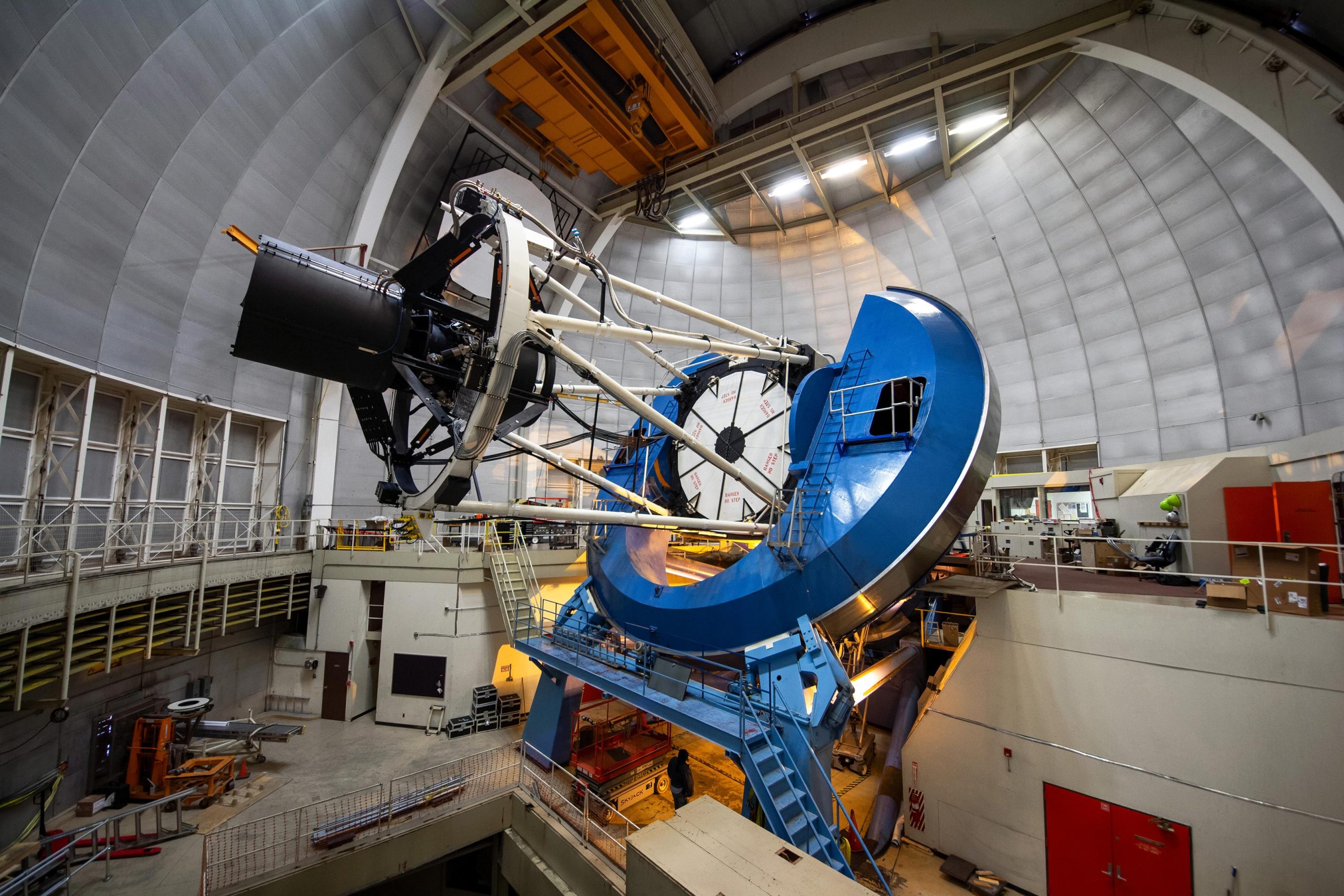
The Dark Energy Spectroscopic Instrument (DESI) was built and is operated with funding from the Department of Energy (DOE) Office of Science. It is installed on the Nicholas U. Mayall 4-meter Telescope at Kitt Peak National Observatory, managed by the National Science Foundation’s (NSF) NOIRLab. The DESI experiment is overseen by the DOE’s Lawrence Berkeley National Laboratory.
DESI receives additional support from the National Energy Research Scientific Computing Center, a DOE Office of Science user facility. Funding also comes from the National Science Foundation, the Science and Technology Facilities Council of the United Kingdom, the Gordon and Betty Moore Foundation, the Heising-Simons Foundation, the French Alternative Energies and Atomic Energy Commission, the National Council of Humanities, Sciences, and Technologies of Mexico, the Ministry of Science and Innovation of Spain, and DESI’s member institutions.
The DESI collaboration acknowledges and respects the privilege of conducting research on I’oligam Du’ag (Kitt Peak), a site of deep cultural and spiritual significance to the Tohono O’odham Nation.
Never miss a breakthrough: Join the SciTechDaily newsletter.
Follow us on Google and Google News.
8 Comments
Puh-leeze. Dark matter/energy are nothing more than fudge factors used to try and square a theory that is obviously incorrect. Many careers and reputations are going to go up in smoke when this is acknowledged.
Isn’t everything getting tugged in different directions one way or another? Either it be a black hole or some other force? Makes sense that everything gets further apart.
It’s possible that there has been a misinterpretation of red shift caused by an expanding universe. Red or blue shift is just a change in energy. There are various causes for this which don’t require an expanding universe.
So, dark matter is now alive, too? Try that crap in school, see how it flies. “Your equation is incorrect” “No, teacher, it evolved”.
Science (or at least cosmology) is definitely in a dark place right now.
String theory we still love you 🥺… Guess
Dark energy attraction and dark matter attraction is everywhere we cannot escape it.
It is the glue of the universe.
#SOSSTSE SCIENTIFIC TECHNOLOGY SOLUTIONS RESEARCH CORPORATION.
We do not know whether dark energy can develop, but the universal acceleration varies in space and time. Our research, for more than 16 years, states that there is a pattern in the change in acceleration, at least with distance!
I’ve liked string theory since the 1970’s. It has died on me a couple of times but has come back. I don’t like dark matter/ energy because I don’t know what it is. Yet it seems to be real. The universe accelerating makes since if there is an accelerant pushing an ever decreasing amount of mass, due to the expansion. Once the accelerant runs out, gravity will pull the universe back together for another big bang. Or so my simple way or perceiving reality goes.
Wish these articles contained a few more specifics.