
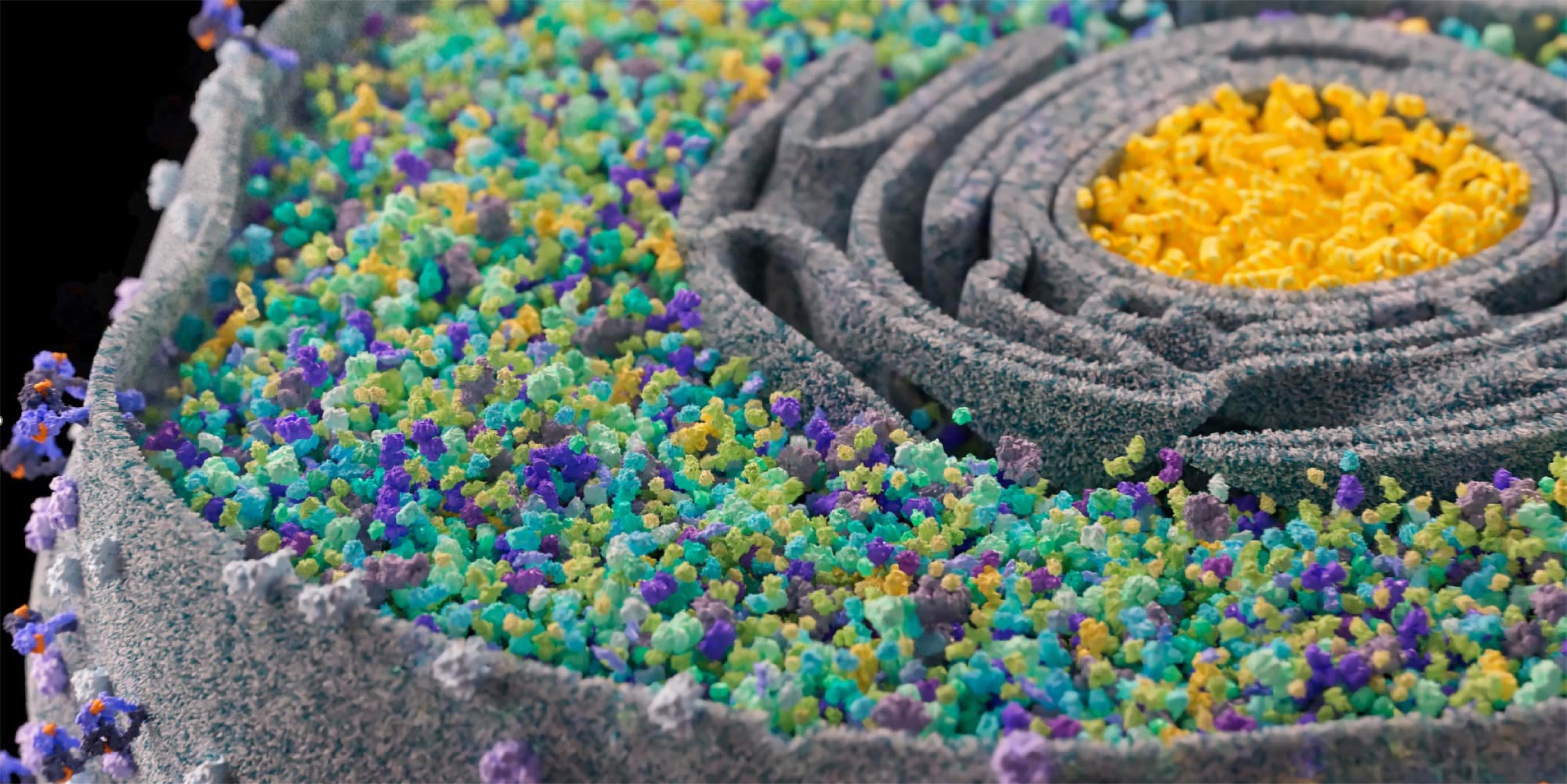
Scientists have enhanced a mass spectrometry method to study protein interactions within cells, aiming to identify changes linked to diseases and discover potential therapeutic targets to restore cellular balance. This work lays the foundation for the development of new drugs to treat diseases such as cancer and Alzheimer’s.
- The function of biological cells is determined by the interactions between proteins. Abnormal protein interactions are the cause of numerous diseases.
- Researchers at ETH Zurich have developed a new method for investigating protein interaction networks.
- This method, and the knowledge it provides, is valuable for pharmaceutical research. It opens the door to developing new drugs that target specific protein interactions.
Dance Club Analogy of Cellular Interactions
Inside cells, it’s like being in a crowded dance club: hundreds of proteins are constantly moving and interacting. Some keep to themselves, while others weave through the crowd, making connections with many along the way. Some interactions are brief, like a quick greeting, while others form lasting bonds, sticking closely to their partners. Just like in the club, there’s a wide variety of interactions happening in cells with proteins.
Cells are packed with different types of proteins that interact and often team up in groups. These groups, known as complexes, act like molecular machines, and they only work correctly when their individual proteins come together and function as a unit.
Party-Crasher Interrupts Normal Interaction
Which proteins interact with each other and how also depends on the state of the body. Under normal conditions in a healthy body, two proteins, which we call blue and red, join together. If the conditions change due to cellular stress, for example, protein blue can change its interaction partner and join forces with protein yellow, which causes nothing but trouble and disrupts the party.
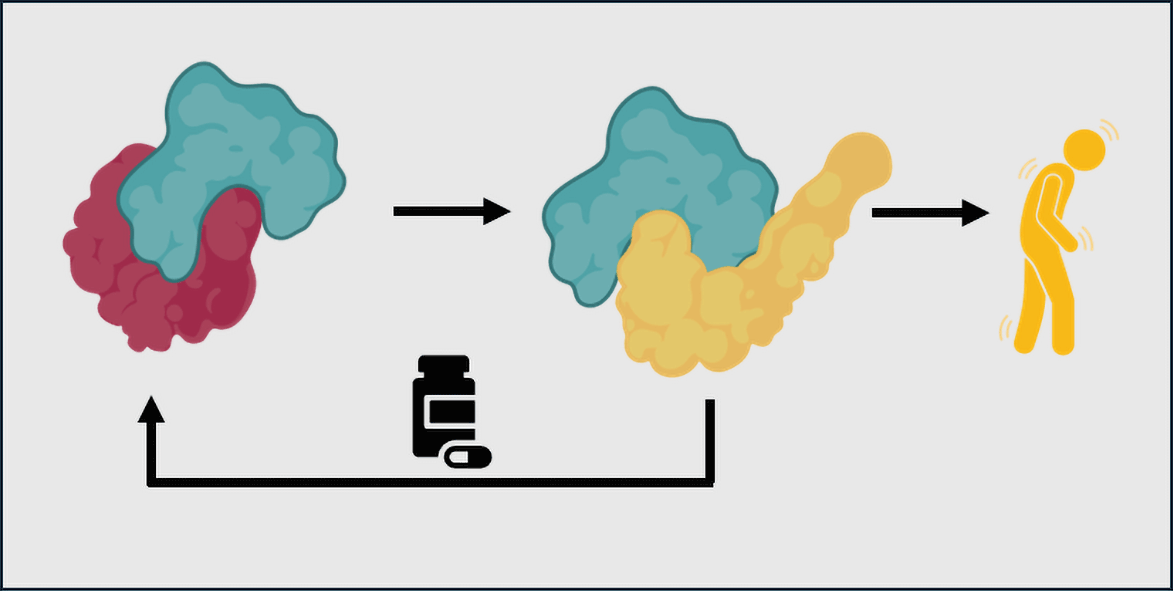
“Altered interactions between proteins can lead to diseases such as Alzheimer’s, Parkinson’s or cancer,” explains Cathy Marulli. She is a doctoral student under Paola Picotti, a professor at the Institute for Molecular Systems Biology at ETH Zurich. “It is therefore important to know how protein-protein interactions differ between healthy and diseased states and what the binding sites between two proteins look like. If we know these down to the last detail, we can develop active substances that block unwanted interactions and restore the cell’s equilibrium,” she explains.
The ETH biochemists have therefore further developed a proven approach in protein research to analyze the complete interaction network of proteins, known as the interactome.
The corresponding study has just been published in the journal Nature Biotechnology.
Advancements in Protein Interaction Research
Several years ago, Picotti and her colleagues developed what is known as LiP mass spectrometry. This enables researchers to measure structural changes in thousands of proteins in any biological sample, without the samples having to be specially purified beforehand. They last used this method to analyze proteins and their functions.
Now they have further developed LiP mass spectrometry to study the interactions between proteins. To this end, they first identified around 6,000 interaction interfaces between proteins and other sites that change when proteins interact with each other. They then used these sites as markers to assess whether a protein changes its interaction with other proteins under a certain condition.
To do this, they used enzymes that cut proteins into pieces. These enzymes can only attack proteins at freely accessible sites. The enzyme cannot cut a protein if another protein is docked at a site. Detailed information on the protein fragments therefore helped the researchers to analyse whether and where individual proteins interact with others. This enabled them to study the interactions of about 1,000 proteins simultaneously and directly in a messy cell matrix.
Cellular Stress and Protein Complex Alterations
The researchers worked with yeast cells to study how the interactions of proteins differ in their normal state from those in a stress situation triggered by a chemical substance.
In so doing, the biochemists discovered that the stress situation had altered around five dozen protein complexes and thus their interactions. The researchers also showed that a protein complex called SAGA plays an important role in the interaction network of the yeast cell. When they removed SAGA from the picture, around two-thirds of the protein complexes behaved differently in the stress situation. “SAGA is the DJ at the party. When it is muted, some party groups stop dancing. They influence other party-goers, who also withdraw. This shows that a single player in the cell has a disproportionately large influence on others,” says Marulli.
Broad Applications and Future of Protein Research
The method developed can also be applied to other organisms. “For each species we want to study, we just need to develop a new set of binding markers to be able to use this method to study protein interactions in mouse or human cells,” says Marulli. The next logical step is therefore to determine the interaction markers for the interactome of human cells to analyze defective protein interactions in a single step.
Determining protein interactions is extremely important in relation to diseases. “We therefore want to further develop our technology for diagnostic purposes and for research into disease mechanisms,” says Picotti. There is a good reason for this hope: previous approaches developed in their laboratory have already been put into practice by ETH spin-off Biognosys.
Pharmaceutical research targets interactions
Pharmaceutical research is also very interested in the interaction markers. If the interaction sites are known, researchers can efficiently search for chemical compounds that can interrupt unwanted interactions or establish new ones.
Compounds that modulate protein-protein interactions are currently a promising new direction in pharmaceutical research. Such compounds could potentially address proteins that are not accessible with current drugs. Or they can be used to develop new drugs with fewer side effects.
Reference: “Global profiling of protein complex dynamics with an experimental library of protein interaction markers” by Christian Dörig, Cathy Marulli, Thomas Peskett, Norbert Volkmar, Lorenzo Pantolini, Gabriel Studer, Camilla Paleari, Fabian Frommelt, Torsten Schwede, Natalie de Souza, Yves Barral and Paola Picotti, 16 October 2024, Nature Biotechnology.
DOI: 10.1038/s41587-024-02432-8
Never miss a breakthrough: Join the SciTechDaily newsletter.
Follow us on Google and Google News.