

Scientists at QuTech have achieved a major milestone in quantum computing by creating highly precise quantum gates on a diamond chip, hitting error rates as low as 0.001%.
By using ultra-pure diamonds and advanced gate designs, the team overcame key challenges that have limited previous approaches. These precise gates passed rigorous testing with long sequences of operations, marking a significant step toward building scalable quantum computers.
Why Quantum Computers Need Ultra-Precise Gates
Quantum computers are expected to tackle complex problems that are beyond the reach of classical computers. To perform calculations, they rely on sequences of basic operations known as quantum gates. For a quantum computer to work reliably, these gates must be extremely precise. The chance of an error occurring during each gate operation needs to be very low, typically below 0.1 to 1 percent. Only at these low error rates can quantum error correction techniques function effectively, allowing accurate computation even when using imperfect hardware.
Spins in Diamond: A Promising Qubit Platform
One promising type of qubit is based on spins in diamond. These qubits use the electron and nuclear spins associated with atomic defects in the diamond lattice, for example, when a nitrogen atom takes the place of a carbon atom. These defects offer several advantages: they can operate at relatively high temperatures (up to 10 Kelvin), are well-shielded from environmental noise, and naturally interact with photons, making them ideal for building quantum networks. However, until recently, achieving a full set of quantum gates with sufficiently low error rates using diamond spins has remained a significant challenge.
Precise Universal Gates on Diamond Chips
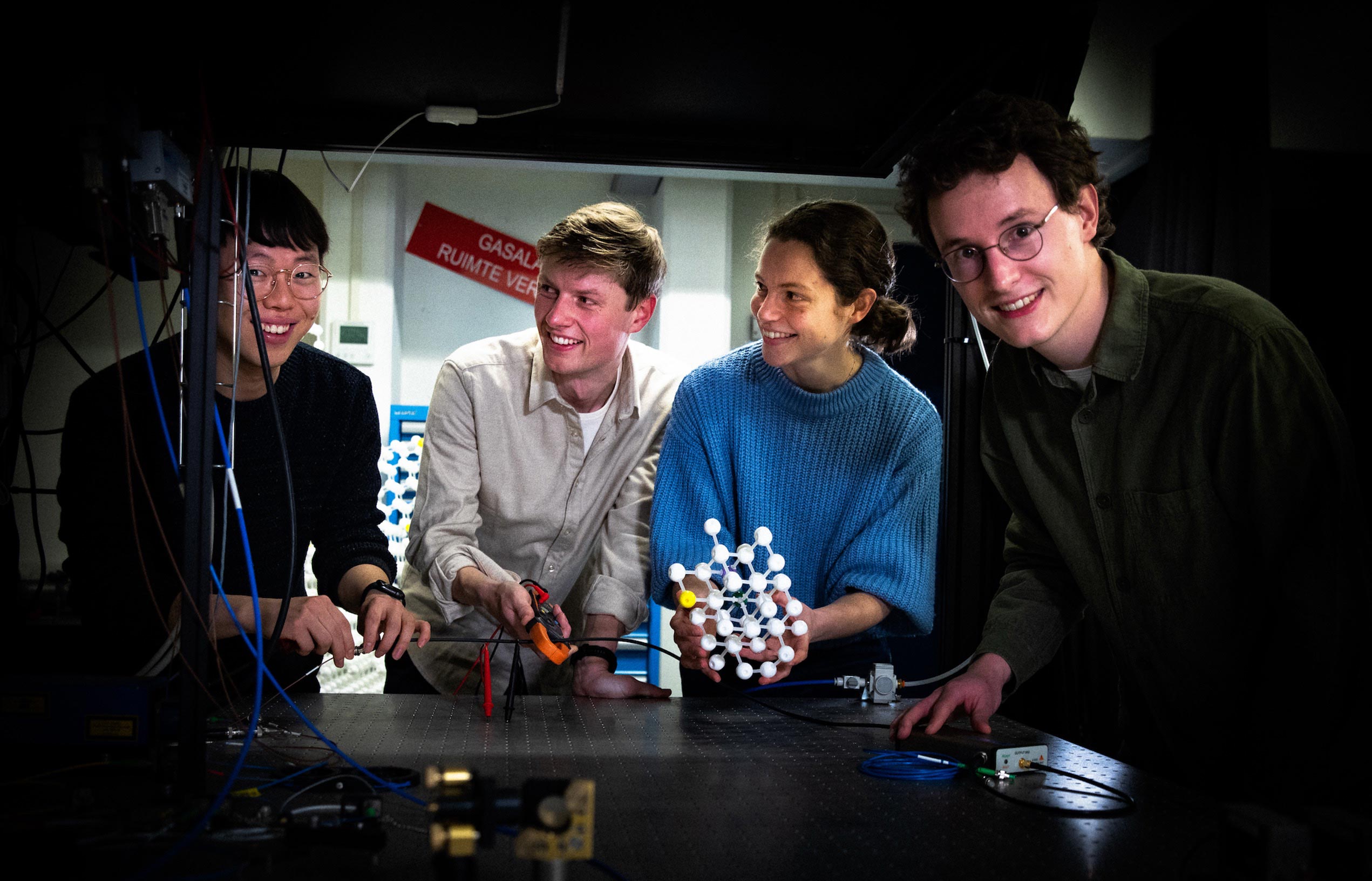
Researchers at QuTech, the interfaculty quantum technology research institute of Delft University of Technology, have now demonstrated a highly precise universal set of quantum gates using a diamond quantum chip. The researchers used a system of two qubits, one formed by the electron spin of the defect center, the other by its nuclear spin. Each type of gate in this two-qubit system operates at an error below 0.1%, and the best gates even reach errors as low as 0.001%.
“To realize such highly precise gates we had to systematically remove sources of errors. The first step was to use ultrapure diamonds that have a lower concentration of carbon-13 isotopes as these cause noise,” says Hans Bartling, lead author. The second key step was to design gates that carefully decouple the spin qubits from each other and from interactions with the remaining noise in the environment.
Characterizing, Optimizing, and Testing the Quantum Gates
A final challenge was to find tools to reliably characterize the gates and optimize their parameters. For this, the team turned to a method called ‘gate set tomography’, which provides the full quantum description of the gates. “It was essential that our characterization provided complete and precise information about the gate errors, as this enabled us to systematically find imperfections and optimize all the gate parameters,” says co-author Jiwon Yun.
Ultimately, the researchers put the quantum gates and their characterization to the test by performing an artificial algorithm with a large sequence of gates. After 800 gate operations the result could be accurately predicted from the team’s knowledge of the individual gates, indicating that the gate operations were now both precise and well understood.
Scaling Up: Challenges on the Road to Full Quantum Power
While high-precision universal gates are a key prerequisite towards quantum computation, there is still a long way to go to large scale computation. “Our demonstration was on a two-qubit system and using a particular type of defect,” says Tim Taminiau who supervised the research. “A key challenge is to maintain and further improve the gate quality when moving to chip-scale integrated optics and electronics and scaling to many more qubits.”
Realizing such larger processors is the focus of the research effort at QuTech and of its collaboration with Fujitsu. The team takes a full stack approach, in which not only improved quantum bits are studied, but also the required control electronics, scalable fabrication methods, and new types of quantum computer architectures. “Making the next big step will require bringing together scientists, engineers, and industry,” says Taminiau.
Reference: “Universal high-fidelity quantum gates for spin qubits in diamond” by H.P. Bartling, J. Yun, K.N. Schymik, M. van Riggelen, L.A. Enthoven, H.B. van Ommen, M. Babaie, F. Sebastiano, M. Markham, D.J. Twitchen and T.H. Taminiau, 21 March 2025, Physical Review Applied.
DOI: 10.1103/PhysRevApplied.23.034052
Never miss a breakthrough: Join the SciTechDaily newsletter.
Follow us on Google and Google News.