

A groundbreaking step in quantum technology has been achieved with the demonstration of an integrated spin-wave quantum memory, overcoming challenges of photon transmission loss and noise suppression.
Quantum memories play a crucial role in creating large-scale quantum networks by enabling the connection of multiple short-distance entanglements into long-distance entanglements. This approach helps to overcome photon transmission losses effectively. Rare-earth ion-doped crystals are a promising candidate for implementing high-performance quantum memories, and integrated solid-state quantum memories have already been successfully demonstrated using advanced micro- and nano-fabrication techniques.
Limitations of Existing Quantum Memory
However, previous implementations of integrated quantum memories for light have been limited to storing information in optically excited states. This method does not allow for on-demand retrieval with adjustable storage times, as the storage duration is fundamentally constrained by the lifetime of the excited states.
Spin-wave storage, which transfers photons into spin-wave excitations in ground states, offers a solution by enabling on-demand retrieval with storage times extended to the spin coherence lifetime. Despite its potential, the integration of spin-wave storage faces a significant challenge: separating single-photon-level signals from the substantial noise generated by strong control pulses in integrated structures.
To date, spin-wave quantum storage has not been successfully demonstrated in integrated solid-state devices, posing a major obstacle to the practical application of this promising technology.
Breakthrough in Spin-Wave Quantum Memory
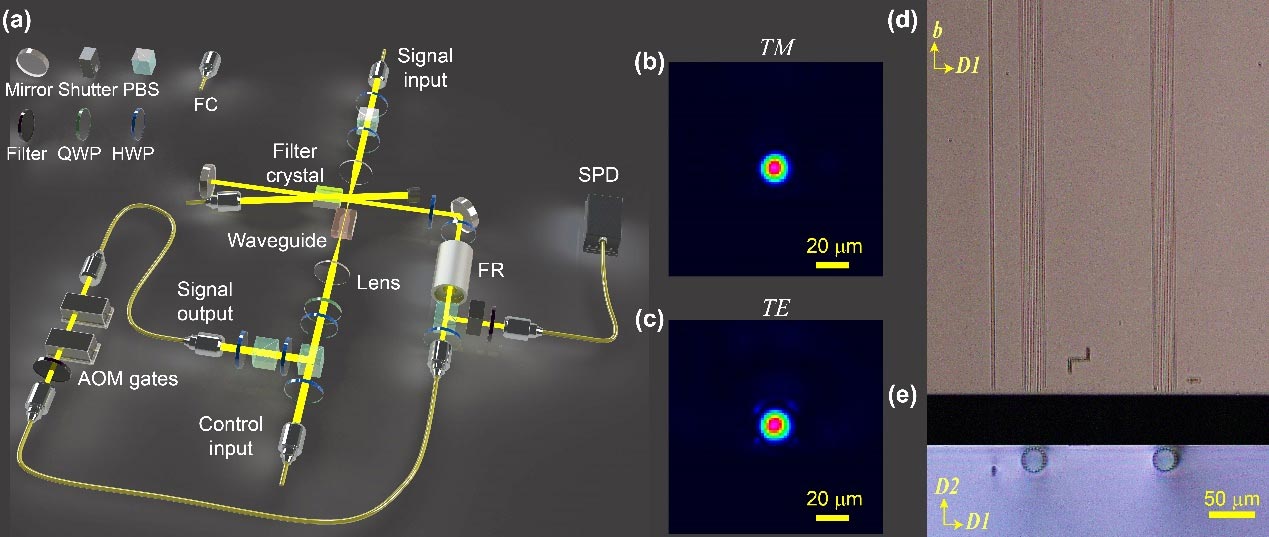
Recently, the group led by Chuan-Feng Li and Zong-Quan Zhou at the University of Science and Technology of China has successfully demonstrated an integrated spin-wave quantum memory, by implementing spin-wave quantum storage protocols using a specially developed device.
To suppress the noise, the group employed direct femtosecond-laser writing to fabricate a circularly-symmetric waveguide in a Eu:YSO crystal, to enable the polarization-based filtering of noise in the integrated device. Combined with filtering techniques in other degrees of freedom, including temporal gates, spectral-filtering crystals, and a counter-propagation configuration, the single-photon-level signal can co-propagate with strong control pulses in the same waveguide and can be efficiently separated.
To retrieve the signal, the group implemented two spin-wave storage protocols, namely, a modified noiseless photon echo (NLPE) and the full atomic frequency comb (AFC) protocol. Under the same experimental configuration, NLPE provides an efficiency enhancement of more than 4 times as compared to the AFC, due to the well-preserved sample absorption in the NLPE memory. Finally, time-bin qubits encoded with single-photon-level inputs are stored and retrieved with a fidelity of 94.9±1.2%, which is far beyond the maximal fidelity that can be obtained with any classical device, demonstrating the reliability of this integrated device.
Future Applications of Spin-Wave Quantum Memory
The successful demonstration of spin-wave integrated quantum memory marks the achievement of a goal that researchers have worked toward for a long time. This breakthrough establishes a solid foundation for developing multiplexed quantum repeaters in integrated configurations and creating high-capacity, portable quantum memory systems.
Reference: “Integrated spin-wave quantum memory” by Tian-Xiang Zhu, Ming-Xu Su, Chao Liu, Yu-Ping Liu, Chao-Fan Wang, Pei-Xi Liu, Yong-Jian Han, Zong-Quan Zhou, Chuan-Feng Li and Guang-Can Guo, 1 May 2024, National Science Review.
DOI: 10.1093/nsr/nwae161
Never miss a breakthrough: Join the SciTechDaily newsletter.
Follow us on Google and Google News.