
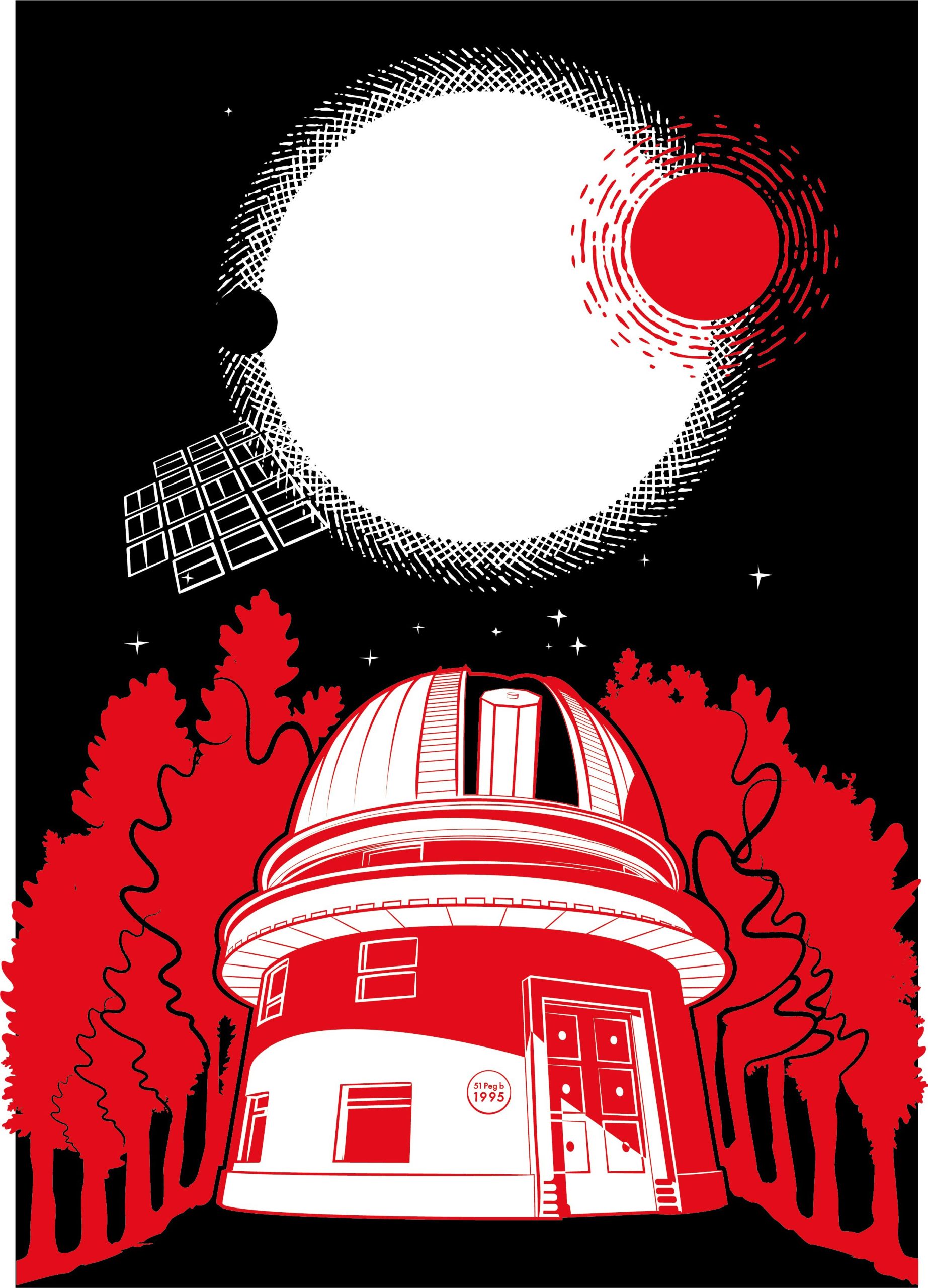
Researchers detected the circumbinary planet Kepler-16b using ground-based radial velocity methods, challenging existing theories on planet formation in binary systems and suggesting planets may migrate inward after forming far from their stars.
A rare exoplanet that orbits around two stars at once has been detected using a ground-based telescope by a team led by the University of Birmingham.
The planet, called Kepler-16b, has so far only been seen using the Kepler space telescope. It orbits around two stars, with the two orbits also orbiting one another, forming a binary star system. Kepler-16b is located some 245 light-years from Earth and, like Luke Skywalker’s home planet of Tatooine, in the Star Wars universe, it would have two sunsets if you could stand on its surface.
The 193cm (6.3ft) telescope used in the new observation is based at the Observatoire de Haute-Provence, in France. The team was able to detect the planet using the radial velocity method, in which astronomers observe a change in the velocity of a star as an exoplanet orbits about it.
The detection of Kepler-16b using the radial velocity method is an important demonstration that it is possible to detect circumbinary planets using more traditional methods, at greater efficiency and lower cost than by using spacecraft.
Importantly the radial velocity method is also more sensitive to additional planets in a system, and it can also measure the mass of a planet – its most fundamental property.
Having demonstrated the method using Kepler-16b, the team plans to continue the search for previously unknown circumbinary planets and help answer questions about how planets are formed. Usually, planet formation is thought to take place within a protoplanetary disc – a mass of dust and gas which surrounds a young star. However, this process may not be possible within a circumbinary system.
Insights into Planetary Accretion and Migration
Professor Amaury Triaud, from the University of Birmingham, who led the team, explains: “Using this standard explanation it is difficult to understand how circumbinary planets can exist. That’s because the presence of two stars interferes with the protoplanetary disc, and this prevents dust from agglomerating into planets, a process called accretion.
“The planet may have formed far from the two stars, where their influence is weaker, and then moved inwards in a process called disc-driven migration – or, alternatively, we may find we need to revise our understanding of the process of planetary accretion.”
Dr. David Martin, from Ohio State University (USA), who contributed to the discovery, explains “Circumbinary planets provide one of the clearest clues that disc-driven migration is a viable process, and that it happens regularly.”
Dr. Alexandre Santerne, from the University of Marseille, a collaborator on the research explains: “Kepler-16b was first discovered 10 years ago by NASA’s Kepler satellite using the transit method. This system was the most unexpected discovery made by Kepler. We chose to turn our telescope and recover Kepler-16 to demonstrate the validity of our radial-velocity methods.”
Dr. Isabelle Boisse, also from the University of Marseille, is the scientist in charge of the SOPHIE instrument that was used to collect the data. She said: “Our discovery shows how ground-based telescopes remain entirely relevant to modern exoplanet research and can be used for exciting new projects. Having shown we can detect Kepler-16b, we will now analyze data taken on many other binary star systems, and search for new circumbinary planets.”
For more on this research, see Astronomers Identify Real-Life Planet With Two Suns.
Reference: “BEBOP III. Observations and an independent mass measurement of Kepler-16 (AB) b – the first circumbinary planet detected with radial velocities” by Amaury H M J Triaud, Matthew R Standing, Neda Heidari, David V Martin, Isabelle Boisse, Alexandre Santerne, Alexandre C M Correia, Lorena Acuña, Matthew Battley, Xavier Bonfils, Andrés Carmona, Andrew Collier Cameron, Pía Cortés-Zuleta, Georgina Dransfield, Shweta Dalal, Magali Deleuil, Xavier Delfosse, João Faria, Thierry Forveille, Nathan C Hara, Guillaume Hébrard, Sergio Hoyer, Flavien Kiefer, Vedad Kunovac, Pierre F L Maxted, Eder Martioli, Nicola J Miller, Richard P Nelson, Mathilde Poveda, Hanno Rein, Lalitha Sairam, Stéphane Udry and Emma Willett, 25 February 2022, Monthly Notices of the Royal Astronomical Society.
DOI: 10.1093/mnras/stab3712
Never miss a breakthrough: Join the SciTechDaily newsletter.
Follow us on Google and Google News.