
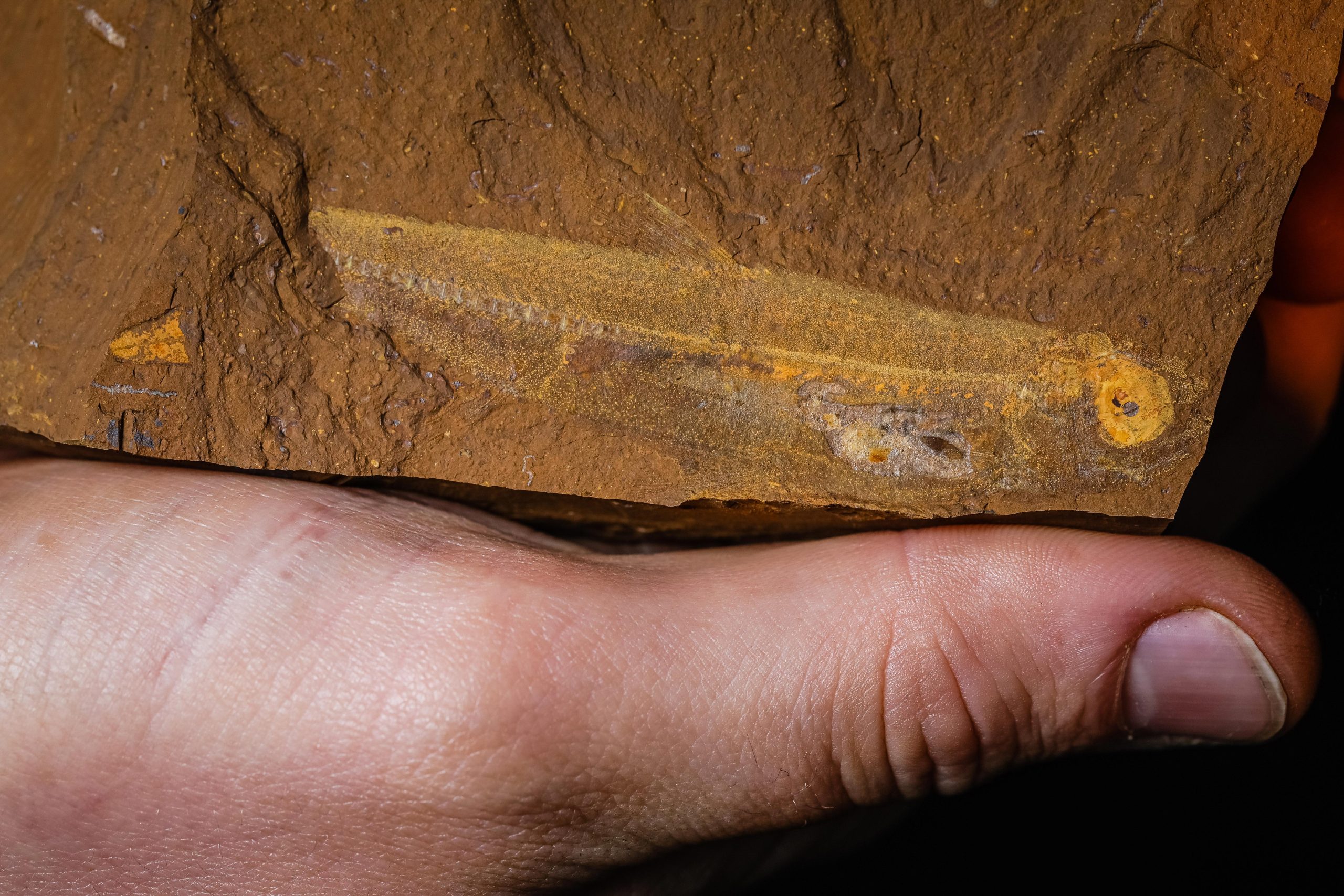
Australian scientists have discovered an ancient freshwater fish fossil with its stomach contents remarkably preserved.
In a groundbreaking discovery, Australian scientists have described a new species of fossilized freshwater fish, Ferruaspis brocksi, marking the first time such a find has been made in Australia. Led by Dr Matthew McCurry, a paleontologist at the Australian Museum and UNSW Sydney, the research team identified the 15-million-year-old species from exceptionally well-preserved fossils that include both stomach contents and traces of coloration patterns.
The study, published in The Journal of Vertebrate Paleontology, highlights the significance of the find from McGraths Flat near Gulgong, NSW, one of Australia’s richest fossil sites. The species is named in honor of Professor Jochen J. Brocks of the Australian National University, who played a key role in discovering several fossil specimens at the site. Ferruaspis brocksi represents the first known fossil of a freshwater smelt (order Osmeriformes) in Australia.
Dr McCurry, the lead author of the paper, said that before this fossil discovery scientists lacked concrete evidence to pinpoint when this group of fish arrived in Australia and how they evolved over time.
“The discovery of the 15 million-year-old freshwater fish fossil offers us an unprecedented opportunity to understand Australia’s ancient ecosystems and the evolution of its fish species, specifically the Osmeriformes group during the Miocene epoch, 11-15 million years ago,” McCurry said.
“Osmeriformes are a diverse group of fish within Australia which includes species like the Australian Grayling and the Australian Smelt. But, without fossils it has been hard for us to tell exactly when the group arrived in Australia and whether they changed at all through time,” McCurry said.
A Glimpse Into Ancient Ecosystems
“Not only does this fossil provide a unique snapshot into the environment it lived in the Central Tablelands, but also because its stomach contents are so well preserved it allows us a glimpse into the behavior of these ancient species. We now know that they fed on a range of invertebrates, but the most common prey was small phantom midge larvae,” McCurry said.
“One of the fossils even shows a parasite attached to the tail of the fish. It’s a juvenile freshwater mussel called a glochidium. These juvenile mussels attach themselves to the gills or tails of fish to hitch rides up and down streams,” McCurry added.
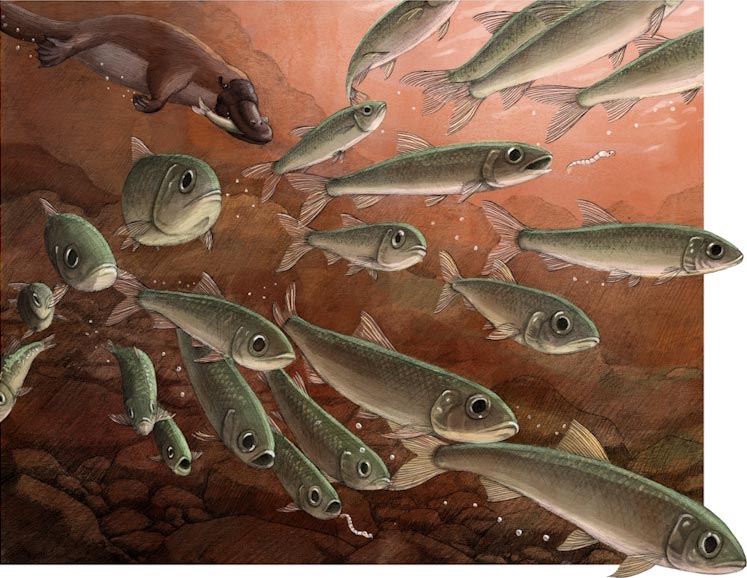
The species was named Ferruaspis brocksi because it was found encased in iron-rich rock. “Ferru,” from ferrum (Latin), meaning “iron,” and “brocksi,” after Professor Jochen J. Brocks of Canberra, Australia.
Acknowledging this honor, Professor Brocks said he was thrilled to have this superb specimen named after him.
“Collecting fossils at McGrath Flat is a highlight for me every year. Splitting the rust-red slabs of rock is like opening an ancient book, revealing the creatures that inhabited an Australian oxbow lake some 15 million years ago. This little fish is one of the most beautiful fossils there, and finding the first vertebrate among the abundant plant and insect fossils was a real surprise. Having F. brocksi named after me is a real joy,” Professor Brocks said.
Revealing Fossil Colors
Dr Michael Frese, a researcher from the University of Canberra and CSIRO, Australia’s national science agency, said that one of the most exciting aspects of the work was that they could tell the color of the fish.
“The fish was darker on its dorsal surface, lighter in color on its belly, and had two lateral stripes running along its side,” Dr Frese said.
“Using a powerful microscope, we were able to see tiny colour-producing structures known as melanosomes. Fossilised melanosomes have previously enabled paleontologists to reconstruct the color of feathers, but melanosomes have never been used to reconstruct of the color pattern of a long extinct fish species,” Dr Frese said.
Director and Chief Scientist, Australian Museum Research Institute, Professor Kris Helgen said, “Dr Matt McCurry’s work at the McGraths Flat fossil site has been outstanding. This is one of many discoveries made at this site, which continues to play a significant role in advancing our understanding of Australia’s evolution during the Miocene era.”
The AM’s new fossil site, McGraths Flat, is located in the Central Tablelands, NSW near the town of Gulgong. It represents one of only a handful of fossil sites in Australia that can be classified as a ‘Lagerstätte’– a site that contains fossils of exceptional quality with remarkable detail.
Dr Matt McCurry’s work at the McGraths Flat fossil site has been outstanding. This is one of many discoveries made at this site, which continues to play a significant role in advancing our understanding of Australia’s evolution during the Miocene era.”
“The fossils formed between 11 and 16 million years ago and provide a window into the past. They prove that the area was once a temperate wet rainforest and that life was rich and abundant in the Central Tablelands, NSW,” McCurry explained.
The initial McGraths Flat expedition in 2017 was funded through a generous donation from a descendant of Robert Etheridge, an English paleontologist who came to Australia in 1866. Etheridge joined the fledging Australian Museum in 1887 as assistant paleontologist and in 1895 was made curator of the museum. Under Etheridge the AM’s collections were greatly enhanced and he also launched a programme of expeditions – the first being to Lord Howe Island – which continues to this day.
Reference: “The paleobiology of a new osmeriform fish species from Australia” by Matthew R. McCurry, Anthony C. Gill, Viktor Baranov, Lachlan J. Hart, Cameron Slatyer and Michael Frese, 17 March 2025, Journal of Vertebrate Paleontology.
DOI: 10.1080/02724634.2024.2445684
The study was funded by the Australian Museum Foundation.
Never miss a breakthrough: Join the SciTechDaily newsletter.
Follow us on Google and Google News.
3 Comments
Stomach contents of fish that died several thousand years ago, not 15 million years ago. Even the astrophysicists are figuring out, at long last, they were wrong about the age of the universe. The earth is not as old as you were told, and there is no evidence that it is. I did not evolve from a lower lifeform, because things that evolve usually degrade over time. Wolf-dog Wild cat-cat
You see where I’m going. Are our monkeys or apes getting smarter with all this sign language?
Lol… Stop. You are either ignorant or intentionally misleading. You don’t work in this field. Stop pretending you know more than those of us who do.
Sorry, last comment was directed toward “Emily C. Caudillo”, not the article.