

Using a murine model, researchers detect changes in the phosphorylation levels of key proteins involved in long-term memory formation.
Multiple studies have demonstrated the memory-enhancing effects of melatonin and its derivatives in animal models. It is also known that the formation of both short- and long-term memories requires the phosphorylation of certain memory-related proteins. However, the molecular mechanisms underlying melatonin-induced memory enhancement have remained elusive.
Now, medical researchers from Sophia University, Japan, have made important findings that contribute significantly to the elucidation of the underlying mechanisms in a recent article that was published in the journal NeuroReport.
Exploring the Effects of Melatonin on Memory-Related Proteins
Regarding the premise of the study, lead author Professor Atsuhiko Chiba from the Department of Materials and Life Sciences, Faculty of Science and Technology, Sophia University, says, “Our study aimed to investigate the effects of melatonin, ramelteon, and N1-acetyl-5-methoxyquinuramine on the relative phosphorylation levels of memory-related proteins in order to explore candidate signaling pathways associated with the receptor- and nonreceptor-mediated memory-enhancing effects of melatonin.”
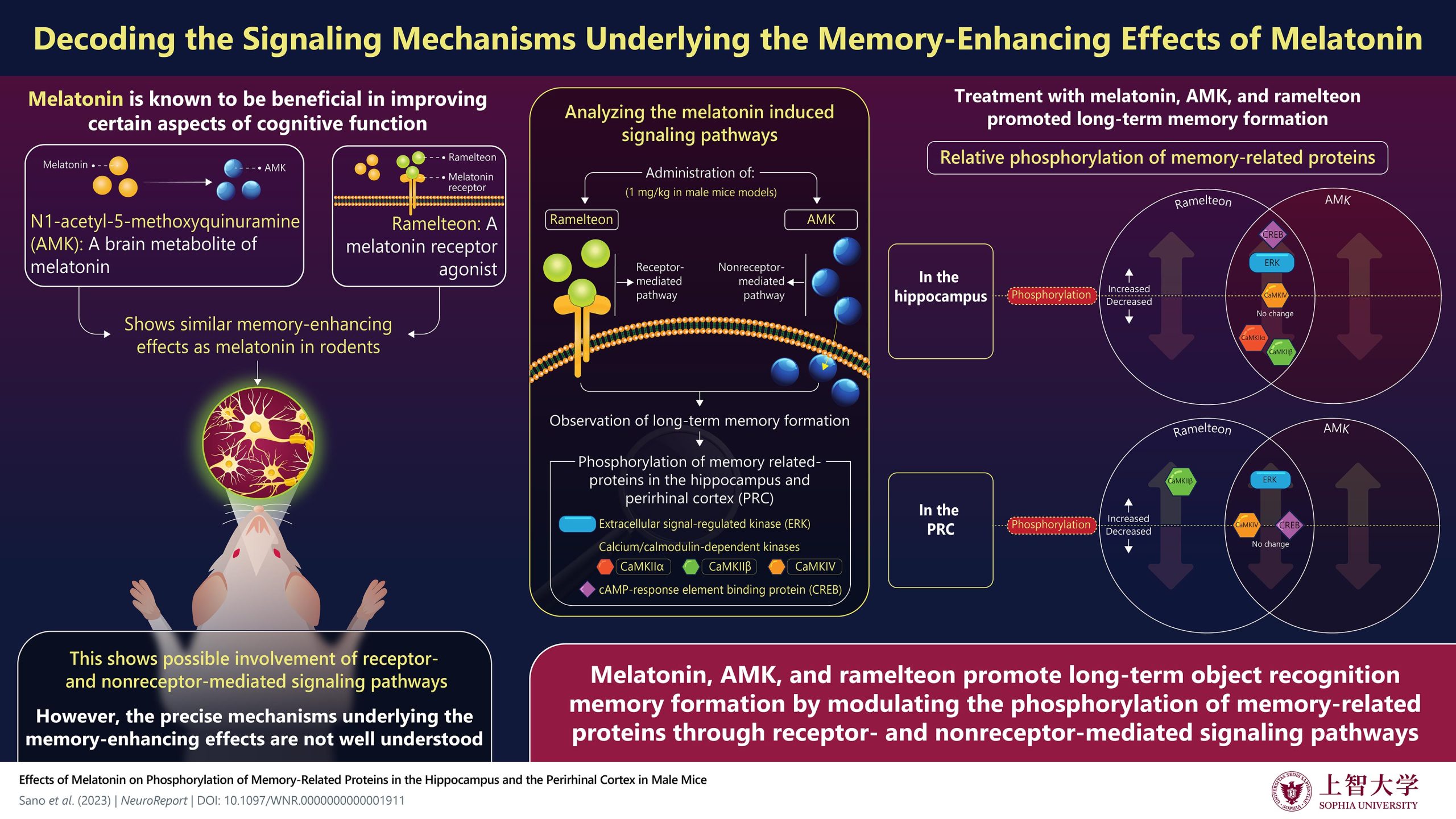
In simpler terms, the research team, which included Dr. Masahiro Sano (currently affiliated with Tohoku University) and Dr. Hikaru Iwashita (currently affiliated with Kansai Medical University), examined the effects of three compounds on memory formation; these compounds were melatonin, a hormone secreted by the pineal gland located in the brain; N1-acetyl-5-methoxyquinuramine (AMK), melatonin’s biological metabolite; and ramelteon, a drug that binds and activates the melatonin receptor.
In addition, they examined “phosphorylation,” or the biochemical addition of phosphate groups to protein structures, in five key proteins involved in memory formation. These included the protein extracellular signal-regulated kinase (ERK), calcium/calmodulin-dependent kinase IIα (CaMKIIα), CaMKIIβ, CaMKIV, and the cAMP-response element binding protein (CREB).
Methodology and Findings of the Memory Enhancement Study
Initial experiments conducted on male mice clearly showed that the administration of melatonin, ramelteon, or AMK at a dose of 1 mg/kg facilitated the formation of long-term memory. The researchers did not investigate the effects of the three compounds on female mice to avoid any likely data variability resulting from the reproductive cycles occurring in female mammals.
Long-term memory formation in male mice was assessed by conducting a series of experiments based on the novel objection recognition task or “NORT.” In this study, laboratory mice under investigation were first acclimated to an experimental arena for 5 minutes per day for three consecutive days. On the fourth day, two identical objects were placed in the experimental arena and mice were allowed to explore these objects for 5 minutes (training phase). Twenty-four hours after the cessation of the training phase, the male mice were subjected to testing. During the testing phase, one out of the two familiar objects was replaced with a new or unfamiliar object. The amount of time spent by the mice exploring each object—a good measure of object recognition memory—was recorded by a trained observer. It is a known fact that mice spend more time exploring novel objects they encounter and less near familiar objects.
The researchers then studied the effects of ramelteon and AMK on the phosphorylation of ERK, CaMKIIα, CaMKIIβ, CaMKIV, and CREB in the male mouse brain after sacrificing the rodents using standard protocols. In the hippocampus, which is the learning and memory center of the mammalian brain, treatment with ramelteon/AMK significantly increased the phosphorylation of both ERK and CREB. However, these drugs significantly decreased CaMKIIα/β phosphorylation in the same brain region. In the perirhinal cortex (PRC), which is also associated with memory functions, both ramelteon and AMK significantly increased ERK, and only ramelteon significantly increased CaMKIIβ phosphorylation. In the hippocampus/PRC, ramelteon/AMK did not affect the phosphorylation of CaMKIV.
Implications for Memory Impairment Treatments
Talking about the study’s results, Prof. Chiba concludes, “Our findings suggest that melatonin is involved in promoting the formation of long-term object recognition memory by modulating the phosphorylation levels of memory-related proteins such as ERK, CaMKIIs, and CREB in both receptor-mediated and nonreceptor-mediated signaling pathways.”
What implications could these study findings have on humans? The researchers believe that the results of their study will contribute to the development of new drugs that can improve memory function in people suffering from age-related memory impairment with fewer side effects. For a steadily ageing global society, this is indeed a remarkable discovery!
Reference: “Effects of melatonin on phosphorylation of memory-related proteins in the hippocampus and the perirhinal cortex in male mice” by Masahiro Sano, Hikaru Iwashita, Chihiro Suzuki, Mari Kawaguchi and Atsuhiko Chiba, 7 June 2023, NeuroReport.
DOI: 10.1097/WNR.0000000000001911
Never miss a breakthrough: Join the SciTechDaily newsletter.
Follow us on Google and Google News.