
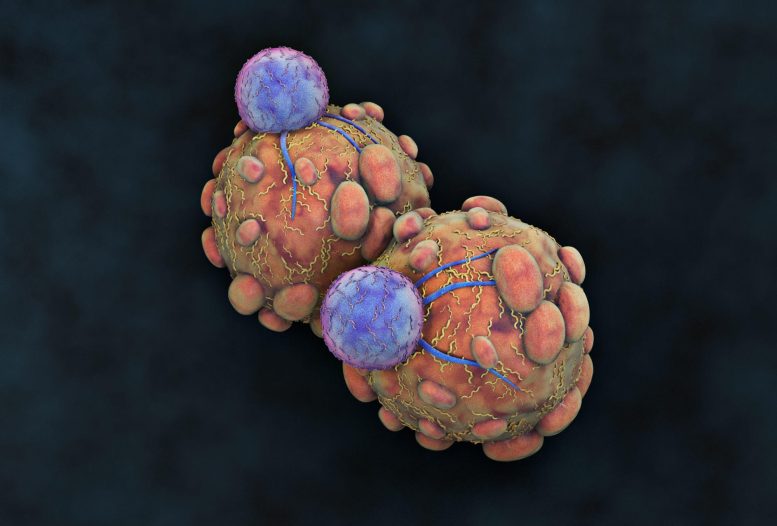
Researchers identified a dysfunctional NK cell subtype, TaNK cells, in tumors, which resists immunotherapy and correlates with worse outcomes. LAMP3+ dendritic cells were also found to suppress NK cell function, offering new targets for cancer therapy.
A research team headed by Prof. Tian Zhigang and Prof. Peng Hui from the University of Science and Technology of China (USTC) of the Chinese Academy of Sciences (CAS), working alongside Prof. Zhang Zemin from Peking University, have illustrated the variations in natural killer (NK) cells across different cancer types and tissues. They identified a specific subgroup of NK cells that demonstrate abnormal anti-tumor functions that thrive specifically within the tumor microenvironment. Their findings were recently published in the journal Cell.
NK cell, named after its ability to directly kill cancer cells, has emerged as a formidable contender in immunotherapy, showcasing exceptional efficacy in blood cancer treatments. However, the heterogeneity of NK cells, varying in phenotype and function within distinct tissue microenvironments, has posed challenges in its application in solid tumor therapy.
Over the years, Prof. Tian and Prof. Peng’s team have been studying the heterogeneity of NK cells across different tissues. In this study, the researchers collected an extensive dataset of single-cell transcriptomes, encompassing 24 cancer types and including a total of 1,223 samples from 716 patients and 47 healthy individuals. They identified five distinct subtypes of CD56brightCD16lo NK cells and nine subtypes of CD56dimCD16hi NK cells at a comprehensive pan-cancer level for the first time. These subtypes were meticulously characterized for their phenotypic and functional diversity.
Identifying Subtypes of NK Cells Across Cancer Types
Through the integration of this extensive dataset, the researchers observed a preference for NK cell subtype composition across different cancer types. Notably, the distribution of NK cell subtypes within tumors, neighboring tissues, and peripheral blood displayed significant disparities. Leveraging advanced bioinformatics techniques, the researchers pinpointed the gene RGS1 as being highly expressed in non-blood NK cells. At the transcriptional level, RGS1 demonstrated remarkable specificity and sensitivity, compared to conventional tissue residency markers.
By probing the tumor microenvironment, the researchers found that a group of DNAJB1+CD56dimCD16hi NK cells were highly enriched in tumor issues. Analysis of this group revealed a dysfunctional phenotype with reduced cytotoxicity, increased inhibitory receptors, and heightened stress-related protein levels. This subtype, named “Tumor-associated NK cells” (TaNK cells), defied the conventional understanding that higher NK cell abundance is beneficial to tumor patients. Instead, TaNK cells exhibited a strong association with adverse prognoses in various cancer types and a significant resistance to immunotherapy.
The Role of LAMP3+ Dendritic Cells in Suppressing NK Function
Besides, the researchers discovered that LAMP3+ dendritic cells (DCs) are critical regulators of NK cell functionality. Spatial distribution data analysis showed that NK cells in close proximity to LAMP3+ DCs exhibited diminished cytotoxic activity. This observation hinted at the potential of LAMP3+ DCs to exert abnormal regulatory effects on NK cell function in the tumor microenvironment.
Reference: “A pan-cancer single-cell panorama of human natural killer cells” by Fei Tang, Jinhu Li, Lu Qi, Dongfang Liu, Yufei Bo, Shishang Qin, Yuhui Miao, Kezhuo Yu, Wenhong Hou, Jianan Li, Jirun Peng, Zhigang Tian, Linnan Zhu, Hui Peng, Dongfang Wang and Zemin Zhang, 21 August 2023, Cell.
DOI: 10.1016/j.cell.2023.07.034
Never miss a breakthrough: Join the SciTechDaily newsletter.
Follow us on Google and Google News.