
Close Menu
    Facebook X (Twitter) Instagram
    SciTechDaily
    • Biology
    • Chemistry
    • Earth
    • Health
    • Physics
    • Science
    • Space
    • Technology
    Facebook X (Twitter) Pinterest YouTube RSS
    SciTechDaily
    Home»Space»Researchers Discovered a Very Rare Type Ibn Supernova
    Space

    Researchers Discovered a Very Rare Type Ibn Supernova

    By Harvard-Smithsonian Center for AstrophysicsMarch 8, 20131 Comment4 Mins Read
    Facebook Twitter Pinterest Telegram LinkedIn WhatsApp Email Reddit
    Share
    Facebook Twitter LinkedIn Pinterest Telegram Email Reddit
    Pan STARRS Telescope Discovers Supernova PS1 12sk
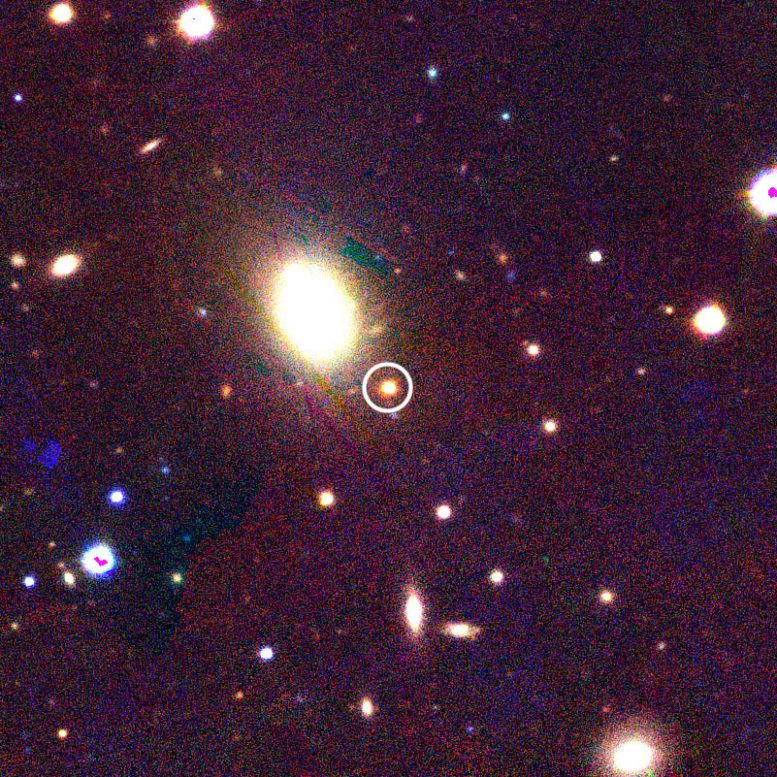
    PS1-12sk, the yellow dot at image center (circled), is classified as a very rare Type Ibn supernova – only the sixth such example found out of thousands of supernovae. It was discovered on the outskirts of a bright elliptical galaxy (the yellow blob to the upper left of the supernova) located about 780 million light-years from Earth. A Type Ibn supernova is thought to come from the explosion of a young, massive star. However, the site of the explosion shows no signs of recent star formation, and a supernova from a massive star has never before been seen in a galaxy of this type. Credit: CfA / PS1 Science Consortium

    Using the Pan-STARRS telescope, researchers discovered a very rare Type Ibn supernova on the outskirts of an elliptical galaxy.

    The star Eta Carinae is ready to blow. 170 years ago, this 100-solar-mass object belched out several suns’ worth of gas in an eruption that made it the second-brightest star after Sirius. That was just a precursor to the main event, since it will eventually go supernova.

    Supernova explosions of massive stars are common in spiral galaxies like the Milky Way, where new stars are forming all the time. They are almost never seen in elliptical galaxies where star formation has nearly ceased. As a result, astronomers were surprised to find a young-looking supernova in an old galaxy. Supernova PS1-12sk, discovered with the Pan-STARRS telescope on Haleakala, is rare in more ways than one.

    “This supernova is one-of-a-kind,” said Nathan Sanders of the Harvard-Smithsonian Center for Astrophysics (CfA), lead author of the discovery paper. “And it’s definitely in the wrong neighborhood.”

    Based on the presence of helium and other features, PS1-12sk is classified as a very rare Type Ibn supernova – only the sixth such example found out of thousands of supernovae. Although the origin of this supernova type is unclear, the most likely cause seems to be the explosion of a massive star that previously ejected massive amounts of helium gas, much like Eta Carinae’s Homunculus Nebula.

    That origin was supported by the fact that the five previous Type Ibn supernovae were all found in galaxies like the Milky Way that are actively forming stars. (Since massive stars don’t live long, they don’t stray far from where they are born before exploding.)

    PS1-12sk is different. It was found on the outskirts of a bright elliptical galaxy located about 780 million light-years from Earth. The site of the explosion shows no signs of recent star formation, and a supernova from a massive star has never before been seen in a galaxy of this type.

    “It could be that we simply got very lucky with this discovery. But luck favors the prepared,” said second author Alicia Soderberg of the CfA.

    The finding suggests that the host galaxy might be hiding a star factory, allowing it to form massive stars where none were expected. Alternatively, PS1-12sk might have an entirely different origin such as a collision of two white dwarfs, one of which was helium-rich.

    “Is this a runaway star from another star formation site? Is it a very local bit of star formation? Is it a different way for such a supernova to occur? None of these seems very likely so we have a real puzzle,” said co-author John Tonry (University of Hawaii Institute for Astronomy).

    The research has been submitted for publication in The Astrophysical Journal.

    Reference: “PS1-12sk IS A PECULIAR SUPERNOVA FROM A He-RICH PROGENITOR SYSTEM IN A BRIGHTEST CLUSTER GALAXY ENVIRONMENT” by N. E. Sanders, A. M. Soderberg, R. J. Foley, R. Chornock, D. Milisavljevic, R. Margutti, M. R. Drout, M. Moe, E. Berger, W. R. Brown, R. Lunnan, S. J. Smartt, M. Fraser, R. Kotak, L. Magill, K. W. Smith, D. Wright, K. Huang, Y. Urata, J. S. Mulchaey, A. Rest, D. J. Sand, L. Chomiuk, A. S. Friedman, R. P. Kirshner, G. H. Marion, J. L. Tonry, W. S. Burgett, K. C. Chambers, K. W. Hodapp, R. P. Kudritzki and P. A. Price, 2 May 2013, The Astrophysical Journal.
    DOI: 10.1088/0004-637X/769/1/39

    Headquartered in Cambridge, Mass., the Harvard-Smithsonian Center for Astrophysics (CfA) is a joint collaboration between the Smithsonian Astrophysical Observatory and the Harvard College Observatory. CfA scientists, organized into six research divisions, study the origin, evolution, and ultimate fate of the universe.

    Never miss a breakthrough: Join the SciTechDaily newsletter.
    Follow us on Google and Google News.

    Astronomy Astrophysics Harvard-Smithsonian Center for Astrophysics Popular Supernova
    Share. Facebook Twitter Pinterest LinkedIn Email Reddit

    Related Articles

    Extreme Weight Loss: Shocking Supernova Discovery Challenges the Standard Theory of Stellar Evolution

    How Do the Most Massive Stars Explode? Bubbles With Titanium Trigger Titanic Explosions

    Intriguing Remains of a Rare Stellar Explosion Discovered in Milky Way Center

    “Heavy Metal” Supernova Discovery Challenges Current Ideas of How Supernovas Occur

    Astronomers Reveal “Missing-Link” in the Supernova-GRB Connection

    3D Map of Core-Collapse Supernova Remnant Cassiopeia A

    Reverse Shock Wave Racing Inward at 1000 Times the Speed of Sound

    Scientists Discover a New Type of Supernova

    Cloud of Hydrogen and Helium Plunging Toward the Galactic Center

    1 Comment

    1. Madanagopal.V.C on March 12, 2013 6:22 am

      Is it cannibalized from a neighboring spiral galaxy where massive stare could be formed unlike elliptical galaxies ? Thank You.

      Reply
    Leave A Reply Cancel Reply

    • Facebook
    • Twitter
    • Pinterest
    • YouTube

    Don't Miss a Discovery

    Subscribe for the Latest in Science & Tech!

    Trending News

    Scientists Uncover Potential Brain Risks of Popular Fish Oil Supplements

    Scientists Discover a Surprising Way To Make Bread Healthier and More Nutritious

    After 60 Years, Scientists Uncover Unexpected Brain Effects of Popular Diabetes Drug Metformin

    New Research Uncovers Hidden Side Effects of Popular Weight-Loss Drugs

    Scientists Rethink Extreme Warming After Surprising Ocean Discovery

    Landmark Study Links Never Marrying to Significantly Higher Cancer Risk

    Researchers Discover Unknown Beetle Species Just Steps From Their Lab

    Largest-Ever Study Finds Medicinal Cannabis Ineffective for Anxiety, Depression, PTSD

    Follow SciTechDaily
    • Facebook
    • Twitter
    • YouTube
    • Pinterest
    • Newsletter
    • RSS
    SciTech News
    • Biology News
    • Chemistry News
    • Earth News
    • Health News
    • Physics News
    • Science News
    • Space News
    • Technology News
    Recent Posts
    • Early Warning Signals of Esophageal Cancer May Be Hiding in Plain Sight
    • Researchers Have Discovered a THC-Free Cannabis Compound That May Replace Opioids
    • Common Blood Pressure Drug Shows Surprising Power Against Deadly Antibiotic-Resistant Superbug
    • Students Build Dark Matter Detector and Set New Experimental Limits
    • Scientists Discover Caffeine Can Repair Key Memory Circuits After Sleep Loss
    Copyright © 1998 - 2026 SciTechDaily. All Rights Reserved.
    • Science News
    • About
    • Contact
    • Editorial Board
    • Privacy Policy
    • Terms of Use

    Type above and press Enter to search. Press Esc to cancel.