
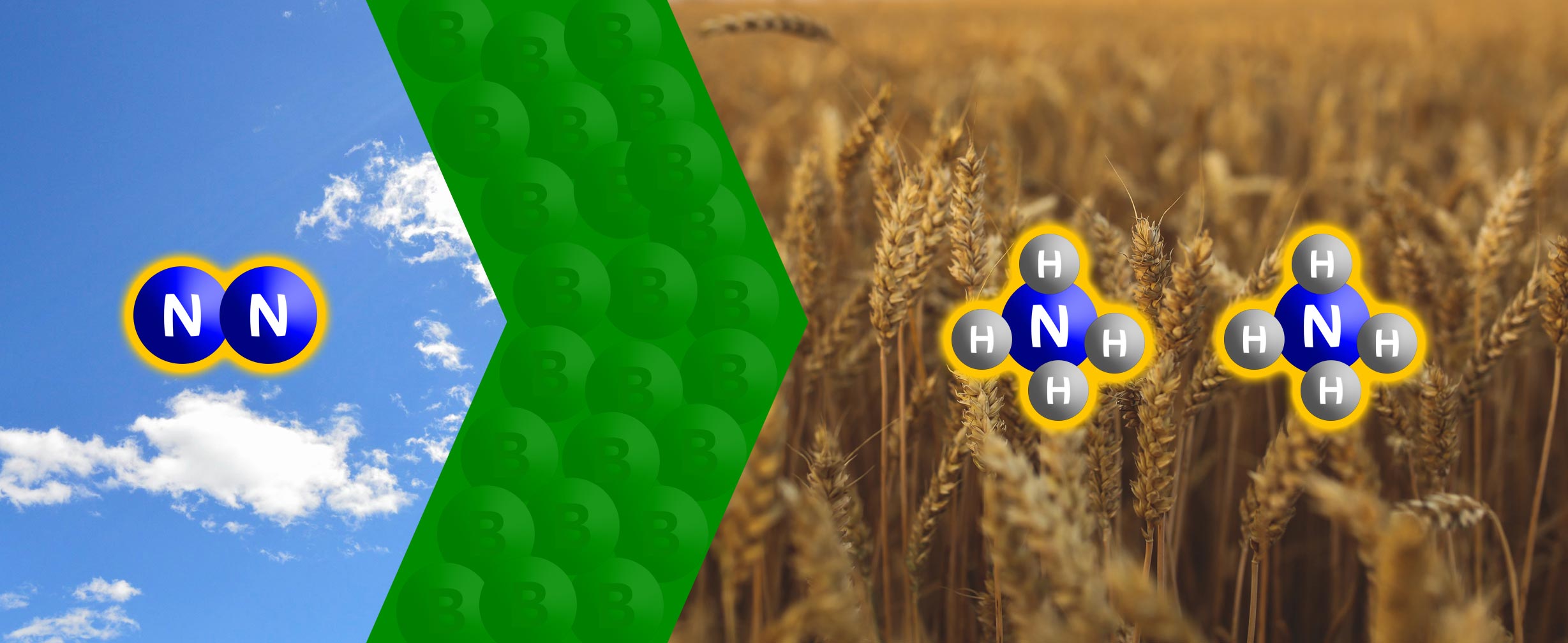
Humankind is reliant on the ammonium in synthetic fertilizer for food. However, producing ammonia from nitrogen is extremely energy-intensive and requires the use of transition metals.
Researchers from Julius-Maximilians-Universität (JMU) Würzburg in Bavaria, Germany, have now achieved the conversion of nitrogen to ammonium at room temperature and low pressure without the need for transition metals. This was reported by a research group led by JMU scientist Holger Braunschweig in the journal Nature Chemistry.
A new toolbox for binding nitrogen
The industrial production of ammonia, the so-called Haber-Bosch process, requires high temperatures and pressures, and is estimated to consume roughly two percent of all energy produced on Earth. This process also relies on transition metal elements, relatively heavy, and reactive atoms.
In 2018, Professor Braunschweig’s team reported the binding and chemical conversion of nitrogen using a molecule constituted only of lighter, non-metal atoms. A year later, they used a similar system to demonstrate the first combination of two nitrogen molecules in the laboratory, a reaction that had otherwise only been seen in Earth’s upper atmosphere and under plasma conditions.
The key in both of these discoveries was the use of boron, the fifth lightest element, as the atom to which the nitrogen binds. “After these two discoveries, it was clear that we had a pretty special system on our hands,” says Braunschweig.
Just add water
Although their system binds and converts nitrogen, only half of the puzzle pieces were in place. “We knew that completing the conversion of nitrogen to ammonia would be a major challenge, as it requires a complex sequence of chemical reactions that are often incompatible with each other,” explains the JMU professor.
The breakthrough came from the most simple of reagents: traces of water left behind in a sample were enough to promote a sequential reaction that brought the team only a single step away from the target ammonium. It was later discovered that the key reactions could be done using a solid acid, allowing the reactions to occur sequentially in a single reaction flask, all at room temperature.
Making ammonium with beer
Realizing that the acidification step of the process appeared to work even with simple reagents such as water, the team repeated the reaction using locally brewed Würzburger Hofbräu beer. To their delight, they were able to detect the pre-ammonium product in the reaction mixture.
“This experiment was in part a bit of fun, but it also shows how tolerant the system is to water and other compounds,” explains Dr. Marc-André Légaré, the postdoctoral researcher who initiated the study. “The reduction of nitrogen to ammonia is one of the most important chemical reactions for mankind. This is undoubtedly the first time it has been done using beer, and it is particularly fitting that it was done in Germany!” says Dr. Rian Dewhurst, Akademischer Oberrat, and coauthor of the study.
Much work left to be done
The reaction, while exciting, is still far from being a truly practical process for industrially producing ammonium. Ideally, finding a way to re-form the active species will be needed to make the process energy efficient and economical.
Nevertheless, the discovery is an exciting demonstration that the lighter elements can tackle even the biggest challenges in chemistry. “There is much left to be done here, but boron and the other light elements have already surprised us so many times. They are clearly capable of so much more,” says Holger Braunschweig.
Reference: “One-pot, room-temperature conversion of dinitrogen to ammonium chloride at a main-group element” by Marc-André Légaré, Guillaume Bélanger-Chabot, Maximilian Rang, Rian D. Dewhurst, Ivo Krummenacher, Rüdiger Bertermann and Holger Braunschweig, 14 September 2020, Nature Chemistry.
DOI: 10.1038/s41557-020-0520-6
Never miss a breakthrough: Join the SciTechDaily newsletter.
Follow us on Google and Google News.