
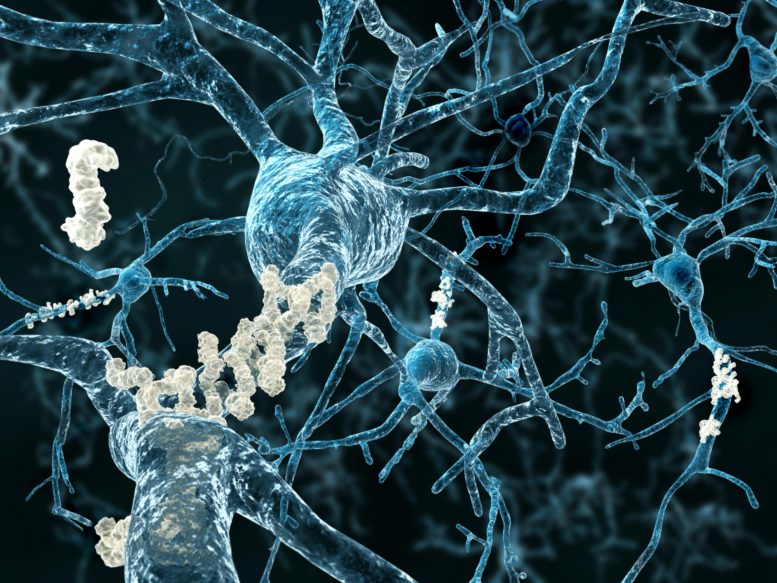
Scientists at the University of Lancaster have developed a new drug that may help prevent the early stages of Alzheimer’s disease by reducing the number of senile plaques and increasing the number of new nerve cells in a region of the brain associated with memory.
A new drug to prevent the early stages of Alzheimer’s disease could enter clinical trials in a few years’ time according to scientists.
Alzheimer’s is the most common type of dementia, which currently affects 820,000 people in the UK, with numbers expected to more than double by 2050. One in three people over 65 will die with dementia.
The disease begins when a protein called amyloid-β (Aβ) starts to clump together in senile plaques in the brain, damaging nerve cells and leading to memory loss and confusion.
Professor David Allsop and Dr. Mark Taylor at Lancaster University have successfully created a new drug that can reduce the number of senile plaques by a third, as well as more than doubling the number of new nerve cells in a particular region of the brain associated with memory. It also markedly reduced the amount of brain inflammation and oxidative damage associated with the disease.
The drug was tested on transgenic mice containing two mutant human genes linked to inherited forms of Alzheimer’s, so that they would develop some of the changes associated with the illness. The drug is designed to cross the blood-brain barrier and prevent the Aβ molecules from sticking together to form plaques.
Professor Allsop, who led the research and was the first scientist to isolate senile plaques from human brain, said: “When we got the test results back, we were highly encouraged. The amount of plaque in the brain had been reduced by a third and this could be improved if we gave a larger dose of the drug, because at this stage, we don’t know what the optimal dose is.”
The drug needs to be tested for safety before it can enter human trials, but, if it passes this hurdle, the aim would be to give the drug to people with mild symptoms of memory loss before they develop the illness.
“Many people who are mildly forgetful may go on to develop the disease because these senile plaques start forming years before any symptoms manifest themselves. The ultimate aim is to give the drug at that stage to stop any more damage to the brain, before it’s too late.”
The other researchers include groups led by Prof. Christian Hölscher at Ulster University, who conducted the mouse studies, and Prof. Massimo Masserini at the University of Milano-Bicocca, Italy, who measured the ability of the drug to bind to Aβ.
Support for the research was given by Alzheimer’s Research UK, and the results are published in the open access journal PLOS ONE.
Dr. Eric Karran, Director of Research at Alzheimer’s Research UK, said: “We are pleased to have supported this study, which represents the first step to developing much-needed new treatments to fight Alzheimer’s. These are promising early-stage results, and several years more work will be required to assess the potential of this approach. For science like this to make a real difference to people’s lives, we must continue to invest in research.”
Reference: P”A Novel Retro-Inverso Peptide Inhibitor Reduces Amyloid Deposition, Oxidation and Inflammation and Stimulates Neurogenesis in the APPswe/PS1ΔE9 Mouse Model of Alzheimer’s Disease” by Vadivel Parthsarathy, Paula L. McClean, Christian Hölscher, Mark Taylor, Claire Tinker, Glynn Jones, Oleg Kolosov, Elisa Salvati, Maria Gregori, Massimo Masserini and David Allsop, 31 January 2013, PLoS ONE.
DOI: 10.1371/journal.pone.0054769
Never miss a breakthrough: Join the SciTechDaily newsletter.
Follow us on Google and Google News.