
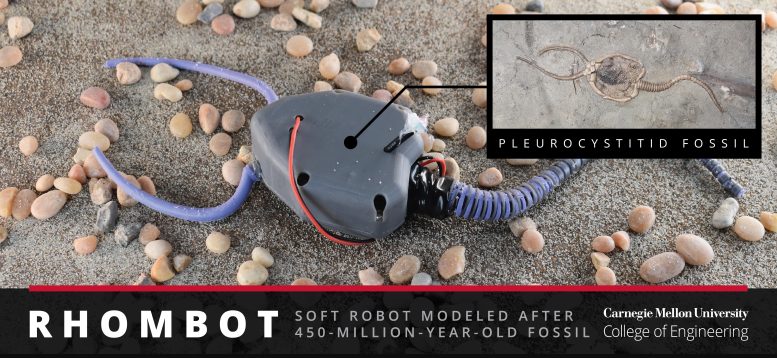
Researchers from Carnegie Mellon University’s Department of Mechanical Engineering, along with paleontologists from Spain and Poland, have utilized fossil records to create a soft robotic model of Pleurocystitid. This marine organism, which lived about 450 million years ago, is thought to be among the earliest echinoderms that could move using a muscular stem.
Breakthrough in Animal Movement and Design
Recently published in the Proceedings of the National Academy of Science (PNAS), the research seeks to broaden the modern perspective of animal design and movement by introducing a new a field of study – Paleobionics – aimed at using Softbotics, robotics with flexible electronics and soft materials, to understand the biomechanical factors that drove evolution using extinct organisms.
“Softbotics is another approach to inform science using soft materials to construct flexible robot limbs and appendages. Many fundamental principles of biology and nature can only fully be explained if we look back at the evolutionary timeline of how animals evolved. We are building robot analogs to study how locomotion has changed,” said Carmel Majidi, lead author and Professor of Mechanical Engineering at Carnegie Mellon University.
Insights from the Past
With humans’ time on earth representing only 0.007% of the planet’s history, the modern-day animal kingdom that influences the understanding of evolution and inspires today’s mechanical systems is only a fraction of all creatures that have existed through history.
Using fossil evidence to guide their design and a combination of 3D printed elements and polymers to mimic the flexible columnar structure of the moving appendage, the team demonstrated that pleurocystitids were likely able to move over the sea bottom by means of a muscular stem that pushed the animal forward.
Despite the absence of a current-day analog (echinoderms have since evolved to include modern-day starfish and sea urchins), pleurocystitids have been of interest to paleontologists due to their pivotal role in echinoderm evolution.
Robotics Inspired by Nature
The team determined that wide sweeping movements were likely the most effective motion and that increasing the length of the stem significantly increased the animals’ speed without forcing it to exert more energy.
“Researchers in the bio-inspired robotics community need to pick and choose important features worth adopting from organisms,” explained Richard Desatnik, PhD candidate and co-first author.
“Essentially, we have to decide on good locomotion strategies to get our robots moving. For example, would a starfish robot really need to use 5 limbs for locomotion or can we find a better strategy?” added Zach Patterson, CMU alumnus and co-first author.
Future Directions
Now that the team has demonstrated that they can use Softbotics to engineer extinct organisms, they hope to explore other animals, like the first organism that could travel from sea to land – something that can’t be studied in the same way using conventional robot hardware.
“Bringing a new life to something that existed nearly 500 million years ago is exciting in and of itself, but what really excites us about this breakthrough is how much we will be able to learn from it,” said Phil LeDuc, co-author, and Professor of Mechanical Engineering at Carnegie Mellon University. “We aren’t just looking at fossils in the ground, we are trying to better understand life through working with amazing paleontologists.”
Reference: “Soft robotics informs how an early echinoderm moved” by Richard Desatnik, Zach J. Patterson, Przemysław Gorzelak, Samuel Zamora, Philip LeDuc and Carmel Majidi, 6 November 2023, Proceedings of the National Academy of Sciences.
DOI: 10.1073/pnas.2306580120
The study was funded by the National GEM Consortium, the National Science Foundation, the Air Force Office of Scientific Research, the National Oceanographic Partnership Program, the Spanish Ministry of Science, Innovation and Universities, the Government of Aragon project “Aragosaurus”, “Severo Ochoa”, and the National Institute of Health.
Additional collaborators include Przemyslaw Gorzelak, Institute of Paleobiology, Polish Academy of Sciences, and Samuel Zamora, The Geological and Mining Institute of Spain.
Never miss a breakthrough: Join the SciTechDaily newsletter.
Follow us on Google and Google News.
1 Comment
Find a plumber near you to help.