
Researchers have innovated reactors that use fly ash to effectively mineralize CO2, presenting a sustainable approach to reducing greenhouse gas emissions and advancing global climate goals.
In a significant advancement in sustainable waste management and CO2 sequestration, researchers have developed reactors that use fly ash particles to mineralize carbon dioxide. This innovative method promises a sustainable and enduring solution to the critical problem of greenhouse gas emissions while repurposing an industrial by-product.
The relentless march of industrialization has corresponded with a surge in CO2 emissions, a key driver of global warming. Existing carbon capture, utilization, and storage (CCUS) technologies grapple with issues of efficiency and cost. Fly ash, a coal combustion by-product, offers a promising avenue for CO2 mineralization, turning waste into a resource and curtailing emissions. Yet, prevailing reactor designs struggle to achieve the desired synergy between gas-particle interactions and operational efficacy. These hurdles underscore the imperative for an in-depth investigation into innovative reactor configurations and operational fine-tuning.
Innovative Research on Reactors
Shanghai Jiao Tong University’s cutting-edge research on fly ash mineralization reactors was published in the Energy Storage and Saving journal on May 7, 2024. The study, subjected to meticulous computational optimization, unveils a pioneering reactor design anticipated to escalate the efficacy of CO2 capture and mineralization.
The research introduces a duo of reactor designs, each meticulously sculpted for CO2 mineralization via fly ash, with computational fluid dynamics at the helm of optimization. The impinging-type inlet design stands out for its capacity to amplify interfacial interactions, extending particle dwell times and significantly augmenting mineralization rates.
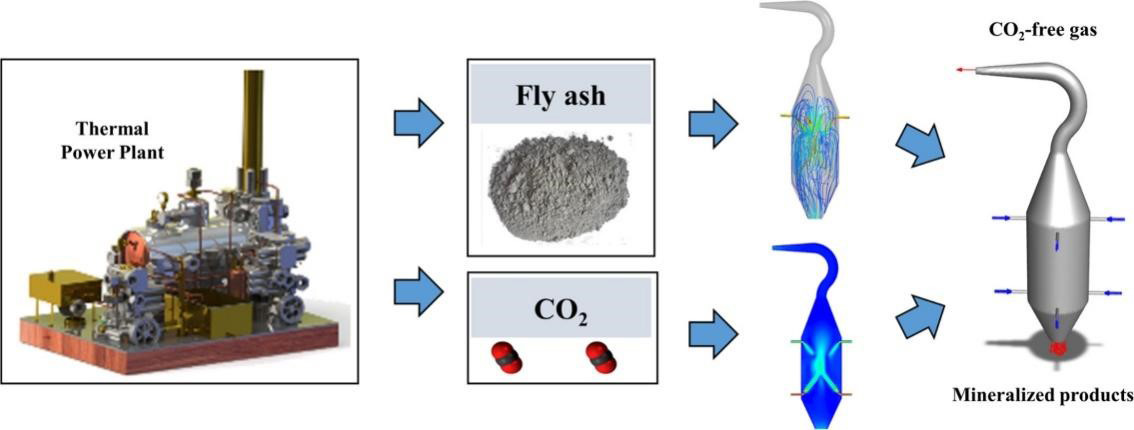
The quadrilateral rotary-style inlet, conversely, champions streamlined flow for comprehensive mixing and reaction efficacy. A rigorous exploration of operational parameters—flue gas velocity, carrier gas velocity, and particle velocity—yielded optimal ranges that promise to propel reactor performance to new heights, ensuring efficient CO2 mineralization and phase separation post-reaction.
Dr. Liwei Wang, the study’s principal investigator, remarked, “Our findings mark a significant leap forward in carbon capture and utilization technologies. By refining reactor designs and operational parameters, we’ve achieved a substantial leap in CO2 mineralization efficiency. This work is not only a boon to sustainable waste management but also presents a pragmatic strategy for curtailing industrial carbon emissions, aligning with global climate action initiatives.”
The research bears profound implications for coal-fired power plants, offering a transformative use for the fly ash they generate. By channeling this by-product into CO2 mineralization, the study paves the way for diminished carbon emissions and a reduction in the environmental burden of fly ash disposal. The broader applications of this research are expansive, presenting a harmonious solution to waste management and CO2 sequestration that could very well redefine CCUS technology approaches.
Reference: “Simulation Design and Optimization of Reactors for Carbon Dioxide Mineralization” by Duoyong Zhang, Chen Zhang, Tao Xuan, Xinqi Zhang, Liwei Wang, Yongqiang Tian and Jinqing Zhu, 7 May 2024, Energy Storage and Saving.
DOI: 10.1016/j.enss.2024.04.002
The study was funded by the National Natural Science Foundation of China.
.com/images/Refinery-Industrial-Carbon-Capture-Concept-Art.jpg”> Researchers at Shanghai Jiao Tong University have developed advanced reactors for CO2 sequestration using fly ash particles. These reactors, detailed in a recent study, are optimized through computational fluid dynamics to enhance the efficiency of CO2 capture and mineralization. The research introduces two innovative reactor designs, each improving interfacial interactions and operational efficiency. This breakthrough holds significant potential for reducing industrial carbon emissions and repurposing fly ash from coal-fired power plants, offering a sustainable solution to greenhouse gas emissions and waste management.[/caption]
Researchers have innovated reactors that use fly ash to effectively mineralize CO2, presenting a sustainable approach to reducing greenhouse gas emissions and advancing global climate goals.
In a significant advancement in sustainable waste management and CO2 sequestration, researchers have developed reactors that use fly ash particles to mineralize carbon dioxide. This innovative method promises a sustainable and enduring solution to the critical problem of greenhouse gas emissions while repurposing an industrial by-product.
The relentless march of industrialization has corresponded with a surge in CO2 emissions, a key driver of global warming. Existing carbon capture, utilization, and storage (CCUS) technologies grapple with issues of efficiency and cost. Fly ash, a coal combustion by-product, offers a promising avenue for CO2 mineralization, turning waste into a resource and curtailing emissions. Yet, prevailing reactor designs struggle to achieve the desired synergy between gas-particle interactions and operational efficacy. These hurdles underscore the imperative for an in-depth investigation into innovative reactor configurations and operational fine-tuning.
Innovative Research on Reactors
Shanghai Jiao Tong University’s cutting-edge research on fly ash mineralization reactors was published in the Energy Storage and Saving journal on May 7, 2024. The study, subjected to meticulous computational optimization, unveils a pioneering reactor design anticipated to escalate the efficacy of CO2 capture and mineralization.
The research introduces a duo of reactor designs, each meticulously sculpted for CO2 mineralization via fly ash, with computational fluid dynamics at the helm of optimization. The impinging-type inlet design stands out for its capacity to amplify interfacial interactions, extending particle dwell times and significantly augmenting mineralization rates.
The quadrilateral rotary-style inlet, conversely, champions streamlined flow for comprehensive mixing and reaction efficacy. A rigorous exploration of operational parameters—flue gas velocity, carrier gas velocity, and particle velocity—yielded optimal ranges that promise to propel reactor performance to new heights, ensuring efficient CO2 mineralization and phase separation post-reaction.
Dr. Liwei Wang, the study’s principal investigator, remarked, “Our findings mark a significant leap forward in carbon capture and utilization technologies. By refining reactor designs and operational parameters, we’ve achieved a substantial leap in CO2 mineralization efficiency. This work is not only a boon to sustainable waste management but also presents a pragmatic strategy for curtailing industrial carbon emissions, aligning with global climate action initiatives.”
The research bears profound implications for coal-fired power plants, offering a transformative use for the fly ash they generate. By channeling this by-product into CO2 mineralization, the study paves the way for diminished carbon emissions and a reduction in the environmental burden of fly ash disposal. The broader applications of this research are expansive, presenting a harmonious solution to waste management and CO2 sequestration that could very well redefine CCUS technology approaches.
Reference: “Simulation Design and Optimization of Reactors for Carbon Dioxide Mineralization” by Duoyong Zhang, Chen Zhang, Tao Xuan, Xinqi Zhang, Liwei Wang, Yongqiang Tian and Jinqing Zhu, 7 May 2024, Energy Storage and Saving.
DOI: 10.1016/j.enss.2024.04.002
The study was funded by the National Natural Science Foundation of China.
Never miss a breakthrough: Join the SciTechDaily newsletter.
Follow us on Google and Google News.