
A novel method of simulating supernovae could shed light on our cosmic origins.
Supernovae, which are exploding stars, play a pivotal role in galaxy formation and evolution. However, simulating these phenomena accurately and efficiently has been a significant challenge. For the first time, a team including researchers from the University of Tokyo has utilized deep learning to enhance supernova simulations. This advancement accelerates simulations, crucial for understanding galaxy formation and evolution, as well as the evolution of chemistry that led to life.
When you hear about deep learning, you might think of the latest app that sprung up this week to do something clever with images or generate humanlike text. Deep learning might be responsible for some behind-the-scenes aspects of such things, but it’s also used extensively in different fields of research. Recently, a team at a tech event called a hackathon applied deep learning to weather forecasting. It proved quite effective, and this got doctoral student Keiya Hirashima from the University of Tokyo’s Department of Astronomy thinking.
“Weather is a very complex phenomenon but ultimately it boils down to fluid dynamics calculations,” said Hirashima. “So, I wondered if we could modify deep learning models used for weather forecasting and apply them to another fluid system, but one that exists on a vastly larger scale and which we lack direct access to: my field of research, supernova explosions.”
Understanding Supernovae and Galactic Influence
Supernovae occur when suitably massive stars burn through most of their fuel and collapse in enormous explosions. They are so huge that they can, and do, influence large areas inside their host galaxies. If a supernova had happened a few hundred years ago within a few hundred light-years from Earth, you might not be reading this article right now. So, the better we understand supernovae, the better we can understand why galaxies are the way they are.
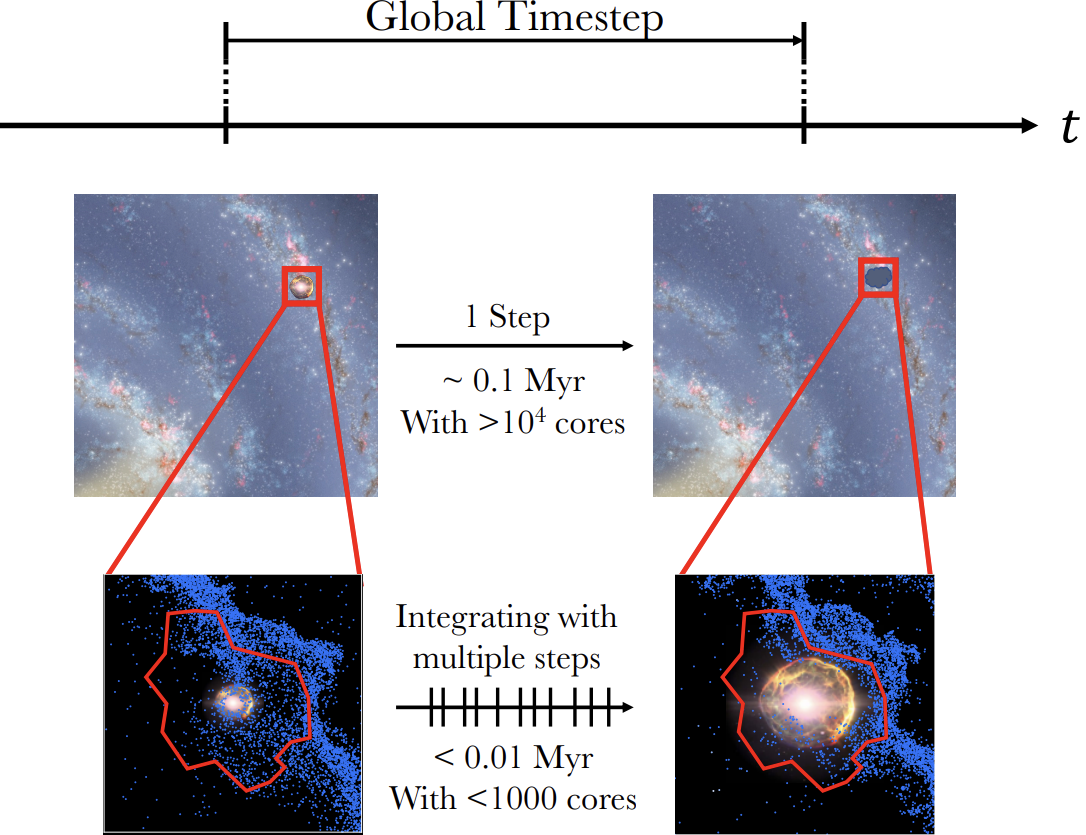
During a supernova simulation, (left) shows the prediction by a current simulation method. (right) shows the prediction by 3D-MIM, which looks close enough to the that of the current leading method, but it takes far less time to execute, saving time, energy and costs for computing time. Credit: 2023 Hirashima et al. CC-BY-ND
“The problem is the time it takes to calculate the way supernovae explode. Currently, many models of galaxies over long time spans simplify things by pretending supernovae explode in a perfectly spherical fashion, as this is relatively easy to calculate,” said Hirashima. “However, in reality, they are quite asymmetric. Some regions of the shell of material that forms the boundary of the explosion are more complex than others. We applied deep learning to help ascertain which parts of the explosion require more, or less, attention during a simulation to ensure the best accuracy, whilst also taking the least amount of time overall. This way of dividing a problem is called Hamiltonian splitting. Our new model, 3D-MIM, can reduce the number of computational steps in the calculation of 100,000 years of supernova evolution by 99%. So, I think we’ll really help reduce a bottleneck too.”
Deep Learning’s Broader Applications in Astrophysics
Of course, deep learning requires deep training. Hirashima and his team had to run hundreds of simulations taking millions of hours of computer time (supercomputers are highly parallel, so this length of time would be divided amongst the thousands of computing elements required). But their results proved it was worth it.
They now hope to apply their methodology to other areas of astrophysics; for example, galactic evolution is also influenced by large star-forming regions. 3D-MIM models the deaths of stars, and perhaps soon it will be used to model their births as well. It could even find use beyond astrophysics altogether in other fields requiring high spatial and temporal resolutions, such as climate and earthquake simulations.
Reference: “3D-Spatiotemporal forecasting the expansion of supernova shells using deep learning towards high-resolution galaxy simulations” by Keiya Hirashima, Kana Moriwaki, Michiko S Fujii, Yutaka Hirai, Takayuki R Saitoh and Junichiro Makino, 18 September 2023, Monthly Notices of the Royal Astronomical Society.
DOI: 10.1093/mnras/stad2864
This work was supported by JSPS KAKENHI Grant Numbers 22H01259, 22KJ0157, 20K14532, 21H04499, 21K03614, and 23K03446, and MEXT Grant Number JPMXP1020230406, and JPMXP1020200109 (hp200124). K.H. is financially supported by JSPS Research Fellowship for Young Scientists and accompanying Grants-in-Aid for JSPS Fellows (22J23077), JEES · Mistubishi corporation science technology student scholarship in 2022, and the IIW program of The University of Tokyo.
Never miss a breakthrough: Join the SciTechDaily newsletter.
Follow us on Google and Google News.