
Researchers have developed a new type of photochromic glass that can store and rewrite data indefinitely.
By embedding manganese and terbium, they’ve created a material that changes colors under different wavelengths of light, allowing for high-density, long-term storage without power. This breakthrough could revolutionize data preservation.
Exploring the Potential of Glass for Data Storage
For years, scientists have explored the potential of glass as a long-term data storage medium, drawn to its ability to preserve information for eons without requiring power. One promising candidate is photochromic glass, a special type of glass that changes color when exposed to different wavelengths of light. Now, researchers have developed a doped photochromic glass that can potentially store and rewrite data indefinitely, according to a study published today (February 26) in ACS Energy Letters.
How Photochromic Glass Could Revolutionize Data Storage
A familiar example of photochromism can be seen in certain eyeglasses that darken in sunlight and return to a clear state indoors, a process known as reversible photochromism. Similarly, some photochromic glass materials can change color based on specific wavelengths of light, making them an appealing, cost-effective option for high-density data storage. However, the challenge lies in not just encoding information but also being able to erase and rewrite it repeatedly.
Now, a research team led by Jiayan Liao, Ji Zhou, and Zhengwen Yang has made significant progress by developing reversible, tunable patterns in photochromic gallium silicate glass, bringing this futuristic technology one step closer to reality.

Developing a New Type of Doped Photochromic Glass
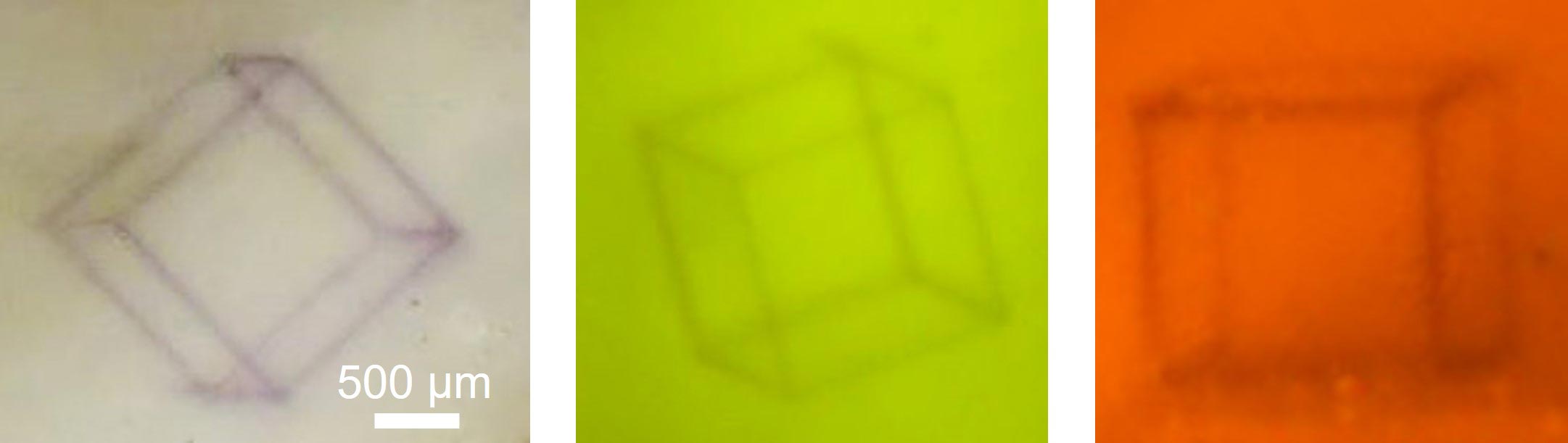
The team first designed gallium silicate glass modified with manganese and terbium ions by using a process called doped direct 3D lithography. Liao and the team used a green 532-nanometer (nm)-wavelength laser to inscribe 3D patterns into tiny slabs of the doped glass.
The intricate patterns, randomly chosen dots, symbols, QR codes, geometric prisms, and even a bird, appear purple in the transparent glass, which turns other colors when excited at precise wavelengths. Terbium luminesces green when excited by a deep violet 376 nm laser, and manganese luminesces red in the presence of violet light at 417 nm.
Then, to fully erase the patterns without changing the structure of the glass, the team applied heat at 1022 degrees Fahrenheit (550 degrees Celsius) for 25 minutes.
A Breakthrough in Rewritable Optical Memory
Furthermore, the researchers consider the use of manganese and terbium groundbreaking for their abilities to luminesce at distinctly different wavelengths, which makes it possible to get a tunable, multicolor readout of 3D patterns from a single material. The new approach could be used for high-capacity, stable 3D optical memory storage, and encryption in industrial, academic, and military applications.
Reference: “Direct 3D Lithography of Reversible Photochromic Patterns with Tunable Luminescence in Amorphous Transparent Media” by Heping Zhao, Jiayan Liao, Shasha Fu, Yingzhu Zi, Xue Bai, Yang Ci, Yueteng Zhang, Xinhao Cai, Yuewei Li, Yangke Cun, Anjun Huang, Yue Liu, Jianbei Qiu, Zhiguo Song, Guogang Li, Ji Zhou and Zhengwen Yang, 26 February 2025, ACS Energy Letters.
DOI: 10.1021/acsenergylett.5c00024
The authors acknowledge financial support from the National Natural Science Foundation of China, Science and Technology Project of Southwest Joint Graduate School of Yunnan Province, Key Project of the National Natural Science Foundation of China-Yunnan Joint Fund, National Natural Science Foundation of High-end Foreign Experts Introduction Plan, Academician Expert Workstation of Cherkasova Tatiana in Yunnan Province, Yunnan Province Major Science and Technology Special Plan, Preparation and Property Control of Luminescent Materials and Application in Plateau Agriculture, University of Technology Sydney Chancellor’s Research Fellowship Program, and the National Health and Medical Research Council.
Never miss a breakthrough: Join the SciTechDaily newsletter.
Follow us on Google and Google News.
3 Comments
This looks and sounds like the kind of stuff they use on Star Trek TOS for their memory memory/data modules.
It’s Manganese (Mn²+) not Magnesium.
Thank you. The article has been corrected.