

A newly discovered altar buried near the center of the ancient Maya city of Tikal is providing fresh insight into the 1,600-year-old tensions between Tikal and the central Mexican capital of Teotihuacan.
Just steps from the center of Tikal, a 2,400-year-old Maya city in present-day Guatemala, a team of international researchers, including scholars from Brown University, has uncovered a buried altar that may help explain a period of major upheaval in the ancient world.
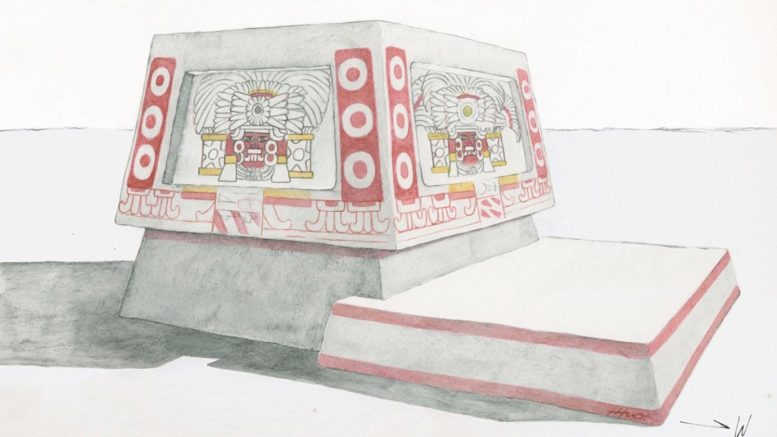
The altar, dating to the late 300s A.D., features four painted panels in red, black, and yellow. These depict a figure wearing a feathered headdress and flanked by what appear to be shields or ceremonial items. The figure’s face has almond-shaped eyes, a nose bar, and a double earspool, closely resembling images of the “Storm God,” a deity known from central Mexico.
In a study published in Antiquity, the Brown researchers and their collaborators from the United States and Guatemala suggest that the altar was likely not created by a Maya artist. Instead, they argue it was crafted by a highly skilled artisan trained in Teotihuacan, the powerful ancient city located 630 miles to the west near modern-day Mexico City.
“It’s increasingly clear that this was an extraordinary period of turbulence at Tikal,” said Stephen Houston, a professor of social science, anthropology, and history of art and architecture at Brown, who co-authored the paper. “What the altar confirms is that wealthy leaders from Teotihuacan came to Tikal and created replicas of ritual facilities that would have existed in their home city. It shows Teotihuacan left a heavy imprint there.”
Even before discovering the altar, Houston and colleagues knew the Maya interacted with Teotihuacan for centuries before their relationship became closer.
Founded in about 850 B.C., Tikal existed for generations as a small city with little influence before ballooning into a dynasty around 100 A.D. Archaeologists have evidence that Tikal and the much more powerful Teotihuacan began interacting regularly about two centuries later. What seemed at first to be a casual trading relationship, Houston said, quickly became something more contentious.
“It’s almost as if Tikal poked the beast and got too much attention from Teotihuacan,” Houston said. “That’s when foreigners started moving into the area.”
An ancient coup d’etat
Houston said that over several decades, scholars have collected mounting evidence of a less-than-friendly relationship. The research started in the 1960s, when archaeologists found a cut and mutilated stone with well-preserved text describing the conflict in broad terms.
Thanks to the stone’s text, they learned that “around A.D. 378, Teotihuacan was essentially decapitating a kingdom,” Houston said. “They removed the king and replaced him with a quisling, a puppet king who proved a useful local instrument to Teotihuacan.”
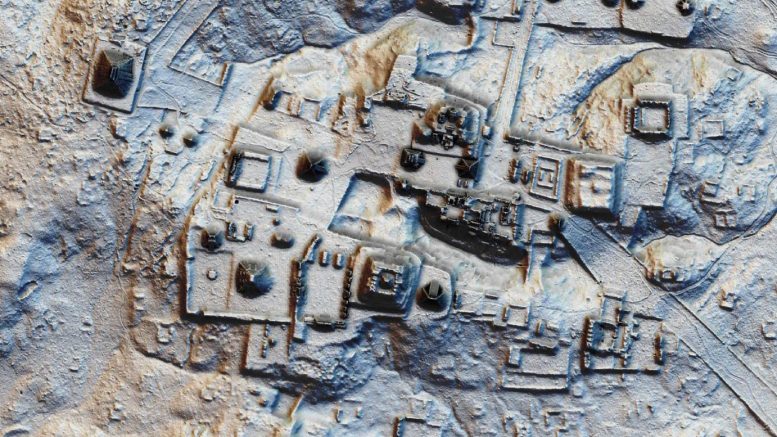
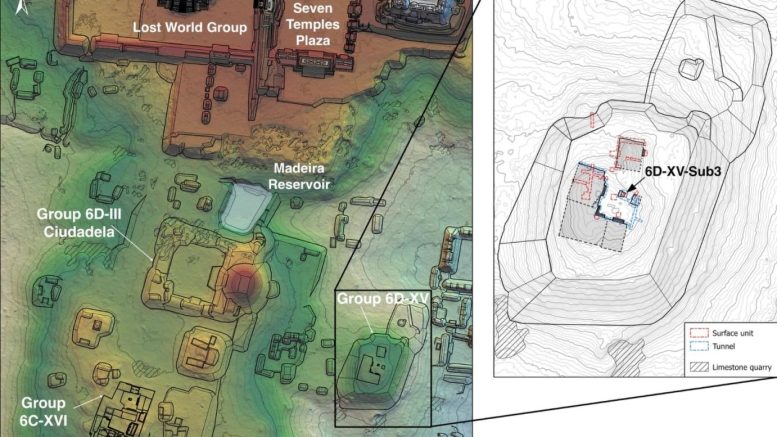
Decades later, using light detection and ranging (LiDAR) technology, the Brown scholars and several colleagues discovered a scaled-down replica of the Teotihuacan citadel just outside the center of Tikal, buried under what archaeologists believed were natural hills. The discovery suggested that in the years leading up to its overthrow, Teotihuacan’s presence in the Maya city probably involved an element of occupation or surveillance.
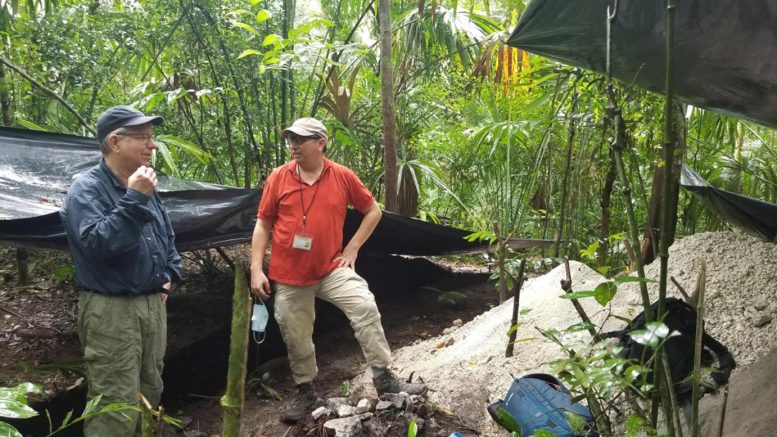
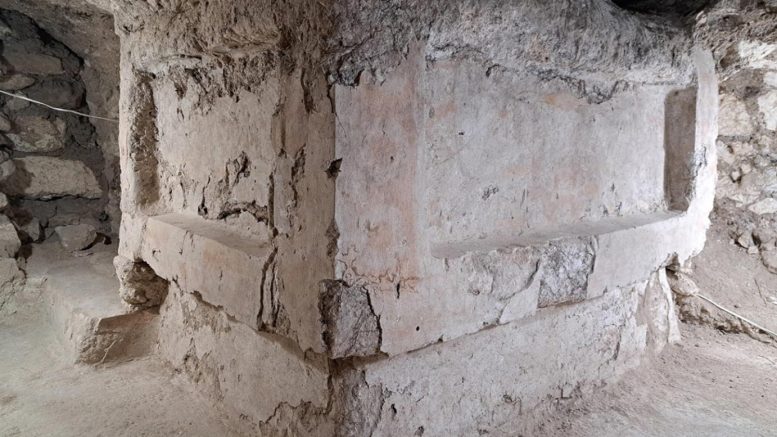
Co-author Andrew Scherer, a professor of anthropology and of archaeology and the ancient world at Brown and director of the Joukowsky Institute for Archaeology and the Ancient World, said the altar was built right around the time of the coup. He said the altar’s meticulously painted exterior isn’t the only evidence of the capital’s heavy-handed presence: Inside the altar, the archaeologists found a child buried in a seated position, a rare practice at Tikal but common at Teotihuacan. They also found an adult interred with a dart point made of green obsidian; Scherer said the material and design of the dart point are distinct to Teotihuacan.
The fact that the altar and the area around it was later buried, Scherer said, cements the research team’s theory that Teotihuacan’s presence left Tikal forever changed and even scarred.
“The Maya regularly buried buildings and rebuilt on top of them,” Scherer said. “But here, they buried the altar and surrounding buildings and just left them, even though this would have been prime real estate centuries later. They treated it almost like a memorial or a radioactive zone. It probably speaks to the complicated feelings they had about Teotihuacan.”
Power begets power
“Complicated” is an apt way to describe Tikal’s collective memory of the Teotihuacan coup, Houston said. The event may have shaken Tikal to its core, but it ultimately made the kingdom more powerful: Over the next few centuries, Tikal rose to yet greater heights, becoming a nearly unmatched dynasty before eventually declining around 900 A.D., along with the rest of the Maya world.
“There’s a kind of nostalgia about that time, when Teotihuacan was at the height of its power and taking increasing interest in the Maya,” Houston said. “It’s something exalted for them; they looked back on it almost wistfully. Even when they were in decline, they were still thinking about local politics in the context of that contact with central Mexico.”
As they uncover more details about the contentious story of Teotihuacan and Tikal, Houston and Scherer said they’re both struck by how familiar it sounds: An all-powerful empire spots paradise and decides to plunder its riches.
“Everyone knows what happened to the Aztec civilization after the Spanish arrived,” Houston said. “Our findings show evidence that that’s a tale as old as time. These powers of central Mexico reached into the Maya world because they saw it as a place of extraordinary wealth, of special feathers from tropical birds, jade, and chocolate. As far as Teotihuacan was concerned, it was the land of milk and honey.”
Reference: “A Teotihuacan altar at Tikal, Guatemala: central Mexican ritual and elite interaction in the Maya Lowlands” by Edwin Román Ramírez, Lorena Paiz Aragón, Angelyn Bass, Thomas G. Garrison, Stephen Houston, Heather Hurst, David Stuart, Alejandrina Corado Ochoa, Cristina García Leal, Andrew Scherer and Rony E. Piedrasanta Castellanos, 8 April 2025, Antiquity.
DOI: 10.15184/aqy.2025.3
Along with Houston and Scherer, authors of the study include Edwin Román Ramírez, Lorena Paiz Aragón, Alejandrina Corado Ochoa, Cristina García Leal and Rony E. Piedrasanta Castellanos of the Proyecto Arqueológico del Sur de Tikal; Angelyn Bass of the University of New Mexico; Thomas G. Garrison and David Stuart of the University of Texas at Austin; and Heather Hurst of Skidmore College. Funding for the research came in part from the PACUNAM Lidar Initiative and the Hitz Foundation.
Never miss a breakthrough: Join the SciTechDaily newsletter.
Follow us on Google and Google News.
19 Comments
Excellent research
Great to read this history
“The altar, dating to the late 300s A.D., …”
I thought that the new politically correct era of time was “Common Era (C.E.). Did someone not get the memo?
Thankfully, PC is a dead language.
Thank you for this wonderful article
Thank you for using AD
I think either is acceptable
I agree completely. It is rather single-minded and myopic to date the entirety of world events by the supposed birth of one religion’s god incarnate. BCE and CE are much more polite, comprehensive, and accurate.
No it’s AD. CE would be a political statement like gay, trans, climate change, clots shots etc.
Wrong. You are imposing Christianity on the world calendar. Not everyone is or wants to be a Christian or be subjected a constant barrage of Christian religious ideology.
It’s always humorous to me when I hear people get miffed at (insert whatever here) that both affects everyone and nothing. I suspect, Kay, that you are perfectly happy with knowing what day you have a doctor’s appointment, or get paid, or what time the morning news comes on. These seemingly unrelated and unremarkable things are also the result of Christian religious beliefs and actions. The standardized Gregorian calendar allows us to communicate around the world and know that whomever we are speaking with can identify the same point in history. I know we all have our own point of view and of reference for our beliefs, but I submit that arguing online with strangers, none of whom is able to change the entire world’s language usage, is possibly not an entirely useful way to spend our limited time on this earth.
No offense intended, and I hope you do not take any. I only offer one possible way to move on from this.
Have a great day and weekend!
BCE and CE have nothing to do with politics. It is the proper scientific terminology.
Thank you for this captivating article!
Awesome to see this , interesting , it’s relevant to today’s world as we see particular movements in left or right or whatever( I’m unbiased and didn’t have left or right ideologies). Nothing has changed really has it.
Moreover I’m interested in the artwork and the legends behind it, no offence .it’s all approx guesswork isn’t it.
Absolutely amazing to read about these discoveries! Seem almost like miracles being discovered!
Thank you for using AD
Great information, thank you.
KS
Thank you. Very interesting article
This information they could have known by asking the Maya Indians, they aren’t extinct.
They lived on the ground floor that’s how they dealt with the heat.