

Nitrogen isotope analysis of tooth enamel reveals no evidence of meat consumption in Australopithecus.
New research published in the journal Science suggests that early human ancestors, such as Australopithecus, which lived approximately 3.5 million years ago in southern Africa, consumed little to no meat. This finding is based on an analysis of nitrogen isotopes in fossilized tooth enamel from seven Australopithecus individuals. The results indicate that these early hominins primarily relied on a plant-based diet, with minimal evidence of meat consumption.
The shift toward animal-based resources, particularly meat, is considered a crucial turning point in human evolution. Meat’s high protein content is associated with brain growth and the advancement of tool-making abilities. However, pinpointing when meat consumption began among early ancestors and understanding its gradual incorporation into the diet has been challenging.
A research team from the Max Planck Institute for Chemistry in Germany and the University of the Witwatersrand in South Africa has now provided compelling evidence. Their findings indicate that Australopithecus individuals living in southern Africa between 3.7 and 3.3 million years ago depended predominantly on plant-based food sources.

The research team analyzed stable isotope data from tooth enamel of Australopithecus individuals found in the Sterkfontein cave near Johannesburg, part of South Africa’s “Cradle of Humankind”, an area known for its rich collection of early hominins fossils. They compared the isotopic data of Australopithecus with that from tooth samples of coexisting animals, including monkeys, antelopes, and large predators such as hyenas, jackals, and big cats.
Tooth enamel preserved dietary signatures
“Tooth enamel is the hardest tissue of the mammalian body and can preserve the isotopic fingerprint of an animal’s diet for millions of years,” says geochemist Tina Lüdecke, lead author of the study. Lüdecke has led the “Emmy-Noether Junior Research Group for Hominin Meat Consumption” at the Mainz-based Max Planck Institute for Chemistry since 2021 and is an Honorary Research Fellow at the Evolutionary Studies Institute of the University of the Witwatersrand in Johannesburg. She regularly travels to Africa to sample fossilized teeth for her analysis. Wits University owns the Sterkfontein Caves and is the custodian of the Australopithecus fossils.
When animals digest food, biochemical reactions favor the “light” isotope of nitrogen (14N). Consequently, the degradation products that are produced in their body contain high proportions of 14N. The excretion of these “light” nitrogen compounds in urine, feces, or sweat increases the ratio of “heavy” nitrogen (15N) to this “light” nitrogen in the body in comparison to the food it eats. This means that herbivores have a higher nitrogen isotope ratio than the plants they consume, while carnivores in turn have a higher nitrogen isotope ratio than their prey. Therefore, the higher the 15N to 14N ratio in a tissue sample, the higher is the trophic position of the organism in the food web.
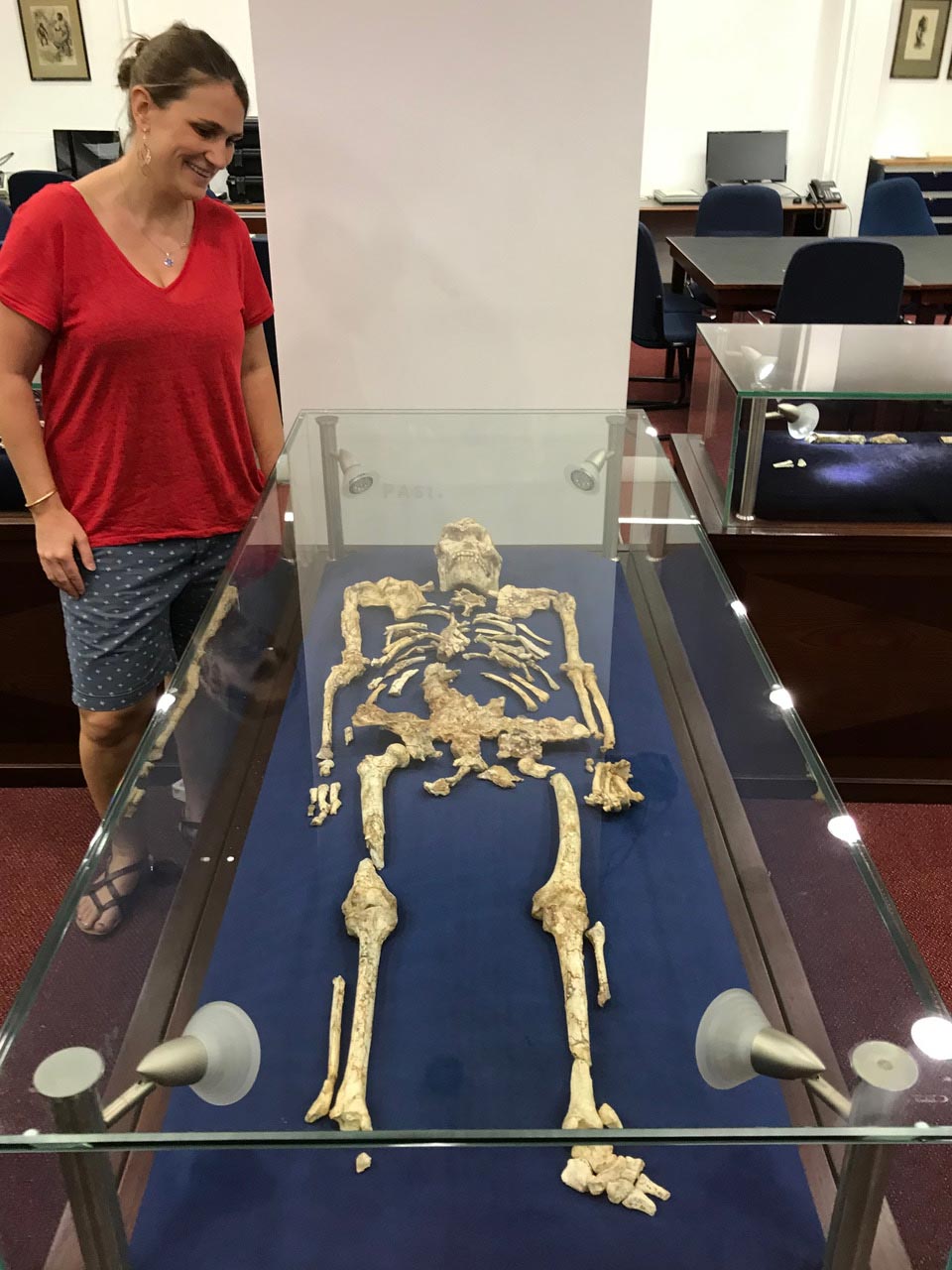
Nitrogen isotope ratios have long been used to study the diets of modern animals and humans in hair, claws, bones, and many other organic materials. However, in fossil material, these measurements have previously been limited to samples that are only a few tens of thousands of years old due to the degradation of organic material over time. In this study, Tina Lüdecke used a novel technique developed in Alfredo Martínez-García’s laboratory at the Max Planck Institute for Chemistry, to measure nitrogen isotope ratios in fossilized tooth enamel that is millions of years old.
Evidence of mostly plant-based food
The team of researchers found that the nitrogen isotope ratios in the tooth enamel of Australopithecus varied, but were consistently low, similar to those of herbivores, and much lower than those of contemporary carnivores. They conclude that the diet of these hominins was variable but consisted largely or exclusively of plant-based food. Therefore, Australopithecus did not regularly hunt large mammals like, for example, the Neanderthals did a few million years later. While the researchers cannot completely rule out the possibility of occasional consumption of animal protein sources like eggs or termites, the evidence indicates a diet that was predominantly vegetarian.
Further research on fossilized tooth enamel
Lüdecke’s team plans to expand their research, collecting more data from different hominin species and time periods. They aim to examine fossils from other key sites in eastern and southern Africa as well as southeast Asia to explore when meat consumption began, how it evolved, and whether it provided an evolutionary advantage for our ancestors.
“This method opens up exciting possibilities for understanding human evolution, and it has the potential to answer crucial questions, for example, when did our ancestors begin to incorporate meat in their diet? And was the onset of meat consumption linked to an increase in brain volume?” says Alfredo Martínez-García, from the Max Planck institute for Chemistry.
“This work represents a huge step in extending our ability to better understand diets and trophic levels of all animals back into the scale of millions of years. The research provides clear evidence that its diet did not contain significant amounts of meat. We are honored that the pioneering application of this new method was spearheaded at Sterkfontein, a site that continues to make fundamental contributions to science even 89 years after the first hominin fossils were discovered there by Robert Broom,” says Professor Dominic Stratford, Director of Research at the Sterkfontein Caves and co-author of the paper.
Reference: “Australopithecus at Sterkfontein did not consume substantial mammalian meat” by Tina Lüdecke, Jennifer N. Leichliter, Dominic Stratford, Daniel M. Sigman, Hubert Vonhof, Gerald H. Haug, Marion K. Bamford and Alfredo Martínez-García, 16 January 2025, Science.
DOI: 10.1126/science.adq7315
The study was funded by the Max Planck Society. Tina Lüdecke’s research group is supported by the Emmy Noether program of the German Research Foundation (DFG).
Never miss a breakthrough: Join the SciTechDaily newsletter.
Follow us on Google and Google News.
26 Comments
I wonder how much Gates paid for this to acco science vegetarian propaganda?
So you spend all this time and money to come to the conclusion that humans were vegetarians based off of one site and how many subjective studies? Humans are omnivores. Our teeth, gut and protein needs prove it. For our ancestors to be hunter gatherers they needed muscle. You dont have muscle with little protein.
Vegetables have protein.
The question is when did we start to eat meat to enlarge our brains? Creating hominids with tool.
Yeah. No way that animals with no claws, flat teeth, weak jaws and closed eye sockets were vegetarian just because they’re designed like an herbivore. Let’s just believe some bleating rando whose feels are hurt by the research.
This is not groundbreaking, Not much different than what I learned in Arch 101 30 years ago. But they also ignore archeological evidence that shows scavenging.
I took it too. Can you find a link to scavaging?
Don’t you know in Genesis all humans were vegetarians until the Flood! I can’t believe non of you commenters read your Bible!
Even the Bible agrees with this research. After all Noah was the first human to get permission to eat meat per the book of Genesis
That’s hilarious.
👍
Able was a shepherd. And he slaughtered animals for sacrifice. This seems incongruent. Why would he even think God would want his dead animals? If he was just milking them, why didn’t he offer milk or cheese? What does dominion over the fish even mean, without fishing?
Old news.
It is already known, meat eating started with the Homo species
Government pushing veggies while they are furthering the development of man-made meats. What they have developed thus far is meat that our bodies have issues degusting and have no nutritional value.
Humanoid life ate meat, berries, nuts and vegetables or anything else that would remove the hunger and fill the need. That is a fact.
What difference does it make to us that our ancestors were herbivores or meat eaters, but it will be interesting for us to see what machines humans used to make the seas, islands, and continents into their present form tens of millions of years ago
They were however using hammer tools (rocks) to break open bones and ate copious amounts of bone marrow.
we still eat plant based food. cows, pigs chickens eat plants. Wolves, tigers, cats eat meat. we generally don’t eat thise
“Nitrogen isotope analysis of tooth enamel reveals no evidence of meat consumption in Australopithecus.”
At least in the individual(s) studied up to this point. Perhaps they died of starvation because of lack of sufficient game animals. Even grizzly bears eat grass when nothing else is available. What does the Australopithecus dentition tell us about their diet? Does it look like that of a herbivore, or an omnivore?
Probably just another great ape. There is a lot of guesswork. And this does not say anything about us either way. The fact is, we need meat (I am including anything with a nervous system) or eggs, or milk, now. Sure, we can manage, but only because in some places, obscure sources of B12 exist. 20,000 years ago, good luck trying to stay alive on a vegan diet, just randomly deposited somewhere. You would have to get very lucky, and like the taste of moldy things, or… as this creature…likely eat your own feces to get B12. The other veggie creatures either have multiple stomachs or eat their own feces. Or, are not truly vegetarian…eating insects or grubs regularly. Unlike gorillas, we would get very sick if we ate our feces…we are not designed for that, if we even had the right bacteria in our gut to make it.
If a person was only an ear-eater, he would never become an intelligent and thoughtful person. Humans became thinking by eating walnuts, pistachios, almonds and nuts
thank you
Chinese baidu: Australopithecus also found in China. …still missing key evidence that Australopithecus is our direct ancestor.
This article could be misused by extrame vegans. It’s like in furture, a bonch of alians landed in nowadays china and unearthed Qing dynasty human teeth fossil and found out that back then humans ate mostly plant-based diet. But a few teeth fossil from Qing dynasty china cant represent the whole human bing, cause contemporaneous Europeans ate mote meat.
Also, before early ape humans, our fish ancestor were like omnivorous around 400 million years ago. It’s a study published on Nature by chinese in 2022.
Another joint study by chinese and Cambridge found Deuterostomia fossil dated back 500 million years ago in china. It ate plankton, at lease not 100% vegan.
Also, if Australopithecus were tough, strong enough, you don’t hink they also wanted to go hunting. Teeth fossil only showed what they could eat in that area at that moment, not what they wanted to eat or kind of foods they were capable of abtaining.
5-600 million years from ape to human, only omnivorous diet can mostly likely make it happen. Otherwise, you should come to china to see where panda is now(these dudes’ ancestors were closely related to bears. Omnivores. But they chose to mostly live on bamboo for some reason and eventually mother nature sent the remaining of them to a few Zoos in china).
It amazes me how quickly comment sections can de-evolve on here. The author said multiple times that more evidence was needed before any conclusions could be drawn.
So many of these comments are written by people who, obviously, have no background whatsoever in science. All many of the contributors here do is trash every article they read! Why bother to read them when you obviously disagree with every one of them.
And please, leave the Bible of if it. The Bible was not written as a scientific research manual.
Some of these, actually, most of these articles, are written by top experts in the field, or at least based on their work. In spite of that, there are always posters who try to sound like they know so much more than the scientists involved in the research. Maybe some should go back 600 million years and tell them you want your FOXO3, CTSD, IGF2R, NCAM1, KMT2D, and BDNF genes back, because your ancestors obviously didn’t pass them on.
I am not eating bugs! Gates, Swab, and all the rest of you globlist pos’s can gfy! Nothing but steak here!
If you test a total vegan today , what do you get in comparison ? Did they have canines or just flat molars ,?
Homo Habilis and Homo Erectus. should be tested and compared